


















Lesson 2 of 46 · Getting Started
What Is Development?
Learn what developmental psychologists mean by development: its three domains, the difference between maturation and learning, and Baltes's lifespan principles.
Think of a photograph of yourself at age five and another at fifteen. Your body, your interests, your friendships, the way you talk and the way you solve a problem have all changed. Yet something is also the same: perhaps your sense of humor, a shy streak, a love of animals. Development is the word psychologists use for this mix of change and stability, and the field's job is to describe it carefully and explain it.
What you will learn
- define development and distinguish change from stability
- name the three domains and give examples of each
- tell maturation from learning
- state the main principles of the lifespan approach (Baltes)
- explain why "development" does not just mean "improvement"
Key terms
Development: systematic, organized changes and continuities in a person from conception to death.
Maturation: change that unfolds mainly from biology, following a genetic timetable (for example, the order in which teeth erupt).
Learning: lasting change in behavior or knowledge that comes from experience.
Normative: typical of most people of a given age or in a given culture.
Plasticity: the capacity to change in response to experience, which exists at every age.
Change and continuity
Developmental psychologists look for systematic change: change with a pattern and an order, not random ups and downs. A toddler who learns to walk is developing. A person who has a bad day is not (unless the day starts a pattern).
They also look for continuity. Some features, like temperament (basic style of reacting to the world), show moderate stability across years. "Moderate" matters: a child rated shy at age four is more likely to be shy later than a child rated bold, but many shy children become confident adults and the reverse also happens. Stability is a matter of degree.
The three domains
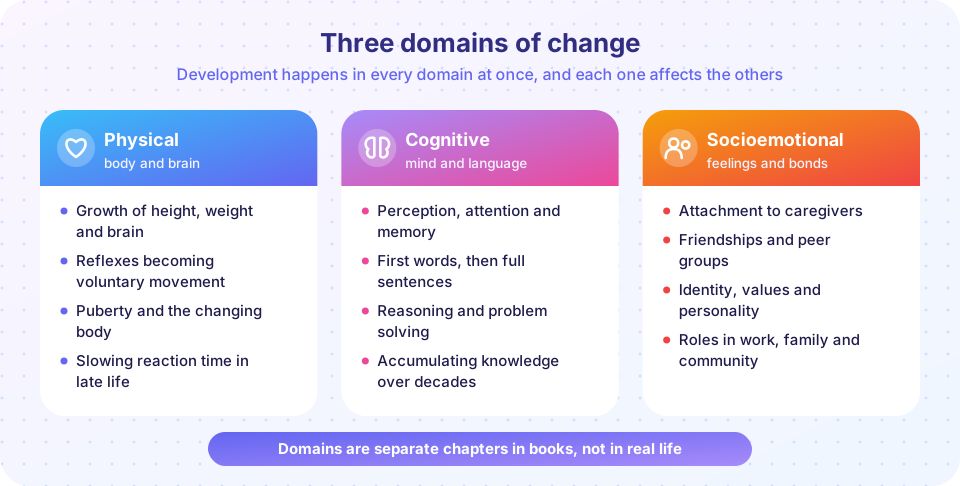
Researchers divide development into three broad domains for convenience.
- Physical development: the growth of the body and brain, motor skills, senses, health, puberty, and later the changes of aging.
- Cognitive development: perception, attention, memory, language, reasoning and problem solving.
- Socioemotional development: emotions, temperament and personality, attachment, friendships, moral values and identity.
The domains overlap constantly. A baby who learns to crawl (physical) suddenly can explore rooms, which changes what she learns about space (cognitive) and also how often she meets a parent's "no" (socioemotional). A teenager whose brain and hormones change (physical) may take more social risks (socioemotional) and also gain abstract reasoning skills (cognitive). When you read about one domain, ask how the others are involved.
Maturation and learning
Two forces make a person change.
Maturation is growth that follows a biological program. All typical infants sit before they walk; teeth erupt in a recognizable sequence; puberty begins in a characteristic window. But maturation never works alone. Walking, for example, needs muscle and brain maturity and chances to practice.
Learning is change from experience: a child learns the words of the language she hears, a teenager learns to drive. Without relevant experience, nothing is learned, but without the right level of maturity, some learning is impossible (a six-month-old cannot learn to read, however much you teach).
Most real developments are a joint product, and the next lesson, Nature and Nurture, shows how tightly the two intertwine.
Baltes's lifespan principles
The German psychologist Paul Baltes (1939–2006) argued in the 1980s that development must be studied across the whole lifespan, and that adulthood is not just the "end point" of childhood. His lifespan perspective rests on several ideas:
- Lifelong. Development never stops. Something is always changing, from the first cell divisions to the last years of life.
- Multidimensional. Each person changes in biological, psychological and social ways at once.
- Multidirectional. Some abilities grow while others decline, at the same time and at every age. A toddler gains words but loses the ability to distinguish sounds not used in her language; an older adult may be slower on a reaction-time test yet richer in vocabulary and experience.
- Plastic. Abilities can be improved by practice and training, even in older age, though plasticity has limits.
- Contextual. People are shaped by their family, culture, historical period and unique events, which is why two people born in the same year can have very different lives.
- Gains and losses. Development always involves both. Baltes described "selective optimization with compensation": people succeed by choosing goals, practicing, and finding workarounds, such as writing notes when memory slips.
When you meet a new finding in this course, ask the lifespan questions: what grows, what shrinks, and in what context? Few results are only "good" or only "bad".
Common misconceptions
"Development means getting better." It means change. Some changes are gains (vocabulary), some are losses (flexibility in hearing certain sounds), and many are neutral reorganizations.
"Development stops when you become an adult." Adulthood brings new roles, new skills and new constraints. The brain remains plastic throughout life.
"Everyone follows the same schedule." Normative ages describe averages. Healthy children walk anywhere from about 8 to 18 months, and the range is wide for nearly every milestone.
Try it
Press Run (or Ctrl + Enter) to see the result here.
Program input · what you'd type while the program runs
Type the answers before you press Run, one per line. Each time the program reads a line (with input()), it gets the next line from this box.
Check your understanding
Quick check · 5 questions
of 5 answered You scored / 5 · perfect!
-
1. Which example is best described as maturation?
Tooth eruption follows a biological timetable. The other three depend heavily on practice or experience. -
2. Baltes called development 'multidirectional'. What does that mean?
At any age some abilities gain while others decline, so development includes both gains and losses. -
3. A baby's crawling lets her explore, which changes what she learns and how parents react. This shows that...
A change in one domain (physical) affects the others (cognitive and socioemotional). -
4. Which statement about 'normative' ages is most accurate?
Norms describe averages and ranges. Variation within the healthy range is normal. -
5. Which of these claims is a common misconception?
Development means change, including losses and neutral reorganization, not just improvement.
Summary
- Development is systematic change and continuity from conception to death.
- The three domains are physical, cognitive and socioemotional, and they interact.
- Maturation follows a biological program; learning comes from experience; most outcomes need both.
- Baltes's lifespan view: lifelong, multidimensional, multidirectional, plastic, contextual, with gains and losses.
- Normative ages are averages; variation is normal.
Next: Nature and Nurture
Track your progress
Create a free account to tick off lessons and pick up where you left off on any device.
of Developmental Psychology lessons completed