


















Lesson 4 of 46 · Getting Started
Lifespan Periods and the Big Questions
Meet the periods of the human lifespan and the great debates of developmental psychology: continuity vs stages, critical vs sensitive periods, and stability vs change.
Textbooks cut the lifespan into neat periods: infancy, early childhood, adolescence, and so on. They are useful handles, but they are conventions, not natural laws. This lesson introduces the usual periods, shows how they depend on culture and history, and then turns to the questions that divide developmental scientists, because those questions drive the research you will meet in every later chapter.
What you will learn
- name the common periods of the lifespan and typical age ranges
- explain why period boundaries are partly cultural conventions
- describe the continuity versus discontinuity debate and the idea of stages
- distinguish critical periods from sensitive periods, with evidence
- discuss stability versus change, and universality versus context
Key terms
Period (or stage): a span of life with characteristic features, defined by age ranges.
Continuity: development as gradual, smooth, quantitative change. Discontinuity: development as a series of qualitatively different stages.
Critical period: a window in which an experience is required for normal development, and after which the chance is lost.
Sensitive period: a window when the brain is especially responsive to experience, but later learning is still possible.
The usual periods
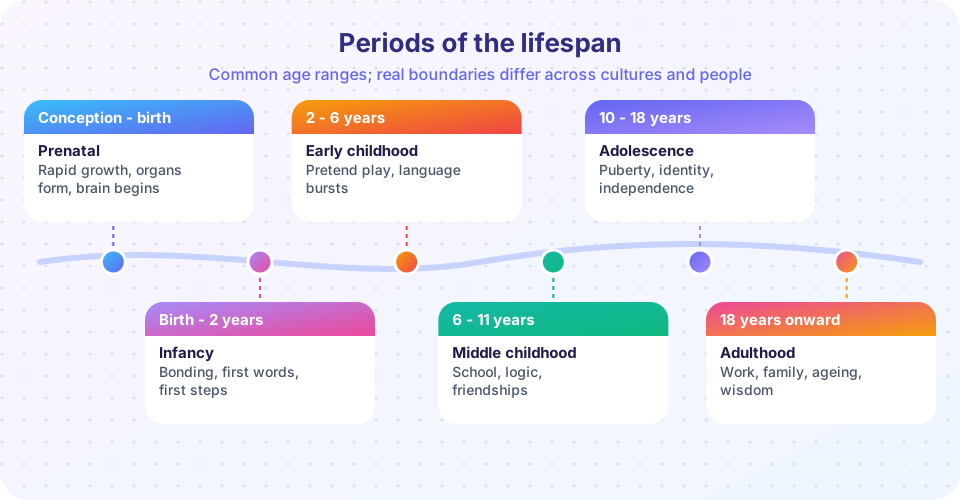
A common scheme divides the lifespan into:
| Period | Typical ages | Main themes |
|---|---|---|
| Prenatal | Conception to birth | Organs and brain form |
| Infancy and toddlerhood | Birth to about 2 | Attachment, first words, first steps |
| Early childhood | About 2 to 6 | Language growth, pretend play, self-control |
| Middle childhood | About 6 to 11 | School, logical thought, friendships |
| Adolescence | About 10 to 18 | Puberty, identity, independence |
| Early adulthood | About 18 to 40 | Work, relationships, parenthood |
| Middle adulthood | About 40 to 65 | Career peak, caring for others, health changes |
| Late adulthood | 65 and older | Retirement, wisdom, loss, meaning |
Treat the ages as approximate. Developmental scientists also mark finer phases, such as "emerging adulthood" for roughly ages 18 to 29 (a term proposed by Jeffrey Arnett to describe a prolonged exploration period in some societies) and splitting late adulthood into the "young-old" and "oldest-old".
Periods are partly cultural
The idea of adolescence as a long, separate time of life is more prominent in societies with extended schooling. Historian Philippe Ariès argued in the 1960s that medieval Europeans did not think of childhood as we do; later historians dispute how strong that claim is, but all agree that ideas about when childhood ends vary with time and place. The age at which people are treated as adults for work, marriage or law differs across countries and has changed over history. When you read "adolescence," ask whose adolescence is being described.
Big question 1: continuity or discontinuity?
Is development like a ramp (gradual, quantitative change: you slowly get better at vocabulary) or like a staircase (qualitatively new stages: a caterpillar becomes a butterfly)?
Stage theories, such as Piaget's four stages of cognitive development, claim discontinuity: children think in different ways at different ages, not merely better. Continuity theories, such as information-processing accounts, picture gradual increases in speed, memory and strategies. The evidence suggests both can be partly right, depending on the domain, the task and how you measure. Some researchers describe development as overlapping "waves" of strategies, with new ones becoming more frequent and older ones fading (Robert Siegler). You will see this debate again in Evaluating Piaget.
Big question 2: one path or many?
Is there one universal course of development, or many context-specific ones? Motor milestones, basic emotions and early language steps show striking similarity worldwide. Other features differ a lot: sleeping arrangements, the age children care for younger siblings, ideas about independence, and the meaning of "being a good child". Researchers worry about "WEIRD" samples (Western, Educated, Industrialized, Rich and Democratic), which describe a small fraction of humanity but supply most participants in published studies (Henrich, Heine and Norenzayan, 2010). A universal claim needs evidence from many cultures.
Big question 3: stability or change?
Are people recognizably themselves across decades? Longitudinal studies find that personality traits show moderate rank-order stability that rises through adulthood: your position among your peers tends to persist. At the same time, average levels change: on average, people become somewhat more conscientious and emotionally stable from young adulthood into middle age. Both stability and change are real and not contradictory.
Big question 4: critical or sensitive periods?
Critical periods
Konrad Lorenz showed in the 1930s that young greylag geese follow the first moving object they see after hatching, a process called imprinting, which occurs only in a short window. Later, David Hubel and Torsten Wiesel (Nobel Prize, 1981) found that if one eye of a young kitten is kept closed during a critical window, the brain's visual cortex rewires and the eye stays functionally weak even after it is opened.
Sensitive periods
In humans the windows are mostly softer. Learning a first language is easiest in childhood, and people who first learn a language after puberty usually do not reach native-like grammar, but many can achieve high levels of skill. Evidence from children raised in severely deprived institutions, such as the Romanian orphans followed by the English and Romanian Adoptees study (Michael Rutter and colleagues) and the Bucharest Early Intervention Project (Charles Nelson, Nathan Fox, Charles Zeanah), suggests that moving children into caring homes earlier leads to better recovery: those placed before about six months to two years generally fared better than those placed later, although recovery was often incomplete. Because randomized assignment to deprivation would be unethical, such studies rely on natural experiments or on the rare ethical randomization of placement (the Bucharest study randomized a move to foster care for children already in institutions).
The famous case of "Genie", a girl isolated until age 13 in the United States, is often cited as evidence for a critical period for language. But her history involved extreme abuse and illness, so it is impossible to say which factors limited her language. Single tragic cases cannot settle a scientific question.
Most developmental scientists therefore prefer the term sensitive period for human development: the brain is especially ready to learn certain things at certain ages, and the cost of missing that window varies from small to large.
Common misconceptions
"If you miss the window, it's too late." Most human windows are sensitive, not critical. Intervention is usually worth trying at any age, though earlier is often easier.
"Stages are rigid and everyone follows them on schedule." Ages are averages with wide healthy ranges, and children may show different levels on different tasks.
"Adolescence is always a time of storm and stress." G. Stanley Hall popularized this idea in 1904. Modern research finds that most teenagers have manageable relationships with their parents, even though emotional ups and downs and risk-taking do increase for some.
Try it
Press Run (or Ctrl + Enter) to see the result here.
Program input · what you'd type while the program runs
Type the answers before you press Run, one per line. Each time the program reads a line (with input()), it gets the next line from this box.
Check your understanding
Quick check · 5 questions
of 5 answered You scored / 5 · perfect!
-
1. Which description matches a stage (discontinuity) view of development?
Stage theories claim qualitative shifts, not just quantitative improvement. -
2. What best separates a critical period from a sensitive period?
Most human windows are sensitive: the brain is especially responsive, but later learning is not impossible. -
3. Why is the case of 'Genie' weak evidence for a critical period in language?
Confounded causes make it impossible to attribute her outcome to the timing of language exposure alone. -
4. What does the 'WEIRD' problem refer to?
Henrich, Heine and Norenzayan pointed out that published samples are unrepresentative of humanity. -
5. Personality traits show moderate rank-order stability in adulthood. What does that mean?
Rank-order stability concerns relative position in a group. Average levels can still change, so stability and change coexist.
Summary
- The lifespan is conventionally divided into prenatal, infancy, early and middle childhood, adolescence, and three adult periods, but the ages are approximate and culture-dependent.
- Core debates: continuity versus stages, universal versus context-specific, stability versus change.
- Critical periods (strict) are rare in humans; sensitive periods (softer) are the better model.
- Evidence from deprived-institution studies suggests earlier improvement in care leads to better recovery, but cases like Genie are confounded.
- Be wary of WEIRD samples when generalizing.
Next: Chapter 1 Review
Track your progress
Create a free account to tick off lessons and pick up where you left off on any device.
of Developmental Psychology lessons completed