


















Lesson 43 of 46 · Projects and Practice
Designing a developmental study: designs, ethics and sample size
Plan a small developmental study: choose a design, protect child participants, pick a sample size with a power simulation and decide how to share your results honestly.
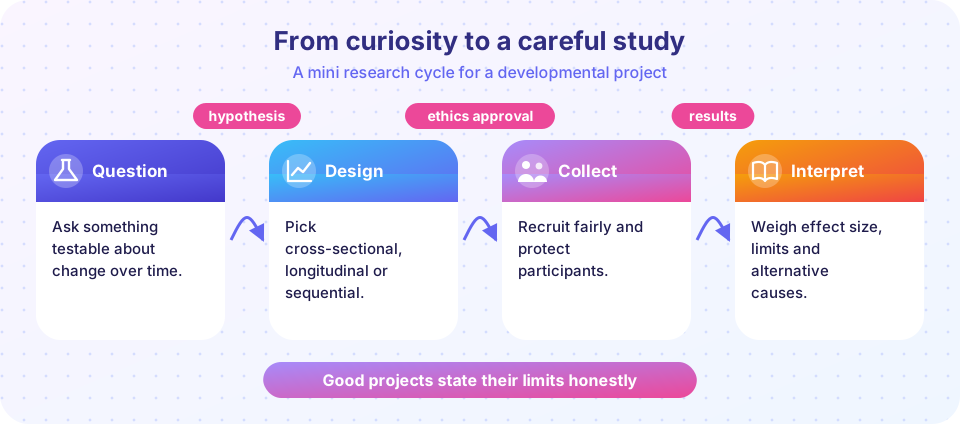
You have read many studies. Now imagine running one. Developmental research has special challenges: participants change quickly, children cannot give full consent, babies cannot tell you what they think, and the interesting questions (how does X change as we get older?) can take years to answer. Good design is how researchers deal with these challenges.
In this lesson you will plan a small study on paper and in code. You will pick a question, choose among the main designs, think through the ethics of involving children, and use a simulation to see why sample size matters. This is a practice project: you will not collect data on real children here.
What you will learn
- How to turn a topic into a testable question and hypothesis.
- The strengths and weaknesses of cross-sectional, longitudinal, sequential and experimental designs.
- The core ethical rules for research with children.
- Why sample size matters, shown through a power simulation.
Key terms
- Hypothesis: a testable prediction, such as "older children will solve the task faster".
- Operational definition: how a concept is measured in practice (for example, "vocabulary" as the number of words on a checklist).
- Informed consent and assent: parents or guardians give consent; children give assent (agreement) as they are able.
- Statistical power: the chance that a study will detect an effect that truly exists.
- Preregistration: publicly recording your plan and analysis before collecting data.
Step 1: from topic to testable question
"Language development" is a topic, not a question. A better question: "Do 24-month-olds who are read to daily know more words than those who are not?" Turn it into a hypothesis and make it testable with operational definitions: what counts as "read to daily" (a parent report?), and how will "knowing more words" be measured (a standard parent checklist)? Notice that this question is correlational. A study that only compares existing groups cannot show that reading causes larger vocabulary, because families who read daily may differ in other ways.
Step 2: choose a design
| Design | How it works | Strength | Weakness |
|---|---|---|---|
| Cross-sectional | Different ages tested once | Fast, cheap | Age is mixed with cohort |
| Longitudinal | Same people tested repeatedly | Shows individual change | Slow, costly, dropout, practice effects |
| Sequential | Several cohorts, each followed for a while | Separates age from cohort | Complex, expensive |
| Experimental | Researchers assign conditions (ideally randomly) | Supports causal claims | May be artificial; not always ethical |
| Observational (naturalistic) | Watching behavior in real settings | Realistic | Hard to control, observer bias |
| Case study | One person or family in depth | Rich detail | Cannot generalize |
Match the design to the question. "How does reaction time change from age 5 to 15?" fits cross-sectional (quick first look) or longitudinal (real change). "Does a reading program improve vocabulary?" needs an experiment with random assignment.
Developmental researchers also have special methods for babies, who cannot answer questions: habituation (babies look less at repeated stimuli), preferential looking (they look longer at what they prefer or find surprising) and violation of expectation (longer looking at an "impossible" event). These methods rely on looking time, and researchers are aware that long looking can mean different things.
Step 3: ethics with children
Research with children follows extra safeguards, built on codes such as the Belmont Report and the Declaration of Helsinki, and the guidelines of professional societies. Core rules:
- Ethics review. An institutional review board (IRB) or research ethics committee must approve the plan before any data is collected.
- Informed consent from parents or guardians and assent from the child. Explain the study in language the child understands, and respect a child's wish to stop at any time.
- Minimal risk and benefit. The risks should be no greater than those of daily life unless there is strong justification.
- Privacy and confidentiality. Store data securely and report results without identifying children.
- Right to withdraw without penalty.
- Fair selection. Do not recruit only from convenient groups without reason.
- Duty to report. Researchers have to know the rules about what to do if they learn a child is at risk.
Some famous older studies, such as the Little Albert experiment (1920) and many early deprivation studies, would not pass modern review, which is why ethical standards matter.
Step 4: sample size and power
How many children do you need? Too few, and a real effect may go undetected. Power is the chance of detecting a real effect, and a common target is 80 percent. Power depends on the effect size, the sample size and the threshold for "significance" (often p < 0.05). Small studies of small effects have low power. They also tend to exaggerate any effects they do find, which is one reason many findings fail to replicate.
You can estimate power by simulation: invent data with a known true effect, run the same test many times, and see how often it detects the effect.
Step 5: analysis, honesty and sharing
- Preregister your hypothesis and analysis plan so that you cannot unconsciously adjust them after seeing the data.
- Report effect sizes and confidence intervals, not only p-values.
- Share data and materials when privacy allows, so that others can check and replicate.
- State limits. Who was in the sample? Who was missing? What else could explain the result?
- Be careful with causal language when your design is correlational.
A worked mini-project
Question: "Do 6-year-olds and 10-year-olds differ in how long they can keep attention on a simple task?" Plan:
- Hypothesis: 10-year-olds will keep attention longer than 6-year-olds.
- Design: cross-sectional comparison of two age groups, a quick first step.
- Measure: time to the first lapse on a standard computer task, in seconds.
- Sample: decide using a power simulation (below).
- Ethics: school and parent consent, child assent, short sessions, anonymous data.
- Limits to acknowledge: two ages only, one school district, possible cohort differences, attention depends on motivation.
Common misconceptions
- "A bigger sample always fixes a weak design." It cannot remove confounds or bias.
- "Parents' consent is enough." Children's assent and their right to stop matter too.
- "If p < 0.05 the effect is real and important." It may be small or a false positive.
Try it
First, a power simulation. For a true effect size of d = 0.5 (a medium effect), see how often a two-group t-test reaches p < 0.05 at different sample sizes per group. Try changing d.
Press Run (or Ctrl + Enter) to see the result here.
Program input · what you'd type while the program runs
Type the answers before you press Run, one per line. Each time the program reads a line (with input()), it gets the next line from this box.
Second, a design chooser. Answer a few yes/no questions in code and see which design the function recommends. It is a teaching sketch, because real choices involve many more factors.
Press Run (or Ctrl + Enter) to see the console output here.
No output.
Third, an ethics checklist. Tick the boxes and see which items are still missing.
Check your understanding
Quick check · 5 questions
of 5 answered You scored / 5 · perfect!
-
1. Which design is best for showing that a program causes improvement?
Random assignment helps make the groups alike apart from the program. -
2. What is the difference between consent and assent in child research?
Both matter, and a child's wish to stop should be respected. -
3. What is statistical power?
A common target is 80 percent. -
4. Why preregister a study?
Preregistration reduces flexible analysis and selective reporting. -
5. A cross-sectional study of 6- and 10-year-olds has which main weakness?
Different age groups are also different cohorts.
Summary
- Turn a topic into a testable question with operational definitions.
- Match the design (cross-sectional, longitudinal, sequential, experimental, observational, case) to the question and its limits.
- Research with children needs ethics approval, parental consent, child assent, minimal risk, privacy and the right to withdraw.
- Sample size drives power; small studies miss real effects and exaggerate the ones they find.
- Preregister, report effect sizes, share what you can and state limits.
Track your progress
Create a free account to tick off lessons and pick up where you left off on any device.
of Developmental Psychology lessons completed