


















Lesson 7 of 46 · Methods and Theories of Development
Research Designs: Cross-Sectional, Longitudinal and Sequential
Compare the three main designs for studying change with age, learn about cohort effects and attrition, and run two simulations that show how designs can mislead.
You want to know whether memory declines as people age. The simplest plan is to test 20-year-olds, 40-year-olds and 70-year-olds and compare them. The most convincing plan is to test the same people at 20, 40 and 70, which takes fifty years. Which is better? Neither is perfect. The art of developmental research is knowing what each design can and cannot tell you, and this lesson shows you why with two small simulations.
What you will learn
- describe cross-sectional, longitudinal and sequential designs and their strengths and weaknesses
- explain cohort effects, attrition and practice effects
- distinguish correlational from experimental studies and name other methods (case studies, observation, microgenetic)
- recognize famous long-running studies and what they teach
Key terms
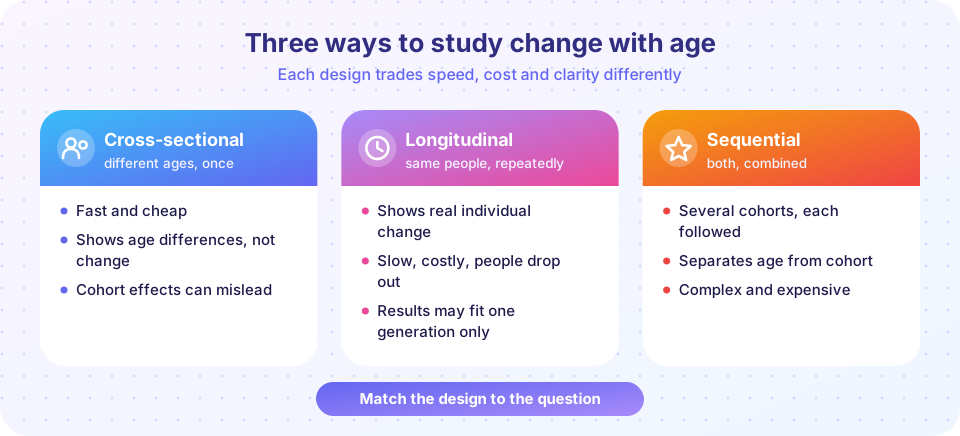
Cross-sectional design: compares people of different ages at one point in time.
Longitudinal design: follows the same people across time.
Sequential design: combines the two by following several birth cohorts over time.
Cohort: a group of people born in about the same period who share historical experiences.
Attrition: loss of participants over the course of a study.
Cross-sectional studies
In a cross-sectional study, researchers test several age groups once. It is fast and cheap, and you can finish in months. It shows age differences but not age changes, because different people are being compared. The big threat is the cohort effect: people born in different years grew up in different worlds. Older adults today had less schooling, on average, than younger adults, and generations differ in diet, health care and exposure to testing. If an older group scores lower on a test, you cannot tell whether aging or generation (or both) is responsible.
Longitudinal studies
A longitudinal study measures the same people repeatedly. It reveals true individual change and stability, and it can show how early events predict later outcomes. Famous examples include:
- Terman's study of high-IQ children, begun in California in 1921, which followed about 1,500 children for most of their lives.
- The Up series, a documentary project filming a group of British children at age 7 in 1964 and returning every seven years.
- The Dunedin Multidisciplinary Health and Development Study, which has followed about 1,000 people born in Dunedin, New Zealand in 1972–73, assessing them from age 3 into midlife.
- The Minnesota Longitudinal Study of Parents and Children, which followed children born to mothers at risk of poverty from birth into adulthood, studying attachment and later relationships.
Longitudinal studies have weaknesses:
- Attrition: people move, lose interest or die. If those who leave differ from those who stay, the remaining sample is biased.
- Practice effects: repeated testing improves scores simply through familiarity.
- Cost and time: results take decades, and methods may become outdated before the study ends.
- Cohort limits: a result from people born in 1972 may not fit people born in 2012.
Sequential designs
A sequential design studies several cohorts, each followed over time. K. Warner Schaie's Seattle Longitudinal Study, started in 1956, is the classic example: it tested adults of different ages (and new samples at each wave) every seven years. Schaie found that many cognitive abilities showed little decline until the sixties, and that apparent earlier declines in cross-sectional data were partly cohort effects. Sequential designs separate age, cohort and time of measurement, but they are complex and expensive.
Other methods
- Correlational studies relate variables as they naturally occur (hours of sleep and school performance) and cannot prove cause.
- Experiments randomly assign participants to conditions, which allows causal conclusions. In developmental research, you can often randomly assign a training (a reading program, a parenting course) but not age, gender or family background.
- Naturalistic observation records behavior in everyday settings. It is realistic but time-consuming and observers can influence behavior.
- Case studies examine one individual in depth; they generate ideas but are hard to generalize.
- Microgenetic studies observe the same children frequently over a short period of rapid change, to catch the moment a strategy appears.
- Surveys, interviews and parent report are practical but depend on memory and honesty.
When you read a headline claiming "aging causes X" or "growing up in Y causes Z", ask first which design produced the result. Many a claim is a cross-sectional or correlational finding in disguise.
Common misconceptions
"Longitudinal studies are always better." They answer questions about change, but they are slower, costlier and suffer from attrition. A cheap cross-sectional study may be the right first step.
"A large sample fixes bias." Large biased samples are still biased. Attrition and cohort effects do not shrink with size.
"Experiments are impossible with children." Many are possible and ethical, such as comparing teaching methods, as long as risks are minimal and consent is obtained (see Studying Babies and Research Ethics).
Try it
Press Run (or Ctrl + Enter) to see the result here.
Program input · what you'd type while the program runs
Type the answers before you press Run, one per line. Each time the program reads a line (with input()), it gets the next line from this box.
Press Run (or Ctrl + Enter) to see the result here.
Program input · what you'd type while the program runs
Type the answers before you press Run, one per line. Each time the program reads a line (with input()), it gets the next line from this box.
Check your understanding
Quick check · 5 questions
of 5 answered You scored / 5 · perfect!
-
1. A cross-sectional study finds that 70-year-olds score lower than 30-year-olds on a puzzle test. Which conclusion is justified?
Age and cohort are confounded in a cross-sectional design, so age differences cannot be told apart from generational differences. -
2. What is attrition?
If the people who drop out differ from those who stay, results can be biased. -
3. Which design separates age effects from cohort effects?
Following several cohorts over time lets researchers compare the same ages across cohorts and the same cohort across ages. -
4. Which study is a long-running longitudinal study of a birth cohort born in the early 1970s?
The Dunedin study followed about 1,000 people born in 1972-73 in New Zealand. -
5. Why can't researchers usually run true experiments on the effect of family income on child development?
Many important influences cannot be randomly assigned, so researchers use observational and quasi-experimental designs.
Summary
- Cross-sectional studies compare ages at one time: fast, but age and cohort are confounded.
- Longitudinal studies follow the same people: they show real change but face attrition, practice effects, cost and cohort limits.
- Sequential designs combine both and separate age, cohort and time of measurement.
- Experiments allow causal claims; many developmental questions rely on correlation, observation and natural experiments.
- Always ask which design produced a claim and what it can rule out.
Track your progress
Create a free account to tick off lessons and pick up where you left off on any device.
of Developmental Psychology lessons completed