


















Lesson 41 of 46 · Aging and Lifespan Perspectives
Chapter review: aging and lifespan perspectives
Review the lifespan perspective, SOC, fluid and crystallized abilities, the aging brain, socioemotional selectivity and grief with a timeline, recap table and ten-question quiz.
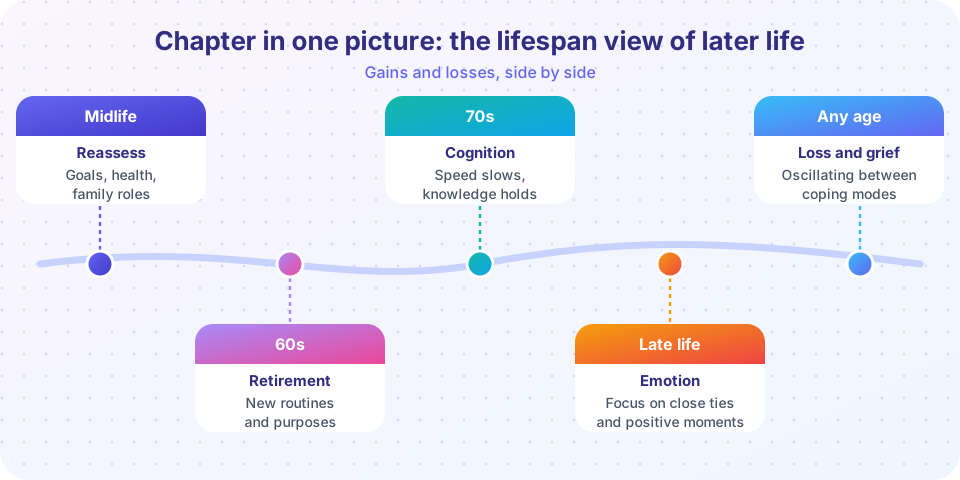
This chapter replaced the picture of later life as a simple slide downhill with a richer one: gains and losses side by side, new strategies for adapting, a brain that stays plastic, emotions that often improve, and models of grief that allow for individual paths. Review the key points below, then test yourself.
What you will learn
- A recap of the lifespan perspective, SOC and the main findings on cognition, emotion and grief.
- Which claims to word carefully.
Recap table
| Topic | Key names | Main idea | Caution |
|---|---|---|---|
| Lifespan perspective | Baltes | Lifelong, multidirectional, plastic, contextual | A framework, not one theory |
| SOC model | Baltes and Baltes | Select, optimize, compensate | Examples vary |
| Fluid vs crystallized | Cattell, Horn | Fluid declines earlier; crystallized grows | Individual differences are large |
| Processing speed | Salthouse | Slowing explains part of cognitive aging | Not the only factor |
| Study design | Schaie, Seattle Longitudinal Study | Sequential design separates age and cohort | Attrition and practice effects |
| Aging brain | Cabeza; Erickson | Volume loss, compensation, plasticity, exercise | Effects modest; HAROLD debated |
| Dementia | Many | Not normal aging; not inevitable | Educational information only |
| Socioemotional selectivity | Carstensen | Time horizon shapes goals | Strongest for close ties |
| Positivity effect | Mather and Carstensen | Relative preference for positive information | Weakens under load |
| Integrity vs despair | Erikson; Butler | Life review and meaning | Descriptive |
| Grief | Kübler-Ross; Stroebe and Schut; Bonanno | Dual process; many trajectories | No fixed stages |
Common misconceptions
- "All abilities decline with age." Knowledge often grows.
- "Cross-sectional age differences equal aging." They mix age and cohort.
- "Older adults are unhappy and lonely." Averages for emotional wellbeing are often good, though risks exist.
- "Grief follows five stages." The stages are not a universal sequence.
Try it
First, a flashcard deck for the chapter.
Second, a quick calculator for how many years separate cohorts, to practice thinking about age versus cohort.
Press Run (or Ctrl + Enter) to see the console output here.
No output.
Check your understanding
Quick check · 10 questions
of 10 answered You scored / 10 · perfect!
-
1. A pianist plays fewer pieces, practices them more and slows before hard passages. Which three SOC elements are shown, in order?
Fewer pieces is selection, more practice is optimization, and slowing before hard passages is compensation. -
2. Which ability typically keeps growing for decades?
Vocabulary and general knowledge tend to rise for decades. -
3. What is a cohort effect?
Different generations had different schooling, health care and technology. -
4. Why is the Seattle Longitudinal Study notable?
Schaie added new samples every seven years and retested earlier ones. -
5. Which finding supports plasticity in older adults?
Erickson and colleagues (2011) reported a small increase in hippocampal volume after aerobic walking. -
6. Which statement about dementia is accurate?
Dementia differs from normal aging and is not universal. -
7. Which is a key idea of socioemotional selectivity theory?
Time horizons shape which goals we prioritize. -
8. What is the dual process model of grief?
Stroebe and Schut proposed healthy oscillation between the two. -
9. In Bonanno's research, which trajectory was the most common in many samples?
Many people showed relatively stable functioning with some sadness. -
10. Why should we be cautious about the positivity effect?
It is an average pattern with conditions and limits.
Summary
- The lifespan view sees gains and losses at every age, and SOC is a strategy for adapting.
- Fluid abilities decline earlier than crystallized ones; study design (cross-sectional versus sequential) shapes what we conclude.
- The aging brain stays plastic; dementia is not normal aging.
- Emotional wellbeing often holds up; grief is flexible, with many paths and frequent resilience.
Track your progress
Create a free account to tick off lessons and pick up where you left off on any device.
of Developmental Psychology lessons completed