


















Lesson 30 of 46 · Social and Emotional Development
Attachment: Bowlby, Harlow, Ainsworth and the Strange Situation
Learn how attachment forms, what Bowlby, Harlow and Ainsworth discovered, how the Strange Situation classifies infants and what the evidence says about its limits.
Why does a baby cry when a parent leaves the room, and why does a familiar arm make the world feel safe again? Attachment theory proposes an answer: humans are born ready to form a close bond with a caregiver because, throughout our evolutionary history, a baby who stayed close to a protector was more likely to survive. That bond becomes a base for exploring the world and, many researchers argue, a template for later relationships.
Attachment is one of the most studied and most debated ideas in developmental psychology. This lesson covers its origins, the experiments that shaped it, the four patterns researchers describe, and the important critiques. You will leave with a clear sense of what attachment research shows and where claims go beyond the evidence.
What you will learn
- The ideas of John Bowlby: secure base, internal working model, and attachment as an evolved system.
- What Harlow's monkeys taught us about comfort.
- How Mary Ainsworth's Strange Situation works and what the four patterns mean.
- The main critiques: temperament, culture and over-reading early patterns.
Key terms
- Attachment: a lasting emotional bond between a child and a particular caregiver.
- Secure base: a caregiver who offers safety so the child can explore.
- Internal working model: the child's expectations about whether others are available and responsive.
- Separation anxiety: distress when a caregiver leaves, common from about 8 to 14 months.
- Caregiver sensitivity: how well an adult notices, interprets and responds to a child's signals.
Bowlby: attachment as survival
John Bowlby, a British psychiatrist, worked in the mid-twentieth century with children separated from their families. He drew on ethology (the study of animal behavior) and evolutionary thinking. His claim was that infants come equipped with behaviors, such as crying, smiling, clinging and following, that keep a caregiver close. These behaviors are not just learned rewards for food.
He described phases that run from indiscriminate social responding in early weeks to a clear preference for specific people at about six to eight months, and then a "goal-corrected partnership" in the preschool years. He also proposed the internal working model: from many interactions the child builds expectations, such as "when I am upset, help comes", that guide later relationships.
Harlow: comfort comes first
Was the baby's bond just about food? Harry Harlow's experiments at the University of Wisconsin in the late 1950s tested this with infant rhesus monkeys. Babies were raised with two artificial "mothers": one made of bare wire that held the milk bottle, and one covered in soft cloth that gave no milk. The infants spent most of their time clinging to the cloth mother and went to the wire mother only to feed. When frightened, they ran to the cloth mother. Harlow concluded that contact comfort matters at least as much as feeding.
The studies changed the field's thinking. They also involved severe, lasting distress to the animals, and are widely discussed today as an example of why research ethics matter.
Ainsworth and the Strange Situation
Mary Ainsworth observed mothers and babies in Uganda and later in Baltimore. She noticed that babies differed in how they used the mother as a secure base. To study this under controlled conditions she and colleagues designed the Strange Situation in the 1960s and 1970s. It is a laboratory procedure of about 20 minutes, divided into short episodes for infants around 12 to 18 months:
- Caregiver and infant enter a playroom with toys.
- A stranger enters.
- The caregiver leaves the infant with the stranger.
- The caregiver returns (the first reunion).
- The caregiver leaves again, then the stranger and finally the caregiver return.
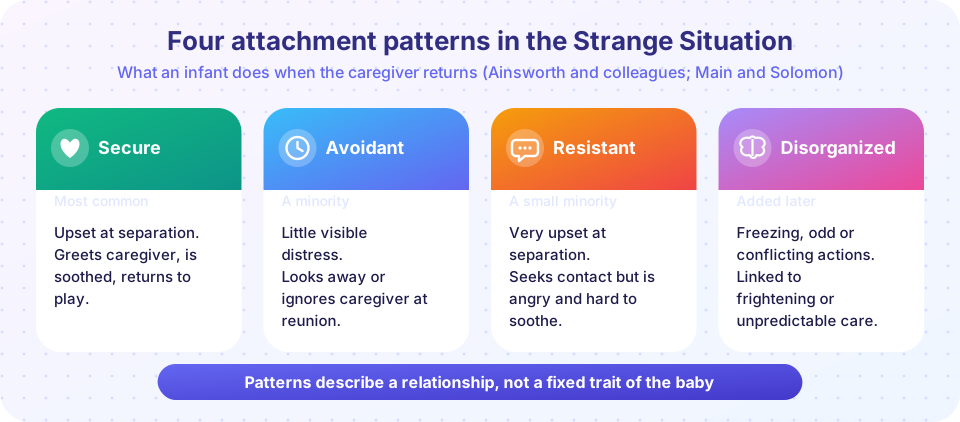
Coders pay the most attention to the reunions. Ainsworth identified three patterns, and Mary Main and Judith Solomon later added a fourth.
| Pattern | Behavior when the caregiver leaves | Behavior at reunion |
|---|---|---|
| Secure | Usually upset, may cry | Seeks contact, is soothed and returns to play |
| Avoidant | Little visible distress | Turns away, ignores caregiver |
| Resistant (ambivalent) | Very upset | Wants contact but is angry, hard to soothe |
| Disorganized | Varies | Freezing, odd or conflicting actions |
In many studies of middle-class families in the United States, roughly six or seven in ten infants are classified secure, with avoidant and resistant patterns making up most of the rest. Disorganized attachment is more common in samples with maltreatment or severe family stress. The exact proportions vary from study to study.
What shapes attachment?
Ainsworth believed that caregiver sensitivity is key: noticing a baby's signals, interpreting them correctly and responding promptly and appropriately. A 1997 meta-analysis by Brenda De Wolff and Marinus van IJzendoorn found that sensitivity is related to security, but the relationship was modest, a correlation of about .24. That means sensitivity matters, but it is not the whole story.
Other factors are in play: the baby's temperament, the parent's own stress and history, and the family and cultural context. Jerome Kagan argued in particular that some of what is called attachment may be the baby's inborn temperament.
Culture and the limits of one test
Attachment theory is often called universal, and studies in many countries find that most infants form attachments. But the Strange Situation's categories may not mean the same thing everywhere. In a 1988 meta-analysis, Marinus van IJzendoorn and Pieter Kroonenberg found more avoidant classifications in Germany and more resistant ones in Japan and Israel (in the kibbutz samples). Researchers argue about whether this reflects real differences in bonds or differences in what the test situation means to babies who are used to different child-rearing practices. For example, babies who are rarely left alone may find the separation unusually stressful.
Two further limits matter:
- Multiple attachments. Babies form bonds with fathers, grandparents and others, not only the mother.
- Predictions are probabilistic. Secure attachment in infancy is linked, on average, to better social and emotional outcomes, but the links are modest and many children change over time, especially if circumstances change.
Deprivation and recovery
What if a child has no steady caregiver? Studies of children raised in institutions in Romania under the Ceausescu regime show serious risks. Michael Rutter's English and Romanian Adoptees study followed children adopted into UK families. Children who spent more than about six months in poor institutions were more likely to have problems with attachment, attention and thinking. The Bucharest Early Intervention Project, led by Charles Zeanah, Nathan Fox and Charles Nelson, randomly assigned some institutionalized children to foster care and others to continued institutional care. Children placed into foster families, especially before about two years of age, did better on many measures than those who stayed. Not every gap closed, and children differ widely.
Both findings convey a hopeful and sobering message: early care matters, and improvement is possible after adversity, but earlier help usually works better.
Attachment in adulthood
Cindy Hazan and Phillip Shaver proposed in 1987 that romantic relationships work like attachments and described adult styles similar to infant patterns. Research since then uses questionnaires and interviews. Adult attachment styles show some stability but also change with life events, and measuring them is harder than it sounds. Treat adult attachment as an interesting, partly supported extension, not a proven map of your love life.
Common misconceptions
- "Attachment style is a permanent label." Patterns describe a relationship at a point in time and often change if circumstances change.
- "Insecure attachment means bad parenting or an abnormal child." Insecure patterns are common and are not diagnoses.
- "Mothers alone matter." Infants attach to several people.
- "Harlow showed food does not matter." He showed that comfort mattered at least as much; food also mattered.
This is educational information about research, not a way to assess a child or advise on care. If you are worried about a child's wellbeing, speak to a qualified professional.
Try it
The first demo lets you walk through the Strange Situation episodes and see how each pattern typically behaves. It is a simplified teaching model of the coding, not the real coding scheme.
The second demo is a simulation: how strong is a correlation of about .24 between caregiver sensitivity and infant security? Each dot is an imaginary family. The data are random numbers made to have that correlation, not real families.
Press Run (or Ctrl + Enter) to see the result here.
Program input · what you'd type while the program runs
Type the answers before you press Run, one per line. Each time the program reads a line (with input()), it gets the next line from this box.
The third demo is a toy scoring sheet that turns three reunion ratings into a pattern. The real coding scheme is much more detailed and requires trained coders.
Press Run (or Ctrl + Enter) to see the console output here.
No output.
Check your understanding
Quick check · 6 questions
of 6 answered You scored / 6 · perfect!
-
1. What did Harlow's cloth and wire mother experiments show?
Contact comfort mattered at least as much as feeding. -
2. Which episodes do coders pay the most attention to in the Strange Situation?
How the infant greets the caregiver after separation is the key information for classification. -
3. A baby shows little distress when the caregiver leaves and ignores her at reunion. Which pattern does this resemble?
Avoidant infants show little visible distress and turn away at reunion. -
4. The correlation between caregiver sensitivity and security is about .24. What does that tell you?
A modest correlation means a real but limited link. -
5. Why might the Strange Situation give different results across cultures?
Differences in what separation means may change behavior without changing the underlying bond. -
6. What did the Bucharest Early Intervention Project find?
Children randomly assigned to foster care did better on many measures, especially if placed early.
Summary
- Bowlby proposed attachment as an evolved system and the internal working model as its mental trace.
- Harlow showed that contact comfort, not just food, draws infants to a caregiver.
- Ainsworth's Strange Situation identifies secure, avoidant and resistant patterns; a disorganized pattern was added later.
- Caregiver sensitivity is related to security, with a modest correlation near .24; temperament and culture matter too.
- Early deprivation raises risks, and good care, especially early, helps recovery.
- Patterns describe relationships and can change.
Next: Emotion and temperament
Track your progress
Create a free account to tick off lessons and pick up where you left off on any device.
of Developmental Psychology lessons completed