


















Lesson 14 of 46 · Prenatal Development and Infancy
Teratogens and Prenatal Risks
Learn what teratogens are, the four principles of dose, timing, genetics and combination, landmark cases such as thalidomide and folic acid, and why outcomes vary.
In 1961, doctors in Germany and Australia began noticing babies born with missing or shortened arms and legs, a condition that had been extremely rare. William McBride in Australia and Widukind Lenz in Germany independently traced it to a popular sedative taken in early pregnancy: thalidomide. The drug was withdrawn, but by then about 10,000 children worldwide had been affected. The disaster showed that the placenta is not a perfect barrier and led to far stricter drug testing. It also gave developmental science a vivid lesson in how timing and exposure interact.
Educational information only. This lesson explains research on prenatal risks. It is not medical advice. Anyone who is pregnant or planning a pregnancy should talk to a doctor or midwife about medicines, vaccines, nutrition and exposures.
What you will learn
- define teratogen and explain the four principles that govern its effects
- describe well-studied teratogens: thalidomide, alcohol, tobacco, rubella, Zika
- explain the role of folic acid and nutrition, and the "crack baby" overstatement
- define preterm and low birth weight, and understand resilience
Key terms
Teratogen: any agent (a drug, an infection, a chemical, radiation) that can cause harm to an embryo or fetus.
Sensitive period (prenatal): the time when a given organ or system is most susceptible to damage.
FASD: fetal alcohol spectrum disorders, a range of effects of prenatal alcohol exposure.
Preterm: born before 37 weeks of gestation. Low birth weight: under 2,500 grams.
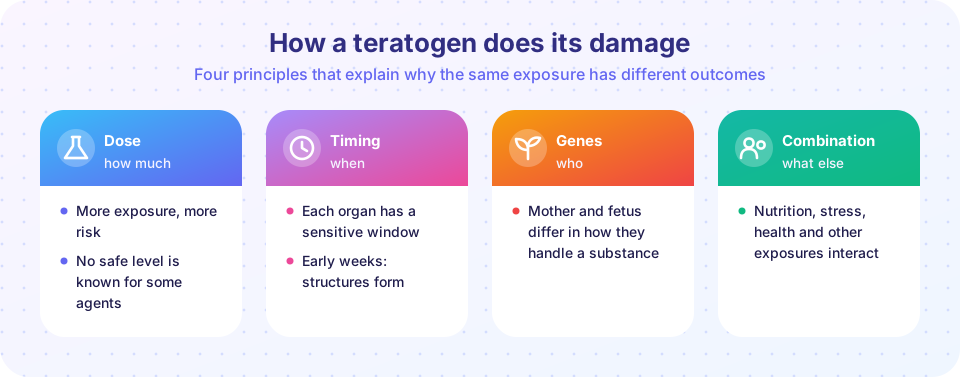
Four principles
- Dose. In general, more exposure means more risk, though for some agents (alcohol is one) no safe level has been established.
- Timing. Each organ has a sensitive period. An exposure during the first weeks of embryonic development can affect the structure of organs that, a month later, would be unaffected. In the fetal period, damage usually affects growth and the finer wiring of the brain rather than basic structure.
- Genetics. Both mother and fetus differ in how they absorb, metabolize and respond to a substance. Two women with the same exposure can have very different outcomes.
- Combination. Risk factors cluster and interact: poor nutrition, stress, low income, lack of prenatal care and other exposures can add up or amplify each other.
The first plot in the Try it section shows textbook-style approximations of the sensitive windows of different organs. Real windows overlap and are more gradual than these bars suggest.
Well-studied teratogens
Thalidomide
Sold in many countries from 1957 as a sedative and treatment for morning sickness, thalidomide caused severe limb malformations (phocomelia) and other defects in thousands of babies when taken during roughly weeks 4 to 8 after conception. In the United States the FDA reviewer Frances Kelsey held back approval because she was not satisfied with the safety data, sparing most American families. The disaster led to the 1962 amendments to US drug law (Kefauver-Harris) requiring evidence of safety and effectiveness, and to similar reforms elsewhere.
Alcohol
Prenatal alcohol exposure can cause fetal alcohol spectrum disorders. The most severe form, fetal alcohol syndrome, includes distinctive facial features, slow growth and impairments of the brain and behavior, such as difficulties with attention, learning and self-control. Because the brain develops throughout pregnancy, and because researchers have not identified a level of drinking that is clearly risk-free, public-health guidelines in many countries advise avoiding alcohol during pregnancy.
Tobacco and other drugs
Smoking during pregnancy is associated with preterm birth and low birth weight, and with other risks. Opioid exposure can lead to neonatal withdrawal symptoms in newborns, which need medical care. The case of cocaine illustrates a lesson in reading research. In the 1980s the media predicted a generation of "crack babies" with permanent brain damage. Later studies found much smaller effects, and many differences were hard to separate from poverty, other substance use and stress. Exposure is not harmless, but early reports greatly overstated the effects and stigmatized children.
Infections
- Rubella (German measles) in the first trimester can cause deafness, heart defects, eye problems and intellectual disability. Vaccination has made congenital rubella rare where programs are strong; before the vaccine, the 1964 epidemic in the US left thousands of babies affected.
- Zika virus in 2015 to 2016 was linked to microcephaly (an unusually small head) and other brain problems in babies in Brazil and elsewhere.
- Cytomegalovirus and toxoplasmosis are other infections that can harm the fetus.
- HIV can pass from mother to child, but treatment with antiretroviral drugs reduces the risk greatly.
Nutrition
Folic acid, a B vitamin, is a good example of a protective factor. Taking enough before conception and in early pregnancy lowers the chance of neural tube defects such as spina bifida. Neural tube closure happens early, often before a woman knows she is pregnant, which is why health agencies recommend folic acid for people who may become pregnant. Severe malnutrition is harmful: studies of the Dutch Hunger Winter of 1944 to 1945 found that exposure in early pregnancy was associated with higher rates of various health problems in adulthood.
Maternal stress and environment
High and sustained maternal stress has been associated with preterm birth and with child temperament, though effects are modest and hard to separate from genes and postnatal environment. Lead, mercury and some air pollutants are also harmful. Minamata disease in Japan (1950s) resulted from mercury poisoning of fish eaten by mothers, and caused serious neurological damage in the children.
Preterm birth and low birth weight
Babies born before 37 weeks are preterm; before 32 weeks, "very preterm". A baby weighing under 2,500 grams is low birth weight, under 1,500 grams very low. Smaller and earlier babies face more risk of breathing, feeding and developmental problems, but most preterm babies, especially those born closer to term, develop typically, and responsive care helps. Programs such as kangaroo care (skin-to-skin contact) have been shown to improve outcomes for small infants.
Resilience
Risk is probabilistic, not deterministic. Emmy Werner's Kauai Longitudinal Study followed nearly 700 children born in 1955 on a Hawaiian island. Among children facing several serious risks, about a third nonetheless became competent, caring adults, usually helped by temperament, a supportive adult and community resources. Resilience research shows that outcomes depend on what happens after exposure as well as on the exposure itself.
Common misconceptions
"Placental barrier: the fetus is protected from everything." Many drugs, viruses and chemicals cross the placenta.
"If a child was exposed, damage is certain." Dose, timing, genes, and care after birth all matter, and many exposed children do well.
"A tiny amount of a risk early on is the same as a lot later." Timing matters: the same agent can cause structural defects early and subtle brain effects later.
Try it
Press Run (or Ctrl + Enter) to see the result here.
Program input · what you'd type while the program runs
Type the answers before you press Run, one per line. Each time the program reads a line (with input()), it gets the next line from this box.
Press Run (or Ctrl + Enter) to see the console output here.
No output.
Check your understanding
Quick check · 5 questions
of 5 answered You scored / 5 · perfect!
-
1. Which principle explains why the same drug can cause limb defects at week 5 but not at week 20?
Each organ has a window in which it is especially vulnerable. -
2. Who delayed US approval of thalidomide, helping prevent a US epidemic of birth defects?
Frances Kelsey, an FDA reviewer, withheld approval because she judged the safety data to be inadequate. -
3. Why is folic acid recommended before pregnancy?
Folic acid supplementation lowers the risk of neural tube defects, and the tube closes in the first weeks. -
4. What does the 'crack baby' episode teach about reading research?
Later studies found far smaller effects than the early predictions suggested, and many differences were hard to separate from other adversity. -
5. A baby is born at 34 weeks and weighs 2,200 grams. According to the standard definitions, she is...
Before 37 weeks is preterm, and under 2,500 grams is low birth weight.
Summary
- Teratogens are agents that can harm the embryo or fetus; effects depend on dose, timing, genetics and combinations of risks.
- Thalidomide, alcohol, tobacco, rubella and Zika are well-studied examples, and folic acid shows how nutrition can protect.
- Overstated early claims (the "crack baby") remind us to demand careful evidence.
- Preterm and low birth weight raise risks, but most children develop well, and resilience and responsive care matter.
Track your progress
Create a free account to tick off lessons and pick up where you left off on any device.
of Developmental Psychology lessons completed