


















Lesson 44 of 46 · Projects and Practice
Glossary of developmental psychology
A plain-language glossary of more than fifty developmental psychology terms, grouped by theme, with a flashcard deck and a searchable term finder to practice.
This glossary collects the terms you have met in the course, grouped by theme. Each definition is a short, plain-language summary. Use it for quick lookups, and use the flashcards and the term finder below to practice recalling meanings without looking.
What you will learn
- Precise meanings of about fifty key terms.
- How terms connect across the three groups.
- How to test yourself with flashcards and a term finder.
Ideas and methods
| Term | Meaning |
|---|---|
| Nature and nurture | The roles of inherited biology and of experience in development; they interact. |
| Continuity and discontinuity | Whether development is gradual or happens in distinct stages. |
| Critical period | A window in which an experience must occur for normal development (a strict version of a sensitive period). |
| Sensitive period | A window when experience has an especially strong effect, with a gradual rather than abrupt end. |
| Cohort | A group of people born at about the same time who share historical experiences. |
| Cross-sectional design | Compares different age groups at one time. |
| Longitudinal design | Follows the same people over time. |
| Sequential design | Combines cross-sectional and longitudinal samples to separate age from cohort. |
| Correlation | A statistical relationship between two variables; it does not show cause. |
| Effect size | How large a difference or relationship is. |
| Cohen's d | An effect size: difference between group means in standard deviation units. |
| Operational definition | How a concept is measured in practice. |
| Replication | Repeating a study to see whether the finding holds. |
| Preregistration | Recording a study plan publicly before collecting data. |
| Informed consent and assent | Consent from a parent or adult; assent (agreement) from a child. |
| Habituation | Decreased response to a repeated stimulus; used to study infant perception. |
| Ecological systems theory | Bronfenbrenner's model of a child nested in micro-, meso-, exo-, macro- and chronosystems. |
| Plasticity | The capacity of the brain and behavior to change with experience. |
Early life
| Term | Meaning |
|---|---|
| Attachment | A lasting emotional bond between a child and a caregiver. |
| Secure base | A caregiver who gives safety so the child can explore. |
| Internal working model | Expectations about relationships built from early experience. |
| Strange Situation | Ainsworth's laboratory procedure for classifying infant attachment. |
| Disorganized attachment | A pattern with confused or contradictory behavior at reunion. |
| Caregiver sensitivity | Noticing, interpreting and responding appropriately to a child's signals. |
| Temperament | Early, partly inborn differences in reactivity and self-regulation. |
| Goodness of fit | The match between a child's temperament and the environment. |
| Behavioral inhibition | A tendency to react to novelty with caution and distress. |
| Effortful control | Focusing attention and overriding impulses. |
| Emotion regulation | Managing the intensity and expression of feelings. |
| Social referencing | Checking a trusted adult's face to decide how to react. |
| Self-conscious emotions | Pride, shame, guilt and embarrassment; they require a sense of self. |
| Phonology, semantics, syntax, pragmatics | Sounds, meanings, grammar and social use of language. |
| Joint attention | Child and adult share attention to the same thing and both know it. |
| Statistical learning | Noticing patterns such as which syllables go together. |
| Fast mapping | Forming a rough meaning for a new word after very few exposures. |
| Overextension | Using a word too broadly. |
| Telegraphic speech | Short sentences with content words and few small words. |
| Overregularization | Applying a rule where it does not belong, such as "goed". |
| Nativism | The view that some knowledge of language is innate. |
| Child-directed speech | A style of talking to young children, with high pitch and exaggerated vowels. |
| Parallel play | Playing near, but not with, another child. |
| Authoritative parenting | High warmth and clear, explained expectations. |
| Heteronomous morality | Piaget's early view that rules are fixed and come from authority. |
| Post-conventional reasoning | Judging by principles such as rights and justice. |
Later life
| Term | Meaning |
|---|---|
| Puberty | The biological process leading to sexual maturity. |
| Secular trend | A long-term shift across generations, such as earlier puberty. |
| Imaginary audience | The belief that everyone is watching you. |
| Personal fable | The belief that your experience is unique. |
| Synaptic pruning | Removal of little-used neural connections. |
| Myelination | Insulation of nerve fibers that speeds signals. |
| Dual-systems model | The idea that reward systems mature before cognitive control. |
| Identity achievement | Marcia's status of commitment after exploration. |
| Moratorium | Exploring options without a firm commitment yet. |
| Foreclosure | Commitment without exploration. |
| Emerging adulthood | Arnett's term for about ages 18 to 29 in some societies. |
| Generativity | Concern for guiding and contributing to the next generation. |
| Maturity principle | The average rise in conscientiousness and emotional stability with age. |
| Lifespan perspective | The view that development lasts across the whole of life. |
| SOC model | Selection, optimization and compensation. |
| Fluid intelligence | Reasoning with new problems. |
| Crystallized intelligence | Accumulated knowledge and skills. |
| Cognitive reserve | Brain resilience built by education and activity. |
| Socioemotional selectivity | Goals shifting toward emotional meaning as time feels limited. |
| Positivity effect | Older adults' relative preference for positive information. |
| Integrity versus despair | Erikson's last stage: finding meaning in one's life. |
| Dual process model | Grief as oscillation between loss- and restoration-oriented coping. |
| Resilience | Relatively stable functioning after stress or loss. |
Common misconceptions
- "Sensitive period" and "critical period" mean exactly the same. Critical suggests a hard deadline; sensitive suggests a gradual change. Human evidence usually fits sensitive better.
- "Correlation and effect size are the same." A correlation is one kind of effect size.
- "Terms like attachment and temperament are interchangeable." Attachment describes a relationship; temperament describes an individual's inborn style.
Try it
First, a flashcard deck for glossary terms.
Second, a small term finder in code. Search for a word and see matching entries. Add your own terms to the list.
Press Run (or Ctrl + Enter) to see the console output here.
No output.
Check your understanding
Quick check · 4 questions
of 4 answered You scored / 4 · perfect!
-
1. Which term describes a long-term shift across generations, such as earlier puberty?
A secular trend is a long-term change across generations. -
2. Which pair matches correctly?
Moratorium means exploring without a final choice. -
3. What does an operational definition do?
It lets others repeat your measurement. -
4. How does a sensitive period differ from a critical period?
Human evidence usually shows gradual changes, so sensitive period is often preferred.
Summary
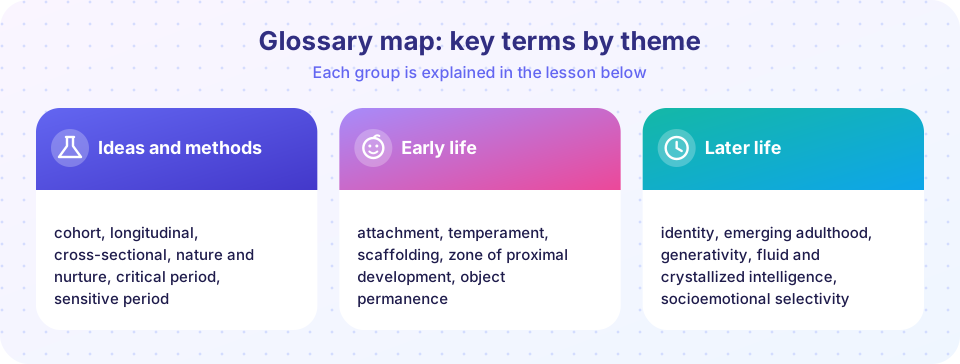
- Terms fall into groups: ideas and methods, early life, and later life.
- Many pairs are easy to confuse: sensitive versus critical period, attachment versus temperament, correlation versus effect size.
- Use flashcards and self-quizzing to turn recognition into recall.
Track your progress
Create a free account to tick off lessons and pick up where you left off on any device.
of Developmental Psychology lessons completed