


















Lesson 26 of 46 · Language Development
From sounds to sentences: babbling, first words and early grammar
How infants tune in to speech, babble, learn their first words, hit the vocabulary spurt and start combining words, with the studies behind each step.
Imagine hearing a language you have never studied. The speaker's words run together with no gaps, like a ribbon of sound. Yet every baby solves this puzzle. By the first birthday infants have found words in the ribbon; by the third they chat in sentences. This lesson follows that path in detail and shows the experiments that revealed it.
The main message is that infants are active learners. Long before they say anything, they are counting sounds, tracking where adults look, and testing guesses about what words mean.
What you will learn
- How infants find words in continuous speech (statistical learning).
- The stages of early sound-making: cooing, babbling and gesture.
- How toddlers learn words so fast, and which shortcuts they use.
- How first sentences look and what errors tell us.
Key terms
- Statistical learning: noticing which sounds or syllables regularly occur together.
- Joint attention: when a child and an adult look at the same thing and both know it.
- Fast mapping: forming a first rough idea of a new word after very few exposures.
- Overextension: using a word too broadly, such as calling every four-legged animal "dog".
- Telegraphic speech: short sentences that keep the content words and drop small ones ("Daddy go work").
Step 1: finding words in a ribbon of sound
Spoken language has no spaces. How does an infant know where a word starts? In 1996 Jenny Saffran, Richard Aslin and Elissa Newport played 8-month-old infants a two-minute stream of made-up syllables, such as "bidakupadotigolabu". Hidden in the stream were four three-syllable "words". Inside a word the next syllable was fully predictable (after "bi" always comes "da"). Between words it was not. Afterwards the babies listened longer to new arrangements than to the old words, showing that they had picked up the pattern. Infants can track transitional probabilities, which is the chance that one syllable follows another, with no instruction at all.
This kind of statistical learning is probably one tool among many. Infants also use rhythm: in English most two-syllable words stress the first syllable ("DOCtor", "BAby"), and babies learn to treat a stressed syllable as a likely word start.
Step 2: cooing, babbling and gesture
At about two months babies coo: soft, vowel-like sounds, often in turn-taking games with a caregiver. Between roughly six and ten months comes canonical babbling, which strings consonants and vowels together ("ba-ba", "ma-ma"). Babbling is not random noise. It gets more like the home language over time, and deaf infants who see sign language babble in sign, as Petitto and Marentette reported in 1991.
Pointing begins around the first birthday and is a milestone in its own right. When an infant points and then checks that you are looking, they are showing joint attention, a skill that strongly predicts later vocabulary. Gesture and speech grow together: first the point, then the word, then the two together ("that!").
Step 3: the first words
Most children say their first real word near twelve months. Early words are usually names of people, animals, foods and routines: "mama", "dog", "ball", "bye-bye". Children understand more than they say. A toddler might understand dozens of words before saying ten, a gap between receptive and expressive language that is normal.
Early meanings are not always adult meanings. In overextension a child may call the moon a "ball" or every man "daddy". In underextension "cup" might mean only one blue cup. These errors show that the child is building categories, not repeating a memorized list.
Step 4: word learning at astonishing speed
By age six, many children have learned several thousand words, which means learning many new words every day. How? Researchers describe several shortcuts:
- Fast mapping. In 1978, Susan Carey and Elsa Bartlett asked three- and four-year-olds to "bring me the chromium tray, not the blue one". Many children later remembered that "chromium" had something to do with olive green. One brief exposure gave them a rough meaning.
- Joint attention. Children map words to whatever the speaker is looking at, not to whatever the child is looking at.
- Whole-object bias. A new word probably names the whole thing, not its parts or color.
- Mutual exclusivity. If a child already knows "ball", a new word probably names something else (Ellen Markman's idea).
These are tendencies, not hard rules. They narrow the huge number of possible meanings.
Step 5: the vocabulary spurt and first sentences
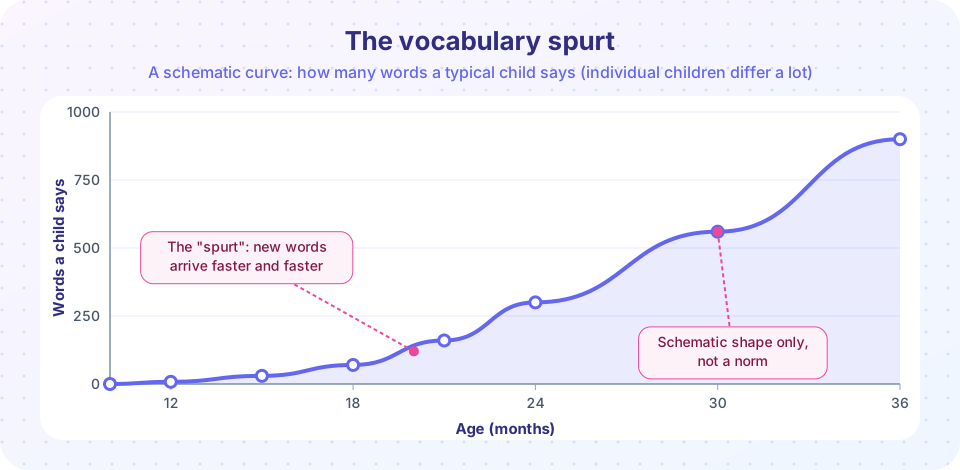
Many children, but not all, show a vocabulary spurt when words start arriving faster, often between 18 and 24 months. Some researchers think it reflects a change in how children understand words as names; others say that the spurt is partly an artifact of averaging and that many children grow steadily. This is an open debate.
Around the same time children join two words: "more juice", "daddy go", "no bed". Early sentences use content words and skip small ones, which is why Roger Brown called them telegraphic. Next come grammar markers. In English the progressive "-ing" and the plural "-s" tend to arrive before the past "-ed" and the possessive.
Children also make overregularization errors such as "foots" or "goed". These are valuable clues: a child who says "goed" has learned the rule "add -ed" and applies it, and nobody ever said "goed" to them. You will come back to this in the theories lesson.
The role of caregivers
Adults in many (not all) cultures speak to babies in a distinctive style: higher pitch, slower pace, exaggerated vowels. This child-directed speech gets infants' attention and may help them hear sound categories. Responsive conversations matter too: caregivers who comment on what the child is looking at, rather than redirecting attention, tend to have children with larger vocabularies.
You may have heard that poor children hear "30 million fewer words" than wealthier children. That claim comes from Betty Hart and Todd Risley's 1995 study of 42 families, which was small and unrepresentative. Later work has found smaller differences, and it shows that the quality and responsiveness of talk probably matters more than a raw word count. Treat the "30 million" figure as a famous but shaky number.
Common misconceptions
- "Baby talk slows language learning." Child-directed speech seems to help, not harm.
- "Flashcards teach babies to talk." Language grows from back-and-forth, shared attention and meaningful play, not from drilling.
- "The 30 million word gap is settled fact." The original study was small, and later research found smaller gaps.
Try it
The first demo recreates the idea behind the Saffran experiment. It builds a stream from four invented words and then measures how likely each syllable is to follow another. It is a simplified model, not the infants' brain.
Press Run (or Ctrl + Enter) to see the console output here.
No output.
The second demo is a simulation, not real data. It draws growth curves for six imaginary children who all follow an S-shaped pattern but start at different ages. It shows why individual children differ even when the pattern is shared.
Press Run (or Ctrl + Enter) to see the result here.
Program input · what you'd type while the program runs
Type the answers before you press Run, one per line. Each time the program reads a line (with input()), it gets the next line from this box.
The third demo lets you try the mutual exclusivity shortcut. Ask the "child" for the "dax": which object do they pick?
Check your understanding
Quick check · 5 questions
of 5 answered You scored / 5 · perfect!
-
1. In the Saffran, Aslin and Newport (1996) study, what cue did 8-month-olds use to find words?
Inside invented words the next syllable was predictable, and between words it was not. Infants noticed that pattern. -
2. A child calls every four-legged animal "dog". What is this called?
Overextension means applying a word more broadly than adults do. -
3. Why is a child saying "goed" a useful clue for researchers?
Adults say "went", so "goed" must come from the child's own application of the rule "add -ed". -
4. What does the "30 million word gap" claim rest on?
Hart and Risley's sample was small and unrepresentative, and later studies found smaller differences. -
5. Which skill shown around age one is a strong predictor of later vocabulary?
Following and directing shared attention helps children link words to the right objects.
Summary
- Infants find words by tracking patterns such as which syllables go together (statistical learning).
- Babbling begins at about six to ten months and is practice in the home language, vocal or signed.
- Early words are often overextended or underextended; understanding runs ahead of speaking.
- Children learn words fast using joint attention, fast mapping and shortcuts like mutual exclusivity.
- Early sentences are telegraphic; overregularization errors show that children apply rules.
- Responsive talk from caregivers matters; the "30 million words" claim is weaker than it sounds.
Track your progress
Create a free account to tick off lessons and pick up where you left off on any device.
of Developmental Psychology lessons completed