


















Lesson 10 of 46 · Methods and Theories of Development
Bronfenbrenner's Ecological Systems Theory
Understand Bronfenbrenner's ecological model of development: microsystem, mesosystem, exosystem, macrosystem and chronosystem, with examples and a sorting activity.
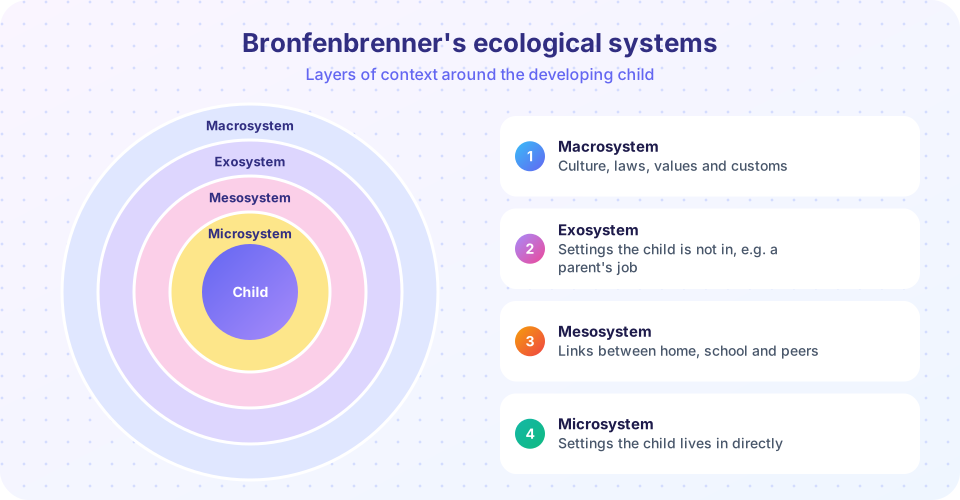
A child does not grow up in a laboratory. She grows up in a house, a classroom, a neighborhood, a country and a historical moment, and each of these shapes who she becomes. Urie Bronfenbrenner, a Russian-born American psychologist, built a theory around this simple observation. His ecological systems theory gives researchers and teachers a map for asking "what else is influencing this child?", and it remains one of the most widely used frameworks in child development, education and social work.
What you will learn
- name and define the five systems in Bronfenbrenner's model
- distinguish the exosystem from the microsystem and mesosystem
- apply the model to analyze a real situation
- describe the later bioecological model (process, person, context, time)
- discuss the strengths and limits of the theory
Key terms
Microsystem: the settings and relationships a child directly takes part in, such as family, school and peers.
Mesosystem: the connections between microsystems, such as between home and school.
Exosystem: settings the child does not take part in, but which affect the child, such as a parent's workplace.
Macrosystem: the broad culture: values, laws, customs and economy.
Chronosystem: time, including life transitions and historical events.
The layers
Microsystem. This is the innermost layer, where the child has face-to-face relationships: family, school, peer group, neighborhood play areas, a religious community. Influence runs both ways. A patient parent may calm a fussy baby, and a fussy baby may stress the parent. Bronfenbrenner stressed this bidirectionality.
Mesosystem. The links among a child's microsystems. When a parent and teacher communicate regularly, the child's learning is supported by both. When home and school give conflicting messages, development can suffer. Children whose parents are involved in school often do better, but this relationship may partly reflect other advantages in the family.
Exosystem. Settings that the child never enters but whose events reach her. A parent's job is the standard example: if it demands long hours or rotating shifts, the child may see less of that parent. A parent's friends, the school board's decisions about class sizes, and a community's health services all belong here.
Macrosystem. The cultural blueprint: beliefs about childrearing, laws about schooling and child labor, economic conditions, social class and the dominant values. Policies such as paid parental leave, universal preschool or compulsory schooling sit here. Cross-cultural research shows how different macrosystems lead to different childhoods. For example, the Six Cultures Study (Beatrice and John Whiting, fieldwork in the 1950s, reported in 1975) found that children in societies where older children routinely cared for younger siblings or did household chores showed more nurturing, responsible behavior.
Chronosystem. Time adds a dimension through the child's own life transitions (starting school, a parent's divorce, moving), and through the historical period (a recession, a pandemic, new technologies). The same event can affect a child differently depending on her age, which is why chronosystem thinking is so useful for explaining individual variations.
The bioecological model
Later in life Bronfenbrenner revised his theory to give the person a bigger role. The bioecological model has four parts, called PPCT: Process (the "proximal processes", the regular, increasingly complex interactions between a child and the people, objects and symbols in her environment, which he considered the main engines of development), Person (the child's own characteristics, such as temperament), Context (the systems described above) and Time. A reading example: the process is bedtime story-reading; the person is a child with a strong interest in animals; the context includes the home, the library and the community; and time covers the child's age and the era.
Using the model
Suppose you want to understand why a nine-year-old is struggling in school. Instead of looking only at the child, work through the layers:
- Micro: relationships with teacher, classmates and family; sleep and nutrition.
- Meso: does the teacher know about difficulties at home, and do the parents know about those at school?
- Exo: has a parent recently lost a job, causing stress at home?
- Macro: what does the community expect from schooling, and what resources does the school get?
- Chrono: did the family recently move, or has the child just started a new level?
This does not tell you the cause, but it generates a checklist of hypotheses to test.
Strengths and limits
Strengths. The theory reminds us that children live in systems, encourages interventions that act on several layers (such as family support programs coupled with school changes), and underlies major policy programs, from Head Start in the United States (to which Bronfenbrenner contributed) to modern community-based interventions.
Limits. It is more a framework than a theory that makes precise predictions: it tells you where to look but not how strong each effect will be. It can be hard to test as a whole. It also tends to describe contexts without addressing the biology of the child, a gap the bioecological revision tried to fill.
When you read a study about a child outcome, look for which layers the researchers measured and which they ignored. Most studies cover one or two.
Common misconceptions
"The exosystem is anything far from the child." The defining feature is that the child is not a participant in the setting, yet is affected by it. A parent's workplace qualifies; a child's own school does not.
"The layers are separate boxes." They influence each other, and influence runs in both directions.
"Culture only matters in foreign countries." Every child grows up within a macrosystem, including those in the researcher's own society.
Try it
Press Run (or Ctrl + Enter) to see the result here.
Program input · what you'd type while the program runs
Type the answers before you press Run, one per line. Each time the program reads a line (with input()), it gets the next line from this box.
Check your understanding
Quick check · 5 questions
of 5 answered You scored / 5 · perfect!
-
1. A child's father is promoted and works longer hours, so the child sees him less. In Bronfenbrenner's terms, the father's workplace is part of the child's...
The child is not a participant in the workplace, but events there affect the child: an exosystem influence. -
2. Which is an example of the mesosystem?
The mesosystem consists of connections among the child's microsystems, such as home and school. -
3. What do PPCT stand for in the bioecological model?
Process, Person, Context and Time. -
4. Which is a limitation of ecological systems theory?
It tells researchers where to look, but it is hard to test as a whole. -
5. A war that began when a child was two affects her differently from one that began when she was fifteen. Which system does this highlight?
The same event can affect people differently depending on their age: a chronosystem idea.
Summary
- Bronfenbrenner described nested systems around the child: micro, meso, exo, macro, with time (chrono) running through them.
- Influence is bidirectional: children also shape their environments.
- The bioecological model adds proximal processes, the person's own characteristics, context and time (PPCT).
- The model is a practical checklist for analyzing situations and for designing multi-level interventions, but it is hard to test as a whole.
Next: Chapter 2 Review
Track your progress
Create a free account to tick off lessons and pick up where you left off on any device.
of Developmental Psychology lessons completed