


















Lesson 27 of 46 · Language Development
How is language learned? Theories, critical periods and bilingualism
Compare the main theories of how children learn language, then look at the critical period debate, the Genie case, and what research says about bilingual children.
In the last lesson you saw what children do. Now the harder question: how? Four main families of theories give four different answers, and the debate between them is one of the most famous in psychology. In the middle of the last century, one camp said language is learned like any habit. Another said children are born with grammar. Today most researchers combine ideas from several camps and argue about the mix.
At the end of the lesson you will also meet two practical questions that follow from the theories: is there an age after which language learning becomes harder, and what happens when a child grows up with two languages?
What you will learn
- The four main theories of language learning and the evidence for and against each.
- What the wug test, overregularization and Nicaraguan Sign Language reveal.
- What the critical (sensitive) period hypothesis says, and what the evidence is.
- What research does and does not show about bilingual children.
Key terms
- Nativism: the view that some knowledge of language is built into the human mind.
- Universal grammar: Chomsky's proposal of a shared blueprint underlying all human languages.
- Poverty of the stimulus: the argument that children's input is too limited to explain what they learn.
- Sensitive (critical) period: a window when experience has an especially strong effect on development.
- Code-switching: moving between two languages within a conversation.
Theory 1: learning through imitation and reward
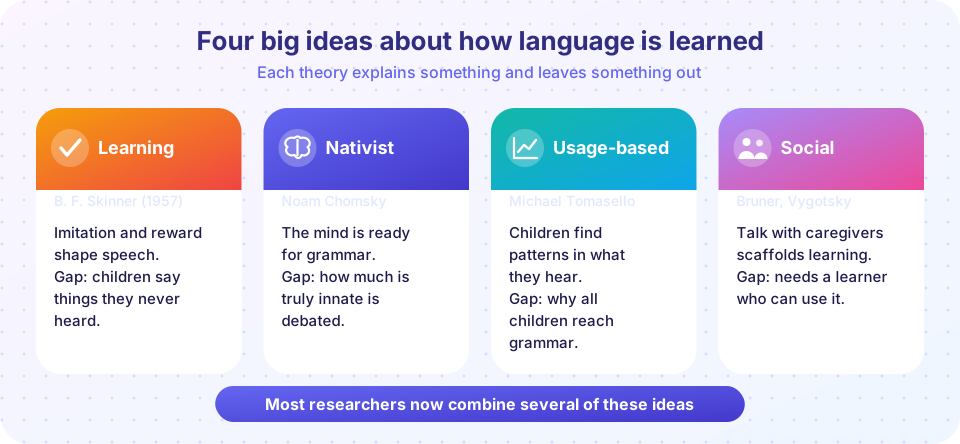
In 1957 B. F. Skinner argued in Verbal Behavior that speech is shaped like any behavior: a child says something, a caregiver responds, and responses that are rewarded are repeated. Imitation helps too. This view explains why children speak the language they hear and why practice matters.
It also has a famous problem. Children say sentences they have never heard, such as "I goed" or "Two mouses". Parents rarely correct grammar in everyday talk. Roger Brown and colleagues found that parents tend to respond to whether a sentence is true, not whether it is grammatical. If imitation and reward were everything, these patterns would be hard to explain.
Theory 2: born ready (nativism)
In a 1959 review of Skinner's book, Noam Chomsky argued that children could not learn a language's full grammar from the sentences they happen to hear, because the input is incomplete, messy and contains no clear list of what is not allowed. He proposed that children are born with a head start: knowledge of what human languages can look like. This was called a language acquisition device, later universal grammar.
Evidence cited in favor of nativism includes:
- Speed and uniformity. Children with very different experiences reach similar grammar at similar ages.
- The wug test. In 1958 Jean Berko showed children a drawing of an imaginary bird called a "wug" and said "Now there are two of them. There are two ___." Children said "wugs". They had never heard that word, so they were applying a rule, not repeating something heard.
- Nicaraguan Sign Language. Before the 1970s, Deaf children in Nicaragua had no shared sign language. When schools brought them together, they created one. Over successive cohorts of children, the language gained more regular grammar. Many scholars see this as children building structure that was not in the input.
Critics ask how much needs to be innate and how detailed it is, and whether general learning abilities can do the job.
Theory 3: usage-based learning
Michael Tomasello and others argue that children learn language the way they learn many things: by noticing patterns in what they hear and by reading other people's intentions. Their evidence includes the observation that toddlers' early sentences are tied to particular words (a child may use "give" in one pattern and "put" in another for a while) before they generalize into abstract rules. Skills such as joint attention, pattern-finding, and understanding what others want are the key tools. You saw statistical learning in the last lesson; this is the theory that builds on it.
The usage-based view is strong on gradual learning. Its critics ask why all children with different input reach a similar adult grammar, and how it handles complex rules.
Theory 4: social interaction
Lev Vygotsky stressed that thinking and language grow through conversation with more skilled partners: what a child can do with help (the zone of proximal development) today, she does alone tomorrow. Jerome Bruner described caregivers as a language acquisition support system: games like peekaboo and shared picture-book reading give children predictable routines that make words easy to learn. This view stresses how caregivers help but does not by itself explain why humans, and not other animals raised in human homes, learn grammar.
Which theory is right?
Probably each is partly right. A modern summary might go like this: humans are born with powerful learning abilities and social instincts (nativist and social ideas), these abilities find patterns in rich, interactive input (usage-based idea), and reward and imitation shape which words and styles a child uses (learning idea). The live debates are about how specific the built-in part is.
The critical period
Is there an age after which learning a first language becomes much harder? In 1967 Eric Lenneberg proposed that language is learned most easily until about puberty. Evidence comes from several places:
- Genie. In 1970, a girl known as Genie was found at about thirteen after years of extreme isolation and abuse. She learned many words but, despite years of help, never mastered ordinary grammar. Linguist Susan Curtiss studied her. The case is moving and important but hard to interpret, because severe neglect harms many things at once, so it cannot cleanly show a language-only critical period.
- Second-language learners. In 1989 Jacqueline Johnson and Elissa Newport tested Chinese and Korean speakers who had moved to the United States on English grammar. Those who arrived before about age seven performed like native speakers, and performance fell as age of arrival rose. The drop was gradual, not a sudden cliff, which is why many scholars prefer the term sensitive period.
- Deaf children. Deaf children who first learn a sign language late (for example, because hearing parents did not use one) often do less well later with that language's grammar than those exposed from birth.
The takeaway: early exposure gives an advantage, especially for grammar and accent, but adults can still learn languages well. The ability fades slowly; it does not switch off.
Growing up with two languages
Roughly half the world's people speak more than one language. What does research say about children raised bilingually?
- Milestones. Bilingual children reach the major language milestones in about the same age range. In each language they may know fewer words than a child who speaks only that language, but their combined vocabulary across both languages is similar to or larger than a monolingual child's.
- Mixing is normal. Code-switching is not confusion. It follows rules and reflects skill.
- Advantages? Some studies have found that bilingual children and adults do better on attention and self-control tasks, the so-called bilingual advantage. Larger and later studies often find no such effect, so scientists now treat this claim as contested. The clearer benefits are practical and cultural: communicating with more people and keeping a link with family heritage.
- Support. Children do best when both languages are used richly, with plenty of conversation, not only exposure to a television.
Common misconceptions
- "Chomsky proved grammar is innate." He made a powerful argument, and many researchers accept parts of it, but the details are still debated.
- "Genie proves there is a critical period." It is suggestive, but severe abuse confounds the evidence.
- "Two languages confuse children." Research finds no long-term harm, and children can separate languages from infancy.
- "After puberty you cannot learn a language." Adults learn languages every day; the advantage for native-like accent and grammar fades gradually.
Try it
The first demo is the wug test in code. Given a made-up noun, the program applies the English plural rule: add the sound /s/ after voiceless sounds, /ɪz/ after hissing sounds and /z/ otherwise. It shows the kind of rule Berko's children used without being taught it.
Press Run (or Ctrl + Enter) to see the console output here.
No output.
The second demo draws schematic curves in the spirit of Johnson and Newport (1989): grammar scores for learners who arrived at different ages. The curve is made up to show the shape, not their actual data.
Press Run (or Ctrl + Enter) to see the result here.
Program input · what you'd type while the program runs
Type the answers before you press Run, one per line. Each time the program reads a line (with input()), it gets the next line from this box.
The third demo shows why a bilingual child's combined vocabulary matters. The word lists are tiny practice examples.
Press Run (or Ctrl + Enter) to see the console output here.
No output.
Check your understanding
Quick check · 6 questions
of 6 answered You scored / 6 · perfect!
-
1. Why did Chomsky criticize Skinner's account of language learning?
Overregularizations such as "goed" and the wug test show children apply rules, which pure imitation does not explain. -
2. What did Jean Berko's wug test show?
Children said "wugs" for a word they had never heard, showing they use a rule. -
3. Which theory stresses that caregivers scaffold learning in routines such as peekaboo?
Bruner and Vygotsky stressed supportive interaction between children and more skilled partners. -
4. What did Johnson and Newport (1989) find?
Early arrivals did best, and performance fell as age of arrival rose, which is why many scholars prefer the term sensitive period. -
5. Which statement about bilingual children is best supported?
Each language may have fewer words, but across both languages bilingual children know about as many concepts. -
6. Why is the Genie case hard to use as proof of a critical period?
Because many things were affected, we cannot say that late language exposure alone explains her outcome.
Summary
- Learning theory says imitation and reward shape speech; it struggles to explain novel errors and sentences.
- Nativism (Chomsky) says humans are born ready for grammar; the wug test and Nicaraguan Sign Language are cited as support, and the extent of innateness is debated.
- Usage-based theory says children find patterns and read intentions; social interaction theory stresses scaffolding by caregivers.
- Most researchers combine ideas from several theories.
- There is a sensitive period for language, with a gradual decline, not a hard cut-off.
- Bilingualism is typical and not harmful; claims of a general bilingual advantage are contested.
Track your progress
Create a free account to tick off lessons and pick up where you left off on any device.
of Developmental Psychology lessons completed