


















Lesson 25 of 46 · Language Development
Chapter overview: language development
A map of how children learn language: from tuning in to speech sounds, through babbling and first words, to grammar, plus the big theories behind it.
Somewhere between the first cry and the first birthday party speech, a child learns one of the most complicated skills humans have. By age five, most children speak in long sentences, tell stories, joke, argue and follow rules of grammar that no one ever sat down and taught them. They do this without a textbook. This chapter explains how that happens, what researchers have found, and where they still disagree.
Language is also a perfect window on development as a whole. It depends on hearing and on the brain, on caregivers who talk and respond, on thinking skills such as memory and categories, and on social skills such as sharing attention. When you study language, you meet nearly every big theme of this course: nature and nurture, sensitive periods, and the difference between what a child can do alone and what they can do with help.
What you will learn
- The big picture of language development from birth to about age five.
- The four parts of language that children must master: sounds, words, grammar and use.
- What each lesson of this chapter covers and how they connect.
- Why "typical" ages are guides and not deadlines.
Key terms
- Phonology: the sound system of a language, including which sounds count as different.
- Semantics: the meanings of words and sentences.
- Syntax: the grammar rules that order words into sentences.
- Pragmatics: the social rules of using language, such as taking turns and being polite.
- Receptive language: what a child understands. Expressive language: what a child says or signs.
The four parts of language
Linguists split language into parts, and children learn them at the same time, not one after another.
| Part | The question it answers | A child's example |
|---|---|---|
| Phonology | Which sounds matter? | Hearing that "bat" and "pat" are different words |
| Semantics | What do words mean? | Learning that "dog" covers a poodle and a husky |
| Syntax | How do words combine? | Saying "I want more juice" and not "juice more want I" |
| Pragmatics | How do I use language with people? | Answering a question, not interrupting |
A child can be ahead in one part and behind in another. A two-year-old may know many words (semantics) but combine them rarely (syntax). That is one reason scientists use several measures, such as how many different words a child says and how long their sentences are.
The story in five scenes
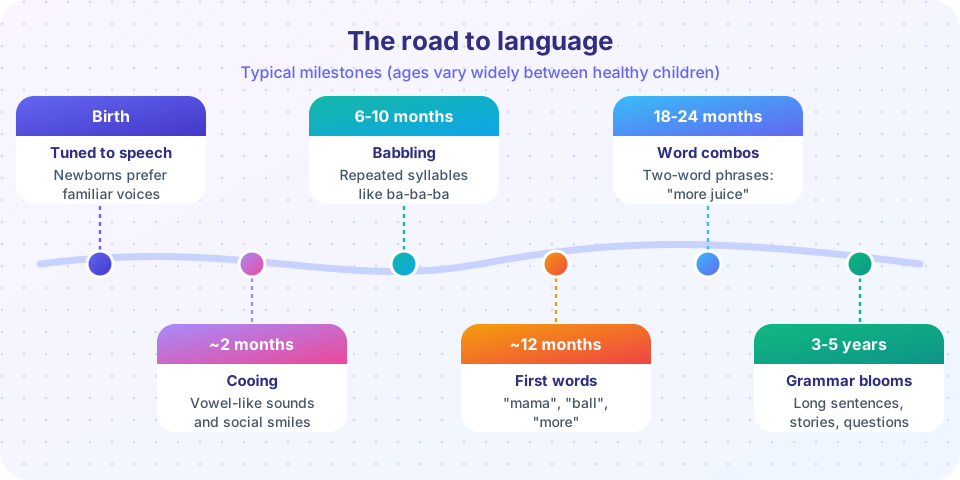
Scene 1: Listening before speaking. Language starts before birth. In a classic 1980 study, Anthony DeCasper and William Fifer let newborns suck on a special nipple to choose between recordings. The babies changed their sucking to hear their mother's voice. Newborns are not reading words; they are recognizing a voice and its rhythm, which they heard through the womb.
Scene 2: Tuning in. Young infants can tell apart speech sounds from many languages. By about ten to twelve months, they are better at the sounds of their own language and worse at sounds that their language does not use. Janet Werker and Richard Tees showed this in 1984. The infant brain is not losing ability; it is specializing.
Scene 3: Practice sounds. Around six to ten months babies start canonical babbling: repeated syllables such as "ba-ba-ba" and "da-da-da". Deaf babies exposed to sign language babble with their hands, as Laura Ann Petitto and Paula Marentette found in 1991. Babbling is practice, and it is linked to the language the baby sees and hears.
Scene 4: Words. First words appear near the first birthday. They are usually names for people, favorite things, and social routines. Sometime between about 18 and 30 months many children go through a vocabulary spurt.
Scene 5: Grammar. Two-word combinations appear around 18 to 24 months ("more juice", "daddy go"). Over the next years children add endings, small words, questions and complex sentences. Roger Brown's classic studies tracked the order in which English-speaking children add grammar markers such as "-ing" and plural "-s".
Listening first
Babbling and gesture
Words arrive
Grammar grows
Typical ages are guides, not deadlines.
Common misconceptions
- "Late talkers will always have a language problem." Many toddlers who talk late catch up, but some do not, and a doctor or speech-language pathologist can tell the difference. Your lesson here is educational, not a screening tool.
- "Children learn language only by imitating." Children say things such as "I goed" that nobody says. You will see why in the theories lesson.
- "A baby who does not babble on schedule has failed." The ages are averages with wide ranges.
What is in this chapter
- How children go from sounds to sentences: the details of babbling, first words, the vocabulary spurt, and early grammar.
- How is language learned? Competing theories: Skinner, Chomsky, Tomasello and others, plus the critical period and bilingualism.
- Chapter review: one picture, a recap table and ten review questions.
Try it
The first demo is a simple slider that shows a typical language behavior at each age. It is a teaching aid built from general milestones and not a screening tool.
The second demo counts how long a child's utterances are, a measure called mean length of utterance (MLU) that researchers use. The sample sentences are made up for practice.
Press Run (or Ctrl + Enter) to see the console output here.
No output.
Check your understanding
Quick check · 4 questions
of 4 answered You scored / 4 · perfect!
-
1. Which of these is a part of language that concerns the order of words in sentences?
Syntax is the set of grammar rules that order words into sentences. Phonology is about sounds and semantics about meaning. -
2. What did DeCasper and Fifer (1980) find about newborns?
Newborns changed their sucking to hear a recording of their mother's voice, suggesting they learned something about it before birth. -
3. Around what age do infants usually begin canonical babbling?
Repeated syllables such as ba-ba-ba typically appear between about six and ten months. -
4. Why do Werker and Tees (1984) matter?
By about ten to twelve months infants discriminate native sounds better and non-native contrasts less well.
Summary
- Language has four parts: sounds, meanings, grammar and social use, learned at the same time.
- Learning begins before birth: newborns prefer familiar voices.
- Infants tune in to their language's sounds, babble, say first words near 12 months, combine words around 18 to 24 months and build grammar in the preschool years.
- Typical ages are guides: healthy children vary a great deal.
Track your progress
Create a free account to tick off lessons and pick up where you left off on any device.
of Developmental Psychology lessons completed