


















Lesson 33 of 46 · Social and Emotional Development
Chapter review: social and emotional development
Review attachment, temperament, emotion regulation, play, parenting styles and moral reasoning with a timeline, a recap table, practice and a ten-question quiz.
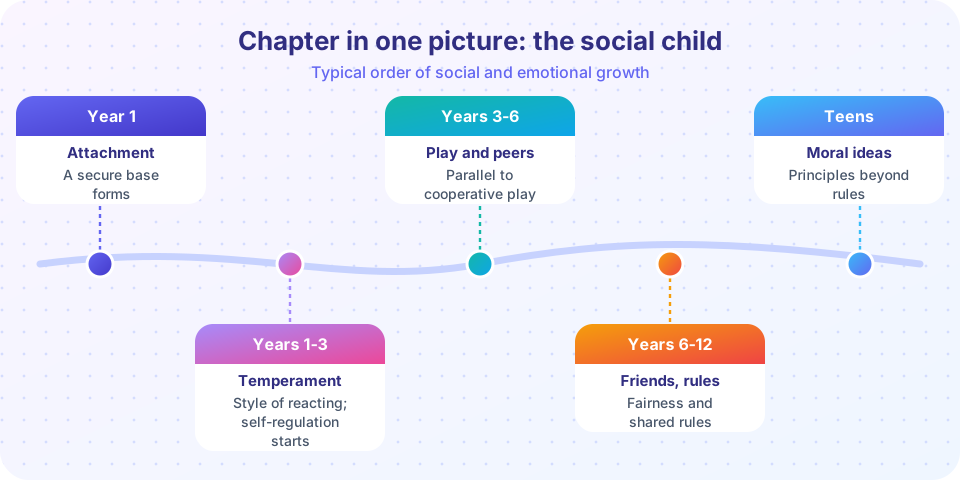
This chapter followed a child's social world from the first bond with a caregiver to moral arguments in the schoolyard. The review below gathers the main findings, the names to remember, and the cautions that keep claims honest. Use the table to check your memory, then try the practice tools and the quiz.
What you will learn
- A recap of the chapter's key studies and terms.
- How the strands connect: temperament, caregiving, peers and morality.
- Which claims need cautious wording.
Recap table
| Topic | Key names | Main idea | Caution |
|---|---|---|---|
| Emotional timeline | Lewis and Brooks-Gunn | Self-recognition near 18-24 months comes with self-conscious emotions | Ages are typical, not fixed |
| Social referencing | Sorce et al., 1985 | Babies use adults' faces to guide action | Lab setting |
| Still-face | Tronick, 1978 | Babies expect responsive partners and recover after repair | Short episode |
| Attachment | Bowlby, Ainsworth, Main | Secure base; secure, avoidant, resistant, disorganized | Describes a relationship, not a fixed trait |
| Contact comfort | Harlow, 1958 | Comfort matters as much as feeding | Ethical concerns |
| Sensitivity link | De Wolff and van IJzendoorn, 1997 | Correlation about .24 | Modest; temperament and culture matter |
| Temperament | Thomas and Chess; Rothbart; Kagan | Early differences; goodness of fit | Tendencies, not destiny |
| Self-control | Mischel; Moffitt (Dunedin) | Early self-control predicts later outcomes | Marshmallow link weaker than popular claims |
| Play | Parten | Solitary, parallel, associative, cooperative | A range, not a strict ladder |
| Parenting styles | Baumrind; Maccoby and Martin | Authoritative linked to good outcomes in Western samples | Correlational; cultural meaning varies |
| Morality | Piaget; Kohlberg; Gilligan; Turiel | Moral reasoning develops through stages | Reasoning is not behavior; culture matters |
How the strands connect
A secure base lets a child explore; exploration supplies the experiences that fuel play and friendship. A child's temperament affects how adults respond, and adults' responses shape how temperament develops. Emotion regulation is the bridge: the child who can calm down can listen, cooperate and think about other people's feelings, which is a basis for moral reasoning. These links are tendencies seen across many children, not guarantees for any one child.
Common misconceptions
- "Attachment type is a lifelong label." Patterns describe relationships and can change.
- "Temperament is destiny." It sets tendencies, and environments matter.
- "Parenting style alone determines outcomes." Children, genes and culture also contribute.
Try it
First, a self-quiz tracker. Mark each topic you feel confident about and see the topics that still need review.
Second, a Kohlberg classifier game. Given a reason, the code looks for key words and suggests a level. It is a crude keyword demo and real scoring is much more careful.
Press Run (or Ctrl + Enter) to see the console output here.
No output.
Check your understanding
Quick check · 10 questions
of 10 answered You scored / 10 · perfect!
-
1. A 20-month-old touches the red mark on her own nose after looking in a mirror. This suggests what?
The rouge test is a classic measure of self-recognition. -
2. What is social referencing?
Babies check a caregiver's face in uncertain situations, as in the visual cliff study. -
3. Which Strange Situation pattern shows strong distress and angry, hard-to-soothe behavior at reunion?
Resistant infants want contact but are angry and not easily comforted. -
4. Which describes goodness of fit?
No temperament is inherently good or bad; the match matters. -
5. What did Watts, Duncan and Quan (2018) report about the marshmallow test?
A larger, more diverse sample showed a weaker link that was reduced by family background and early ability. -
6. Why is it risky to say that authoritative parenting causes good outcomes?
Two-way influences, genes and culture complicate causal claims. -
7. Which Kohlberg stage involves wanting to be seen as a good person?
Stage 3 is about approval and good-person expectations, in the conventional level. -
8. What did Piaget's younger children focus on when judging a naughty act?
Heteronomous morality focuses on consequences. -
9. The still-face experiment shows what, in brief?
Babies become distressed when the partner freezes, and recover when normal interaction resumes. -
10. Which statement about parallel play is best supported?
Later research found that parallel and solitary play remain common and useful.
Summary
- Emotions and self-awareness develop together; babies read faces and need responsive partners.
- Attachment patterns describe a relationship; temperament sets tendencies; goodness of fit matters.
- Play, friendships and parenting form the social worlds of childhood; findings often depend on culture.
- Moral reasoning develops through stages, with critiques about care, culture and behavior.
Track your progress
Create a free account to tick off lessons and pick up where you left off on any device.
of Developmental Psychology lessons completed