


















Lesson 5 of 46 · Getting Started
Chapter 1 Review: Getting Started
Review chapter 1 of developmental psychology: development, domains, nature and nurture, lifespan periods and the big debates, with a recap table and a 9-question quiz.
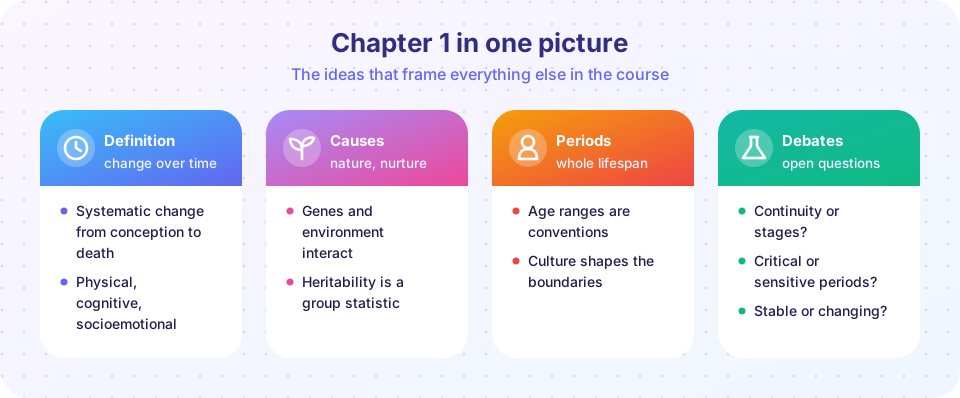
You now have the vocabulary of the whole field. This review gathers the chapter into one picture, one table and one quiz. Do the quiz without peeking, then reread the lessons for anything that surprised you.
What you will learn
- check that you can explain each key idea of chapter 1 in your own words
- connect the ideas: how domains, nature and nurture, periods and debates fit together
- practice retrieval with a mixed quiz
Recap table
| Lesson | Big idea | Remember |
|---|---|---|
| What Is Development? | Systematic change and continuity across the lifespan | Three domains; maturation plus learning; Baltes: multidirectional, plastic, contextual |
| Nature and Nurture | Genes and environment act together | Heritability is a population statistic; gene-environment correlation; replication problems in G×E |
| Lifespan Periods and the Big Questions | Periods are conventions; debates drive research | Continuity vs stages; critical vs sensitive periods; WEIRD samples |
Key terms
Development, domain, maturation, learning, plasticity. The basic vocabulary of the field.
Genotype, phenotype, heritability, reaction range. The language of nature and nurture.
Continuity, discontinuity, critical period, sensitive period. The language of the big debates.
How the ideas connect
A single example ties the chapter together. Take a toddler learning to speak. It is a cognitive change, with physical roots (brain maturation, mouth control) and socioemotional effects (making friends). Her genotype sets a range, and the environment (how many words she hears) moves her within it. The sensitive period for language makes early input especially valuable. Her path is typical in broad terms, but her timing is her own, and her culture shapes which words and social rules she learns. Every concept in the chapter touches this one example.
Common misconceptions
"Genes versus environment." The word "versus" is the problem; they interact at every step.
"Stages are exact." Ages are averages, and different skills shift at different times.
"Development ends at 18." The lifespan view says otherwise.
Try it
Press Run (or Ctrl + Enter) to see the result here.
Program input · what you'd type while the program runs
Type the answers before you press Run, one per line. Each time the program reads a line (with input()), it gets the next line from this box.
Check your understanding
Quick check · 9 questions
of 9 answered You scored / 9 · perfect!
-
1. Which pair of terms describes the DIRECT contrast between growth driven by biology and change driven by experience?
Maturation follows a biological program; learning comes from experience. -
2. Baltes argued that development involves gains and losses at every age. Which example fits?
A loss in one ability alongside a gain in another shows multidirectional change. -
3. A twin study finds r = 0.75 for identical twins and r = 0.45 for fraternal twins. By Falconer's formula, the heritability estimate is...
2 x (0.75 - 0.45) = 0.60, under the model's simple assumptions. -
4. Why can the heritability of height differ between two populations?
Heritability is a share of total variance, so it depends on how much the environment varies as well as on genes. -
5. A child who loves books fills her room with books and joins the library club. This is...
Active correlation (niche-picking): the child chooses environments that match her tendencies. -
6. Which is the best description of a sensitive period in humans?
Most human windows are soft: costs of missing them vary, and later intervention can still help. -
7. What was the main lesson of the failed replications of early gene-by-environment findings?
Large studies often failed to confirm early candidate-gene results, so researchers adopted genome-wide methods. -
8. Which sentence about stages is MOST accurate?
Ages in stage schemes describe typical ranges, and cultures and individuals vary. -
9. What does the 'WEIRD' critique warn about?
Henrich and colleagues showed that many results come from a narrow slice of human societies.
Summary
- Development is systematic change and continuity in three interlocking domains.
- Genes and environments act together: heritability is a group statistic that changes with the environment.
- Period boundaries are conventions, and critical periods in humans are mostly sensitive periods.
- Continuity vs stages, universality vs context, stability vs change are the standing debates.
- Evidence quality matters: replication and WEIRD samples are recurring themes.
Track your progress
Create a free account to tick off lessons and pick up where you left off on any device.
of Developmental Psychology lessons completed