


















Lesson 23 of 46 · Cognitive Development
Theory of Mind: Understanding Other Minds
Explore how children come to understand that others have beliefs, desires and knowledge: joint attention, pretend play, the Sally-Anne task, culture, language and open debates.
Watch a four-year-old play hide-and-seek, tell a white lie, or comfort a friend, and you are watching her use a theory of mind: the understanding that other people have minds of their own, with beliefs, desires, intentions and knowledge that may differ from hers and from reality. A younger child hiding "from" you may cover only her own eyes, as though what she cannot see you cannot see. This lesson follows the growth of mind reading from the first months to middle childhood, shows how it is tested, and asks how culture, language and brain shape it.
What you will learn
- define theory of mind and explain why false-belief tasks are the classic test
- trace precursors: joint attention, pretend play, desires and knowledge
- describe the age of passing the standard false-belief task and the evidence for variations across cultures
- explain the roles of language and social experience
- evaluate the debate about infants' implicit understanding
Key terms
Theory of mind: the ability to attribute mental states, such as beliefs, desires and intentions, to oneself and others.
False belief: a belief that does not match reality, held by someone who lacks information.
Joint attention: two people attending to the same thing, and knowing it.
Metarepresentation: representing a representation, as in "she thinks that the marble is in the basket".
The false-belief task
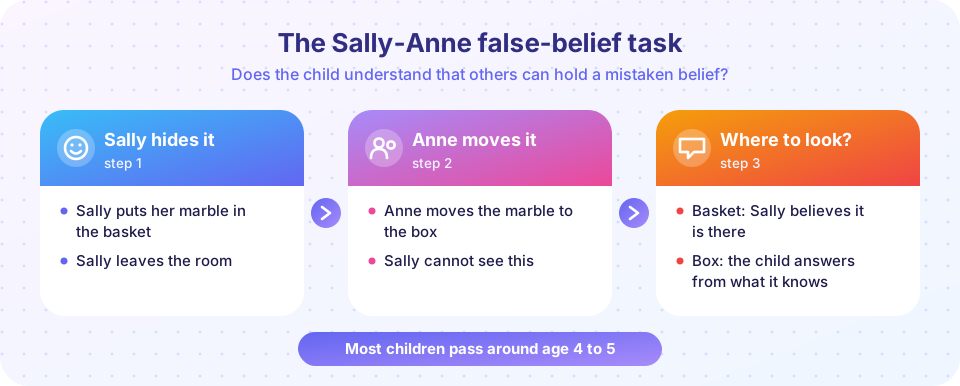
Heinz Wimmer and Josef Perner (1983) introduced the idea with Maxi and a bar of chocolate. Simon Baron-Cohen, Alan Leslie and Uta Frith (1985) turned it into the famous Sally-Anne task, in which a child watches a scene played with dolls:
- Sally puts her marble in a basket and leaves the room.
- While she is away, Anne moves the marble to a box.
- Sally returns. The child is asked: Where will Sally look for her marble?
To answer correctly ("in the basket") the child must hold two things in mind: where the marble really is, and what Sally believes about it. A child who simply reports reality ("in the box") shows no grasp of the fact that Sally's belief is false. Children are usually also asked control questions ("Where is the marble really?") to be sure they remember the events.
When does it appear?
A large meta-analysis of 178 studies by Henry Wellman, David Cross and Julanne Watson (2001) found that, in many countries, three-year-olds mostly fail standard false-belief tasks and five-year-olds mostly pass, with the transition around age four. Passing is not the end: understanding second-order beliefs ("Sally thinks that Anne thinks...") usually arrives around six to seven, and understanding sarcasm, faux pas and hidden emotions develops through middle childhood.
Precursors
Understanding minds does not appear suddenly at four. Developmental researchers have mapped earlier building blocks.
- Joint attention (9 to 12 months). Infants follow a caregiver's gaze and point to share interest. Michael Tomasello argues that this "shared intentionality" is the foundation of human culture.
- Pretend play (18 to 24 months). Alan Leslie proposed that pretending, treating a banana as a phone while knowing it is a banana, requires a first form of metarepresentation.
- Desires and intentions (2 to 3 years). Toddlers understand that people want different things (diverse desires): one child likes crackers, another likes broccoli.
- Knowledge access (about 3 to 4 years). Children understand that seeing leads to knowing: the person who looked in the box knows what is inside.
- Appearance versus reality. In a task by John Flavell and colleagues (1983), children handled a sponge painted to look like a rock. Many three-year-olds said that it really is a rock, while most four- and five-year-olds said it looks like a rock but is a sponge.
Wellman and David Liu (2004) found that many children master tasks in a fairly regular sequence: diverse desires, diverse beliefs, knowledge access, false belief and hidden emotion.
Culture, language and family
The overall sequence is found in many societies, but its details vary. In studies in China, children tended to understand knowledge access before diverse beliefs, the reverse of the usual order in the United States, a pattern some researchers link to the value placed on learning from others in the Chinese setting (Wellman and colleagues, 2006). Other work from Iran, India, Samoa and elsewhere shows differences in timing and in the ways cultures talk about minds.
Language matters. Deaf children born to hearing parents who do not sign tend to pass false-belief tasks later than hearing children, whereas deaf children of deaf, signing parents, who have a full language from birth, do not show the delay (Candida Peterson and Michael Siegal and later studies). Conversations that mention thoughts and feelings (mental-state talk) predict later performance. Children with siblings, particularly older ones, often pass earlier, though the effect is modest and depends on the family's culture.
Theory of mind and autism
In the 1985 study, Baron-Cohen, Leslie and Frith tested 20 autistic children, 14 with Down syndrome and 27 typically developing children. Most of the typical and Down syndrome groups passed, while about 80 percent of the autistic group failed, which led to the proposal that difficulties with theory of mind help explain some features of autism. Later research showed that many autistic people pass these tasks as they get older, and that difficulties with mutual understanding go in both directions, a view known as the "double empathy problem" (Damian Milton, 2012). Autism is diverse, and understanding is still developing.
What do infants understand?
Kristine Onishi and Renée Baillargeon (2005) reported that 15-month-old infants looked longer when an actor searched for a toy in a place that was inconsistent with her own false belief, as if they expected her to act on what she believed. This suggested an early, implicit sense of beliefs, long before children can pass verbal tasks. But several attempts to repeat the finding, including studies with eye tracking, produced inconsistent results, and researchers still debate whether infants track beliefs or use simpler cues. Large collaborative projects such as ManyBabies are testing the question across labs. For now, it is safest to say that something about other minds is present in infancy and that full, flexible understanding develops over years.
Why it matters
Theory-of-mind skills are related to social competence: children with better skills tend to be more skillful in negotiating, cooperating and understanding humor, and they can also deceive. Telling lies, which requires knowing that the listener does not know the truth, appears around age three to four. Research suggests the relationship works both ways, with social experience also building understanding.
Common misconceptions
"Younger children lack empathy." Toddlers respond to others' distress and help in simple ways. False-belief understanding is about representing beliefs, which is only one part of social understanding.
"All children pass at exactly age four." Ages vary by culture, language, task and individual.
"Failing a false-belief task means a child has a disorder." Most three-year-olds fail, and nothing is wrong.
Try it
Press Run (or Ctrl + Enter) to see the result here.
Program input · what you'd type while the program runs
Type the answers before you press Run, one per line. Each time the program reads a line (with input()), it gets the next line from this box.
Press Run (or Ctrl + Enter) to see the result here.
Program input · what you'd type while the program runs
Type the answers before you press Run, one per line. Each time the program reads a line (with input()), it gets the next line from this box.
Check your understanding
Quick check · 5 questions
of 5 answered You scored / 5 · perfect!
-
1. Why is the Sally-Anne task a test of theory of mind?
The child must represent Sally's false belief about the marble's location. -
2. Around what age do most children pass standard false-belief tasks?
Wellman, Cross and Watson (2001) found the main transition between about 3 and 5. -
3. What does joint attention in the first year help build?
Following gaze and pointing to share interest are early steps toward understanding other minds. -
4. Deaf children of hearing, non-signing parents often pass false-belief tasks later. What does this suggest?
Deaf children of signing parents show no delay, which points to the role of rich communication. -
5. What is the current status of the infant false-belief findings (Onishi and Baillargeon, 2005)?
Researchers disagree about whether infants track beliefs or use simpler cues.
Summary
- Theory of mind is understanding that others have beliefs, desires and knowledge that may differ from our own or from reality.
- False-belief tasks such as Sally-Anne mark a shift around age four; precursors include joint attention, pretend play and knowledge access.
- Culture, language and family shape timing; deaf children without early language access show delays.
- Whether infants understand beliefs is still debated, and understanding continues to grow through middle childhood.
Next: Chapter 4 Review
Track your progress
Create a free account to tick off lessons and pick up where you left off on any device.
of Developmental Psychology lessons completed