


















Lesson 29 of 46 · Social and Emotional Development
Chapter overview: social and emotional development
A guide to how children form bonds, show feelings, make friends and build a sense of right and wrong, with the main researchers and a map of the chapter.
Children are born into relationships. A baby who cannot lift her head can still lock eyes with a caregiver, smile back, and cry until someone comes. Over the next years she learns to read faces, manage big feelings, make friends, share, cooperate, and decide what is fair. Psychologists call this social and emotional development, and it matters as much for a good life as learning to read or count.
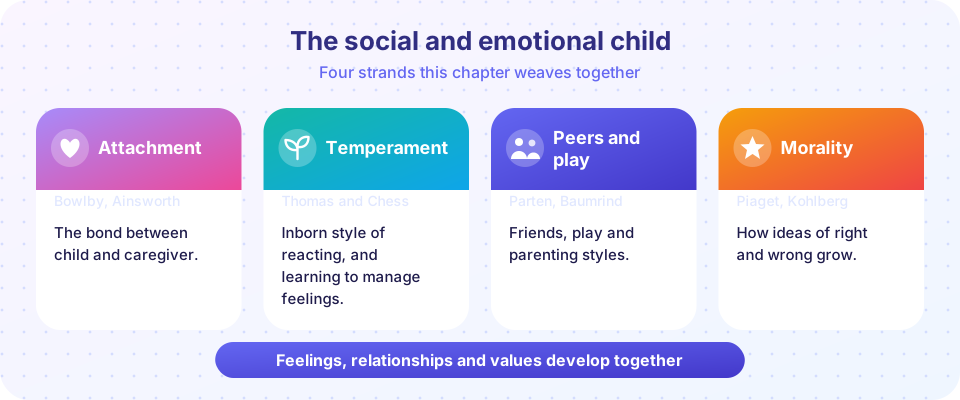
This chapter looks at four strands: attachment (the first close bond), emotion and temperament (how children feel and react), peers and parenting (the social worlds children live in), and morality (how ideas of right and wrong grow). The strands interact all the time. A child with a secure attachment may find it easier to explore, make friends and handle frustration, though no single early experience seals a child's fate.
What you will learn
- The main strands of social and emotional development and who studied them.
- When basic and self-conscious emotions appear.
- Bronfenbrenner's idea that a child grows inside nested social systems.
- What each lesson in this chapter covers.
Key terms
- Emotion regulation: the ability to manage the intensity and expression of feelings.
- Social referencing: checking a trusted adult's face to decide how to react to something uncertain.
- Self-conscious emotions: feelings such as pride, shame, guilt and embarrassment, which need a sense of self.
- Temperament: inborn differences in mood, activity and reactivity.
- Ecological systems theory: Urie Bronfenbrenner's model of a child nested in family, school, community and culture.
The emotional timeline
Newborns show distress and contentment. By about two to three months infants smile socially, and by six months most show clear joy, anger and fear. Between about 18 and 24 months a new set of feelings appears: embarrassment, pride, shame and guilt. They need a sense of "me" as a separate person who can be judged. Michael Lewis and Jeanne Brooks-Gunn tested this with the rouge test: a dab of red marked on an infant's nose, then a look in the mirror. Around 18 to 24 months many children begin to touch their own nose rather than the mirror, which suggests they recognize the reflection as themselves. The same age range is when self-conscious emotions start to show.
Emotion regulation grows slowly. A baby uses sucking or looking away. A toddler needs a caregiver to help calm down. A school-age child can talk herself through frustration. Many adults still use tools they learned in childhood.
Social referencing and the still-face
In a famous 1985 study, Mary Sorce and colleagues placed 12-month-olds at the edge of a visual cliff (a safe glass surface that looks like a drop). When the mother smiled, most babies crossed. When she looked fearful, almost none did. Babies read adults' faces and use them as a guide to the world.
Ed Tronick's still-face experiment (1978) shows the reverse: a mother who has been playing with her baby suddenly freezes her face. Within moments the baby tries to re-engage, then becomes distressed and turns away. The baby expects a responsive partner. When the mother resumes normal interaction, most babies recover quickly, which is an important reminder that ordinary breaks in a relationship can be repaired.
Nested worlds
Urie Bronfenbrenner argued that you cannot understand a child without understanding the layers around her:
- Microsystem: direct settings such as home, school and friends.
- Mesosystem: links between microsystems, such as how a parent and teacher communicate.
- Exosystem: settings the child does not enter but that affect her, such as a parent's workplace.
- Macrosystem: culture, laws and values.
- Chronosystem: time, including life events and historical change.
Four strands
The emotional timeline
Nested systems
A child grows inside many layers.
Common misconceptions
- "Babies are only reacting, not feeling." Babies show real, organized emotions, though their full range develops over years.
- "Early bonds decide everything." Early relationships matter, but development stays open to change, and later relationships and support matter too.
- "All cultures define good parenting the same way." Norms differ, which is why researchers test ideas across cultures.
What is in this chapter
- Attachment: Bowlby, Harlow, Ainsworth and what the Strange Situation shows.
- Emotion and temperament: Thomas and Chess, behavioral inhibition and how self-control grows.
- Peers, parenting and morality: friends, play, parenting styles and Kohlberg's stages.
- Chapter review: one picture and a mixed quiz.
Try it
The first demo shows when emotions typically appear. Click an age to see the emotion that is typical at that point. It is a teaching aid built from general findings.
The second demo sorts everyday examples into Bronfenbrenner's systems. Try changing the examples.
Press Run (or Ctrl + Enter) to see the console output here.
No output.
Check your understanding
Quick check · 4 questions
of 4 answered You scored / 4 · perfect!
-
1. At about what age do self-conscious emotions such as pride and shame typically appear?
They need a sense of self, which shows up in self-recognition around 18 to 24 months. -
2. What did the Sorce visual cliff study show about 12-month-olds?
Most babies crossed when mothers smiled and almost none when mothers looked fearful, which is social referencing. -
3. Which Bronfenbrenner system is a parent's workplace for a child?
The child does not enter the workplace, but it affects her indirectly. -
4. In the still-face experiment, how do most babies react when the mother resumes normal interaction?
Ordinary breaks in a relationship can be repaired, which is a key message of the research.
Summary
- Social and emotional development covers attachment, emotion and temperament, peers and parenting, and morality.
- Emotions unfold from simple distress and contentment to self-conscious emotions around 18 to 24 months.
- Babies read faces (social referencing) and expect responsive partners (still-face).
- Bronfenbrenner places the child inside nested systems from home to culture to time.
Track your progress
Create a free account to tick off lessons and pick up where you left off on any device.
of Developmental Psychology lessons completed