


















Lesson 11 of 46 · Methods and Theories of Development
Chapter 2 Review: Methods and Theories
Review research designs, infant methods, research ethics and the main developmental theories with a recap table, a one-picture summary and a ten-question quiz.
This review pulls chapter 2 together. You met three research designs, a toolkit for studying babies, the ethics that protect children, four families of theory and one very influential map of context. The aim now is to be able to explain each idea without looking, and to see how they connect: theories generate questions, designs and measures answer them, and ethics govern how you may ask.
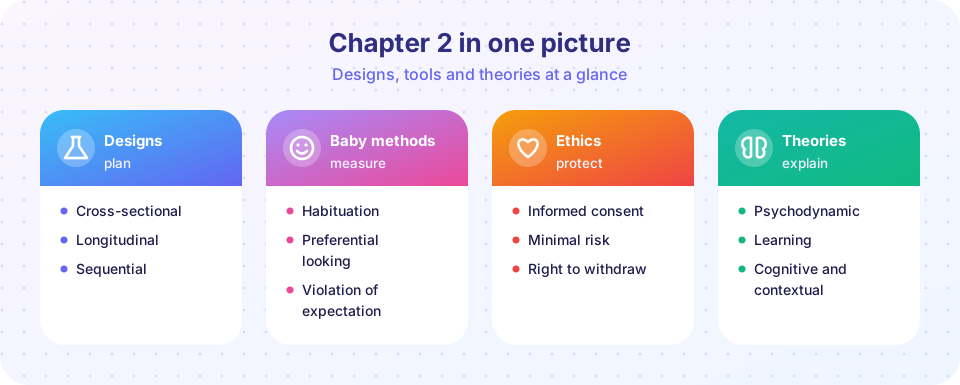
What you will learn
- consolidate the main designs, tools and theories of the chapter
- practice choosing a design for a question and spotting threats to validity
- test yourself with a ten-question mixed quiz
Recap table
| Lesson | Key ideas |
|---|---|
| Research Designs | Cross-sectional (fast; age confounded with cohort); longitudinal (real change; attrition); sequential (separates age, cohort, time). Famous studies: Terman, Dunedin, Seattle. |
| Studying Babies and Research Ethics | Habituation, preferential looking, violation of expectation; looking time is evidence, not mind reading; consent, assent, minimal risk, review. |
| Major Theoretical Perspectives | Psychodynamic (Freud, Erikson), learning (Pavlov, Skinner, Bandura), cognitive (Piaget, information processing), contextual (Vygotsky, Bronfenbrenner). |
| Ecological Systems | Micro, meso, exo, macro and chrono systems; bioecological PPCT; bidirectional influence. |
Key terms
Cohort effect, attrition, practice effect: the three classic threats to age comparisons.
Habituation, dishabituation, violation of expectation: core baby-research paradigms.
Informed consent, assent: how participants (or their parents) agree to take part.
Reinforcement, observational learning, psychosocial crisis, microsystem, exosystem: vocabulary from the major theories.
Decision guide: which design?
| If your question is... | A good starting design |
|---|---|
| How do ages differ right now? | Cross-sectional |
| How do individuals change or stay stable? | Longitudinal |
| Is the apparent aging effect really cohort? | Sequential |
| What causes an effect? | Experiment with random assignment |
| What exactly happens during a rapid change? | Microgenetic |
Common misconceptions
"The best theory is the one that is hardest to disprove." The opposite: good theories make risky predictions.
"Ethics slow science down." Ethical rules protect participants and also make findings more trustworthy and more likely to be accepted.
"Habituation proves a baby understands." It shows that the baby can tell two things apart.
Try it
Press Run (or Ctrl + Enter) to see the result here.
Program input · what you'd type while the program runs
Type the answers before you press Run, one per line. Each time the program reads a line (with input()), it gets the next line from this box.
Check your understanding
Quick check · 10 questions
of 10 answered You scored / 10 · perfect!
-
1. A researcher wants to know whether children who are shy at age 3 remain shy at 15. Which design is the most direct?
Only following the same children over time shows individual stability and change. -
2. What is the main weakness of a cross-sectional design when studying aging?
Different age groups are also different generations, so differences may be due to cohort rather than aging. -
3. Infants look less and less at a repeated picture and then look more at a new one. This pattern is called...
Falling responses to repetition and recovery to novelty is the habituation-dishabituation pattern. -
4. Why is parental consent alone not enough in child research?
The child's assent and right to stop, and minimal risk, are separate protections. -
5. In Erikson's theory, the crisis of adolescence is...
Adolescence centers on forming an identity. -
6. Which situation illustrates observational learning?
Learning by watching a model is Bandura's observational learning. -
7. A parent's company closes, and the family has to cut expenses and move. For the child, the company is part of the...
The child does not participate in the workplace, but events there affect the child. -
8. Which statement about looking-time research is most defensible?
Looking time can reflect surprise, interest or perceptual differences, so interpretation needs care. -
9. What did the Seattle Longitudinal Study (Schaie) help to show?
Sequential designs separate cohort from age, and cross-sectional comparisons overstate earlier decline. -
10. Which is a core limit of ecological systems theory?
It is more a framework than a set of precise, falsifiable predictions.
Summary
- Match the design to the question and know its threats: cohort effects, attrition, practice effects, confounds.
- Baby research relies on looking, sucking, heart rate and brain responses; interpretation needs care.
- Ethical research protects children through minimal risk, consent and assent, and review.
- Four theory families give different answers; contextual models like Bronfenbrenner's ask what else surrounds the child.
Track your progress
Create a free account to tick off lessons and pick up where you left off on any device.
of Developmental Psychology lessons completed