


















Lesson 13 of 46 · Prenatal Development and Infancy
Prenatal Stages: Germinal, Embryonic and Fetal
Follow prenatal development from conception to birth: the germinal, embryonic and fetal stages, genetics basics, what fetuses sense, and a due-date calculator.
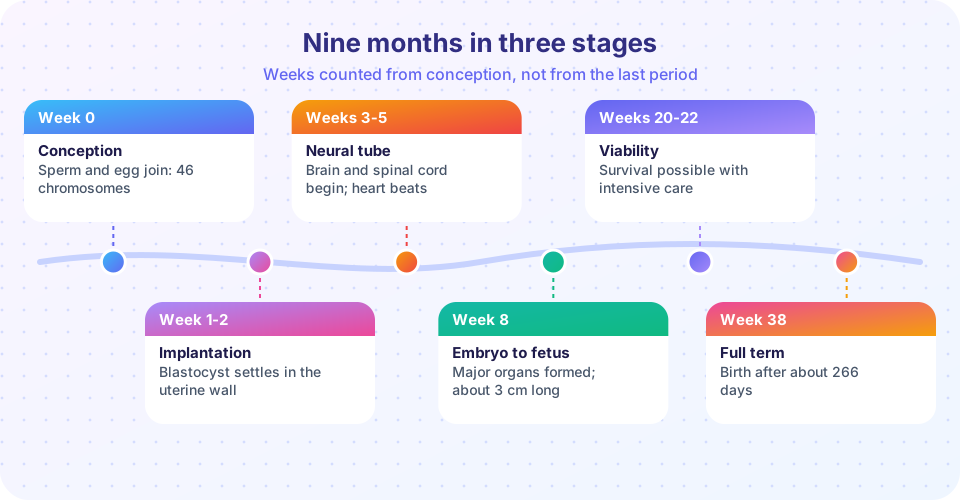
About 266 days separate conception from a typical birth. In that time a single cell divides into trillions, organs take shape in a strict order, and a fetus begins to move, hear and respond to the world. The order is so reliable that doctors can date a pregnancy from the size of the fetus. This lesson walks through the three stages, one at a time, and explains the genetic starting point.
Educational information only. This is a general description of typical prenatal development, not medical advice. Individual pregnancies vary, and anyone who is pregnant should rely on their own health professional.
What you will learn
- explain how conception and genetics set the starting point
- describe the germinal, embryonic and fetal stages and their milestones
- convert between gestational age and conception age
- summarize what fetuses can sense and learn, and the limits of that evidence
Key terms
Zygote: the single cell formed when a sperm fertilizes an egg.
Blastocyst: a ball of cells, about five days after fertilization, that implants in the uterus.
Embryo: the developing organism from about week 3 to week 8 after conception. Fetus: from week 9 until birth.
Placenta: the organ that passes oxygen and nutrients to the fetus and carries waste away.
Viability: the point at which a fetus can survive outside the womb with medical help.
The starting point: conception and genes
Each parent contributes 23 chromosomes (in a sperm and an egg), so a zygote has 46, arranged as 23 pairs. Twenty-two pairs are autosomes; the last pair determines sex: XX typically leads to a female and XY to a male, and the father's sperm carries either an X or a Y.
Twins form in two ways. Fraternal (dizygotic) twins come from two eggs fertilized by two sperm and share about half their varying DNA, as ordinary siblings do. Identical (monozygotic) twins come from one zygote that splits in two, so they share nearly all their DNA; this happens in roughly three to four of every thousand births.
Some conditions come from the chromosome count or from single genes. Down syndrome usually results from an extra copy of chromosome 21 (trisomy 21); its likelihood rises with maternal age, but because younger women have more births, most children with Down syndrome are born to women under 35. PKU and cystic fibrosis are recessive single-gene conditions that appear when a child inherits one altered copy from each parent.
Stage 1: the germinal stage (weeks 0 to 2)
Within about 30 hours of fertilization the zygote begins to divide as it travels down the fallopian tube. By about day 5 it is a blastocyst, a hollow ball with an inner mass of cells that will become the embryo and an outer layer that will form the placenta and membranes. Between about days 6 and 10 the blastocyst implants in the uterine wall. This stage is risky: a substantial fraction of fertilized eggs never implant or are lost early, often without the woman knowing.
Stage 2: the embryonic stage (weeks 3 to 8)
Once implanted, the embryo forms three layers that become different body systems: the ectoderm (nervous system, skin), mesoderm (muscles, bones, heart and blood vessels) and endoderm (digestive and respiratory systems). Structures appear in a fixed order:
- The neural tube, the precursor of the brain and spinal cord, forms and closes in weeks 3 to 4.
- The heart starts beating at about week 3 (after conception) and the circulatory system takes shape.
- Arm and leg buds, eyes, ears and the face begin to form.
- The placenta, umbilical cord and amniotic sac develop, protecting and nourishing the embryo.
By the end of week 8 the embryo is roughly 3 centimeters long, yet the basic plan of nearly every major organ is present. Because so much is forming at once, this is the period when the embryo is most vulnerable to harmful exposures, which you will study next.
Stage 3: the fetal stage (week 9 to birth)
Now organs mature and the body grows. The external genitals become distinguishable around week 12 (after conception). By the middle of the pregnancy the mother usually feels movements ("quickening"); fetuses move from early on, and these movements help muscles and joints develop. The brain surface starts to fold, and the lungs mature later, which is a main reason why very early preterm babies need breathing support. A fat layer forms, a waxy coating called vernix protects the skin, and fine hair called lanugo appears.
A baby born at full term arrives between 37 and 42 weeks after the last menstrual period (that is, about 35 to 40 weeks after conception). Preterm birth means birth before 37 weeks. With intensive care, some infants born as early as 22 to 24 weeks of gestation survive, though survival and long-term outcomes improve with every extra week; the figures vary by hospital and country.
Gestational age versus conception age
Because the exact moment of conception is usually unknown, doctors count from the first day of the last menstrual period (LMP). This gestational age is about two weeks greater than the true time since conception. A typical pregnancy lasts about 40 weeks of gestational age. Many popular timelines use gestational weeks, while embryology textbooks often use weeks after conception, so always check which one a source uses.
What can fetuses sense and learn?
- Hearing. The fetal ear works from the second half of pregnancy, and the sounds that reach it include the mother's voice, heartbeat and muffled outside noise.
- Learning. Anthony DeCasper and William Fifer (1980) tested newborns and found that they sucked in a pattern that produced their own mother's voice rather than a stranger's. DeCasper and Melanie Spence (1986) had pregnant women read a short story aloud daily, and their newborns preferred the familiar story over a new one. The samples were small, but later work, including measures of fetal heart rate in response to the mother's voice, is consistent with prenatal auditory learning.
- Taste and smell. Flavors from the mother's diet pass into the amniotic fluid, and some studies suggest infants show greater acceptance of those flavors later.
These findings show that the fetus responds to experience. They do not show that classical music or special prenatal programs boost intelligence; claims of that sort are not supported by good evidence.
Prenatal testing in brief
Doctors use ultrasound to check growth, blood tests and ultrasound measurements to screen for chromosomal conditions, and, when indicated, chorionic villus sampling or amniocentesis to analyze fetal cells. Screening tests give probabilities, while diagnostic tests give answers, and families often face difficult decisions that are best discussed with a genetic counselor.
Common misconceptions
"Pregnancy lasts nine months of exactly 40 weeks from conception." Pregnancy is conventionally 40 weeks from the last period, about 38 from conception, and normal birth spans several weeks around that.
"Fetuses hear nothing until birth." They hear muffled sounds in the second half of pregnancy.
"The sex chromosomes come from the mother." The egg always carries an X, and the sperm determines whether the child is XX or XY.
Try it
Press Run (or Ctrl + Enter) to see the result here.
Program input · what you'd type while the program runs
Type the answers before you press Run, one per line. Each time the program reads a line (with input()), it gets the next line from this box.
Press Run (or Ctrl + Enter) to see the result here.
Program input · what you'd type while the program runs
Type the answers before you press Run, one per line. Each time the program reads a line (with input()), it gets the next line from this box.
Check your understanding
Quick check · 5 questions
of 5 answered You scored / 5 · perfect!
-
1. During which stage do the major organs begin to form, making the embryo especially vulnerable?
Weeks 3 to 8 after conception, when the basic plan of the organs is laid down. -
2. Gestational age is counted from the last menstrual period. Compared with time since conception it is...
Ovulation and conception occur about two weeks after the start of the last period. -
3. What did DeCasper and Spence (1986) find?
The study suggests prenatal auditory learning but does not support claims that prenatal music boosts intelligence. -
4. Which determines the sex of the child at conception?
All eggs carry an X chromosome; a sperm carries X (giving XX) or Y (giving XY). -
5. How do identical twins form?
Identical (monozygotic) twins come from the splitting of one zygote and share nearly all their DNA.
Summary
- Conception brings 46 chromosomes together; the sperm determines whether the child is XX or XY.
- Germinal stage (weeks 0-2): division, blastocyst, implantation. Embryonic (3-8): organs and the neural tube form. Fetal (9-birth): growth and maturation.
- Gestational age counts from the last period and exceeds conception age by about two weeks.
- Fetuses hear and learn simple patterns, but extravagant claims about prenatal enrichment lack evidence.
Next: Teratogens and Risks
Track your progress
Create a free account to tick off lessons and pick up where you left off on any device.
of Developmental Psychology lessons completed