


















Lesson 24 of 46 · Cognitive Development
Chapter 4 Review: Cognitive Development
Review chapter 4 of developmental psychology: Piaget's stages and critiques, Vygotsky's ZPD, memory and executive function, and theory of mind, with a recap table and a 10-question quiz.
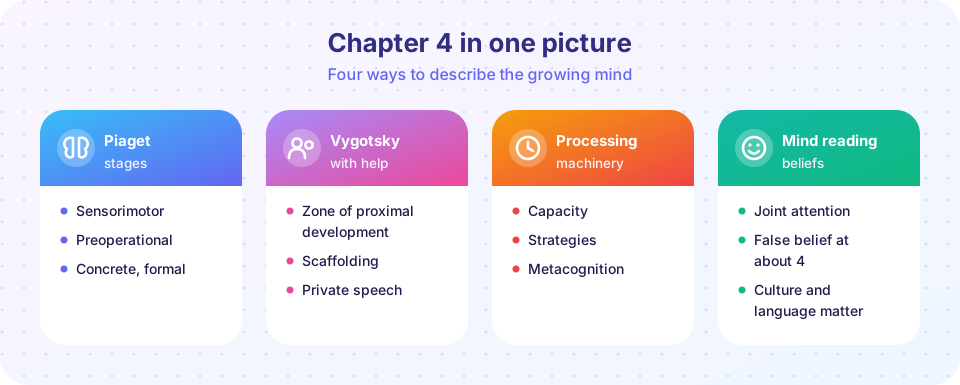
This chapter gave you four lenses on the thinking child. Piaget showed that children are active builders whose reasoning changes in kind. Later research showed that he underestimated infants and preschoolers and overstated the neatness of stages. Vygotsky showed that thinking is a social achievement built with cultural tools. The information-processing view revealed the machinery of capacity, speed and strategies, and theory-of-mind research opened the question of how children come to understand other minds. Use this review to join the lenses into one picture.
What you will learn
- consolidate the main ideas and evidence of all four lenses
- practice comparing the theories and spotting what each explains best
- test yourself with a ten-question mixed quiz
Recap table
| Lens | Core claim | Key evidence | Main limit |
|---|---|---|---|
| Piaget | Four stages: sensorimotor, preoperational, concrete, formal | A-not-B, three mountains, conservation, pendulum | Underestimated infants and preschoolers; stages overlap |
| Evaluating Piaget | Active construction held up; details revised | Policeman doll, naughty teddy, violation of expectation, décalage | Core knowledge and looking-time interpretation debated |
| Vygotsky | Thinking starts between people; ZPD; scaffolding; private speech | Scaffolding studies, private speech research | Less precise; mixed classroom evidence |
| Memory and attention | Capacity, speed, strategies and metacognition grow | Rehearsal studies, DCCS, day-night Stroop | Marshmallow replication shows overinterpretation |
| Theory of mind | Understanding false belief arrives around age 4, built on precursors | Sally-Anne, meta-analysis, cross-cultural work | Infant findings debated |
Key terms
Schema, assimilation, accommodation, equilibration, conservation, object permanence: Piaget's vocabulary.
ZPD, scaffolding, private speech, cultural tools: Vygotsky's vocabulary.
Working memory, strategy, metacognition, executive function: the information-processing vocabulary.
Theory of mind, false belief, joint attention: the language of social understanding.
Which lens for which question?
| If you want to know... | Start with |
|---|---|
| How a child's reasoning differs from an adult's | Piaget |
| How a teacher can best help a struggling child | Vygotsky (ZPD, scaffolding) |
| Why a child's recall improves from 5 to 10 | Information processing |
| Why a four-year-old can lie but a two-year-old cannot | Theory of mind |
Common misconceptions
"Piaget was wrong." Parts were revised; the active-child idea remains central.
"Vygotsky and Piaget are opposites." They stress different engines (action versus interaction), and modern accounts combine them.
"Children's failures show that they lack the concept." Task wording, memory and executive function can all produce failures.
Try it
Press Run (or Ctrl + Enter) to see the result here.
Program input · what you'd type while the program runs
Type the answers before you press Run, one per line. Each time the program reads a line (with input()), it gets the next line from this box.
Check your understanding
Quick check · 10 questions
of 10 answered You scored / 10 · perfect!
-
1. A baby watches a toy being hidden at location B but searches at location A, where it was found before. Which concept did Piaget use to explain this?
Piaget interpreted the A-not-B error as incomplete object permanence, though later work points to other contributing factors. -
2. Which finding most directly challenges Piaget's view of the preoperational child?
Meaningful task contexts reveal competence that the standard tasks hid. -
3. Which statement about the zone of proximal development is correct?
The ZPD depends on the task, the helper and the context. -
4. What best describes scaffolding?
Contingent support, withdrawn as skill grows. -
5. Which would count as a memory strategy?
Rehearsal is a deliberate technique used to remember. -
6. A five-year-old rarely rehearses a list; a ten-year-old usually does. Which pattern do we expect in their recall?
Rehearsal improves memory for earlier items, so a primacy effect appears with age. -
7. What did the 2018 marshmallow test replication show?
Family background and early ability explained much of the original association. -
8. In the Sally-Anne task, a child who answers 'in the box' shows...
Answering from reality suggests the child has not yet represented Sally's belief, though task demands also matter. -
9. Which is a reliable conclusion about theory-of-mind development?
Meta-analyses find a broad transition window and many influences. -
10. A teacher helps a student solve a hard problem, then gradually lets him do more himself. This is consistent with whose theory?
Guided help within the ZPD, withdrawn as skill grows, is Vygotskian scaffolding.
Summary
- Piaget's active-child picture endures; his stages are broad, overlapping and task-dependent.
- Vygotsky adds that thinking is built with others and cultural tools; scaffolding and the ZPD guide teaching.
- Information-processing research tracks capacity, speed, strategies, metacognition and executive function.
- Theory of mind emerges around age four from earlier precursors, with variation across cultures and language settings.
- Good reasoning about development combines lenses and asks about the evidence.
Track your progress
Create a free account to tick off lessons and pick up where you left off on any device.
of Developmental Psychology lessons completed