


















Lesson 34 of 46 · Adolescence and Adulthood
Chapter overview: adolescence and adulthood
A guide to puberty, the teenage years and early adult life: what changes in body, brain and relationships, plus the myths about teens that research has tested.
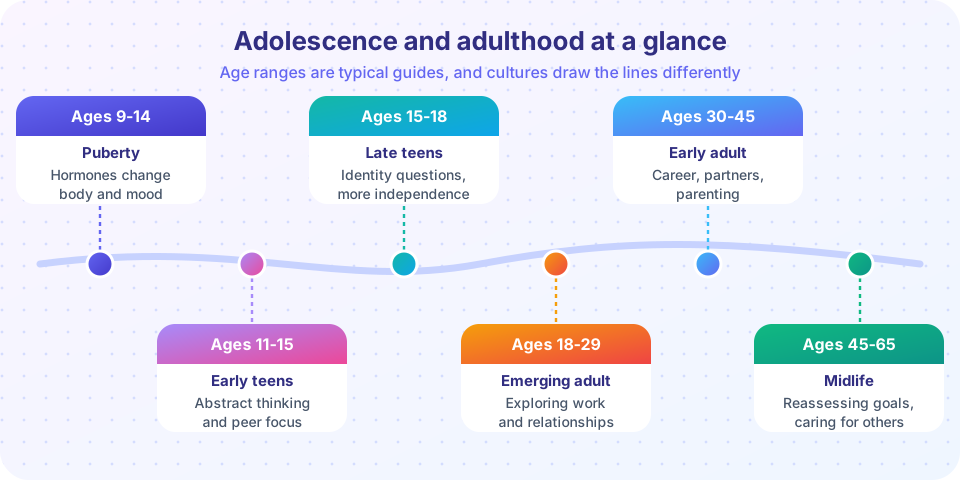
For most of history, the move from child to adult was marked by a single ceremony or a quick change of work and family status. In modern societies the road is longer and less defined: a changing body, new ways of thinking, growing independence, identity questions, education, work and partnerships that continue into the late twenties and beyond. Developmental psychologists now study this long stretch as a series of overlapping phases.
This chapter covers three big topics. First, adolescence: the biological changes of puberty, the maturing brain and the search for identity. Second, adulthood: the new demands of work, love and parenthood and how adults keep growing. Third, the chapter review. Before starting, it helps to meet the main ideas and clear away some myths.
What you will learn
- What happens in puberty and why timing varies.
- How thinking changes in adolescence (Piaget, Elkind).
- Whether adolescence really is "storm and stress".
- What each lesson of this chapter covers.
Key terms
- Puberty: the biological process that leads to sexual maturity and adult body size.
- Adolescence: the social and psychological period between childhood and adulthood.
- Secular trend: a long-term shift across generations, such as earlier puberty.
- Imaginary audience: the teen's belief that everyone is watching and judging them.
- Emerging adulthood: a proposed phase between about 18 and 29 in societies with long education and delayed commitments.
Puberty: a body in transition
Puberty begins when the brain signals the glands to release more of certain hormones. In girls the first visible sign, breast development, typically begins somewhere between about 8 and 13; in boys, enlargement of the testes typically begins between about 9 and 14. Growth in height peaks, on average, at about age 12 in girls and age 14 in boys. Menarche, the first menstrual period, typically occurs at around 12 to 13 in many countries.
These are ranges, and healthy children can fall outside them. In many countries, average ages of puberty onset, especially for girls, have moved earlier over the past century. Better nutrition and health are leading explanations, and body fat and other factors may also play a role. The full picture is still being studied.
Timing matters socially. Research suggests that girls who mature much earlier than their classmates are at higher risk for body-image worries, early relationships and mood problems. For boys, early maturing is often linked to social advantages such as athletic success but also to more risk-taking. Reactions from peers and parents, not just the hormones, shape these effects.
Hormones are not the whole story of teen moods. They contribute, but changes in sleep patterns also matter. Adolescents' body clocks tend to shift later, which is why many teens are sleepy in early-morning classes.
Thinking in new ways
Jean Piaget proposed that around age 11 or 12, many young people reach formal operational thinking: they can reason about abstract ideas, hypotheses and possibilities, not only about concrete things in front of them. This opens the door to algebra, scientific reasoning, political ideals and philosophical questions. Later research shows that not everyone uses this kind of thinking in every situation, and that it depends on education and practice.
David Elkind described two features of teen thinking. The imaginary audience is the feeling that others are always watching and evaluating you, which helps explain intense self-consciousness. The personal fable is the belief that your experience is unique and that bad things happen to other people. Later work suggests these are partly linked to the strong focus on peers during this time and are not unique to teenagers, but they provide useful names for common feelings.
Storm and stress?
In 1904 psychologist G. Stanley Hall described adolescence as a time of "storm and stress". The phrase stuck. Modern evidence, summarized by Jeffrey Arnett (1999) and others, suggests a more nuanced view. Compared with other ages, adolescents on average do have more conflict with parents, bigger mood swings and more risk-taking. But most teens get through adolescence without serious problems, and most still feel close to their parents. Cultures differ a great deal: in societies where adolescents have defined responsibilities, the stormy picture is less common.
Puberty
Thinking
Identity
Adult roles
Not every path looks the same.
Common misconceptions
- "Teen rebellion is inevitable." Conflict rises, but most teens and parents get along well.
- "Teen brains are just broken." They are changing in ways that serve learning and social life, which you will study in the next lesson.
- "Everyone reaches puberty at the same age." Timing varies widely among healthy children.
What is in this chapter
- Brain, risk and identity: the maturing brain, the dual-systems idea, Erikson and Marcia, and peers and risk-taking.
- Emerging adulthood, work and family: Arnett's proposal, Erikson's adult stages, relationships and parenthood.
- Chapter review: one picture and a mixed quiz.
Try it
The first demo shows the typical ranges for the start of puberty and peak growth. The bars are approximate guides and not a measure of any individual.
The second demo is a myth-or-evidence checker. Each statement has a verdict based on the research summarized above.
Press Run (or Ctrl + Enter) to see the console output here.
No output.
Check your understanding
Quick check · 4 questions
of 4 answered You scored / 4 · perfect!
-
1. Which is a typical age range for the start of puberty in boys?
Testicular enlargement typically begins between about 9 and 14, though healthy boys can fall outside this range. -
2. What is the imaginary audience?
Elkind used the term for a teen's intense self-consciousness. -
3. How do modern researchers view the idea that adolescence is always storm and stress?
Evidence shows an average rise in conflict and mood swings but wide variation. -
4. What is a secular trend in puberty?
In many countries average puberty onset, especially for girls, has moved earlier over the past century.
Summary
- Puberty timing varies widely, and in many countries onset has shifted earlier over generations.
- Adolescent thinking can become more abstract (formal operations), with new self-consciousness such as the imaginary audience.
- "Storm and stress" is overstated: most teens are fine, but average conflict and risk-taking rise.
- The chapter continues with brain and identity, then adult roles.
Next: Brain, risk and identity
Track your progress
Create a free account to tick off lessons and pick up where you left off on any device.
of Developmental Psychology lessons completed