


















Lesson 46 of 46 · Projects and Practice
Further study: where to go next after developmental psychology
Plan your next steps in psychology: connected tracks on this site for the mind, brain, language, research methods and statistics, plus how to read research and use what you learned.
You now have a map of human development from before birth to old age, a toolkit for judging evidence and a sense of how many questions are still open. The next step depends on what interested you most. This lesson suggests connected topics on this site, ways to deepen your skills and ideas for using what you learned in real life.
What you will learn
- Which tracks on this site connect most closely to developmental psychology.
- How to choose a next step based on your interests.
- Habits that keep you learning: reading research, practicing methods and applying ideas.
Key terms
- Primary source: the original research article describing a study.
- Review article or meta-analysis: a summary that pools many studies.
- Open access: research that anyone can read for free.
- Replication: repeating a study to see whether the finding holds.
Three paths
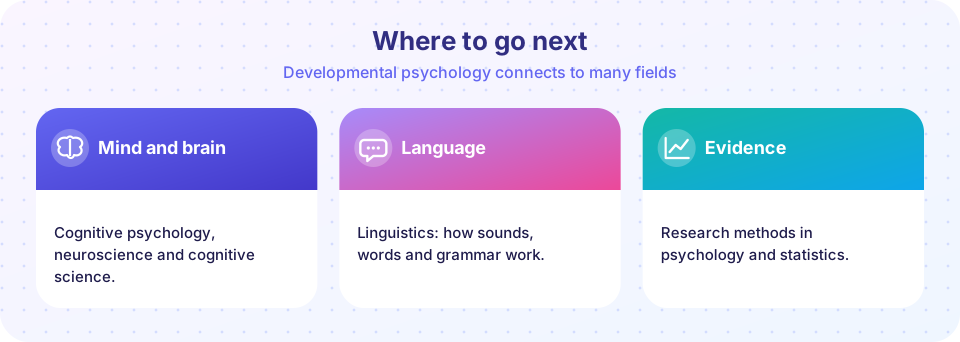
Path 1: the mind and brain. If the chapters on infants, language and aging made you curious about how thinking works, study Cognitive Psychology for memory, attention, reasoning and decision-making, Neuroscience for how the brain produces behavior, and Cognitive Science for how psychology, computing, linguistics and philosophy meet. Many developmental questions, such as how memory changes with age, are answered with the tools of these fields.
Path 2: language. If the language chapter was your favorite, Linguistics covers the structure of sounds, words and sentences in the world's languages, and how languages change. It gives you more precise tools to describe what children do when they learn to speak.
Path 3: evidence. If the study-design lessons excited you, build your methods skills with Research Methods in Psychology and Statistics and Probability. Understanding samples, effect sizes and uncertainty will help you read every future headline critically.
Other related areas include Clinical Psychology (understanding and treating psychological difficulties, with professional training), Introduction to Psychology for the broader field, Sociology for how societies and institutions shape lives, and Anthropology for how cultures raise children differently.
Habits that keep you learning
- Read a primary source. Pick one study from this course, such as the Strange Situation or the Gardner and Steinberg driving study, and read the original paper. Compare it with a summary: what was left out?
- Prefer reviews for big questions. For a topic such as bilingualism or social media and wellbeing, a systematic review or meta-analysis gives a broader picture than any single study.
- Practice the five questions. For every claim: question, design, findings, limits, ethics.
- Watch for updates. Developmental psychology changes quickly: findings are revised, replicated or overturned. Date your knowledge.
- Apply ideas carefully. What you learned can help you listen to children, support friends and plan your own learning. It is not a toolkit for diagnosing anyone.
Using what you learned
- As a parent, carer or teacher: treat milestones as ranges, not deadlines; respond warmly to children's signals; remember that temperament and context vary.
- As a young person: remember that identity exploration and uneven maturity are normal, and that help is available if you are struggling.
- As an older adult or caring for one: emphasize meaningful goals, social connection and activity, and use strategies such as SOC when abilities change.
- As a reader of news: be curious and skeptical when you see a headline about "the first three years" or "the teenage brain".
If a child's development worries you, ask a pediatrician or another qualified professional. This course is educational and does not replace expert assessment.
Common misconceptions
- "Finishing a course makes me an expert." It makes you a better reader of research; expertise takes years of practice.
- "The newest study is the best study." Newer is not always better; consistency across studies matters.
- "Psychology only applies to people with problems." Most developmental psychology describes typical growth and ordinary challenges.
Try it
First, a path chooser. Tick the topics that interest you and see which track to try next.
Second, a personal study planner. Edit the weekly plan in code and see the total hours and a simple schedule.
Press Run (or Ctrl + Enter) to see the console output here.
No output.
Check your understanding
Quick check · 3 questions
of 3 answered You scored / 3 · perfect!
-
1. Which source is best for getting a broad picture of a big, contested question?
Reviews pool many studies and give a broader view. -
2. Which track would best deepen your understanding of samples, effect sizes and uncertainty?
Statistics gives tools for judging evidence. -
3. What does it mean to read a primary source?
Primary sources show what researchers actually did and found.
Summary
- Connected paths: mind and brain (cognitive psychology, neuroscience, cognitive science), language (linguistics) and evidence (research methods, statistics).
- Keep learning by reading primary sources and reviews, practicing the five questions, and watching for updates.
- Apply what you learned with care, and seek professional help for real concerns.
Next: back to the Developmental Psychology course map
Track your progress
Create a free account to tick off lessons and pick up where you left off on any device.
of Developmental Psychology lessons completed