


















Lesson 12 of 46 · Prenatal Development and Infancy
Prenatal Development and Infancy: Overview
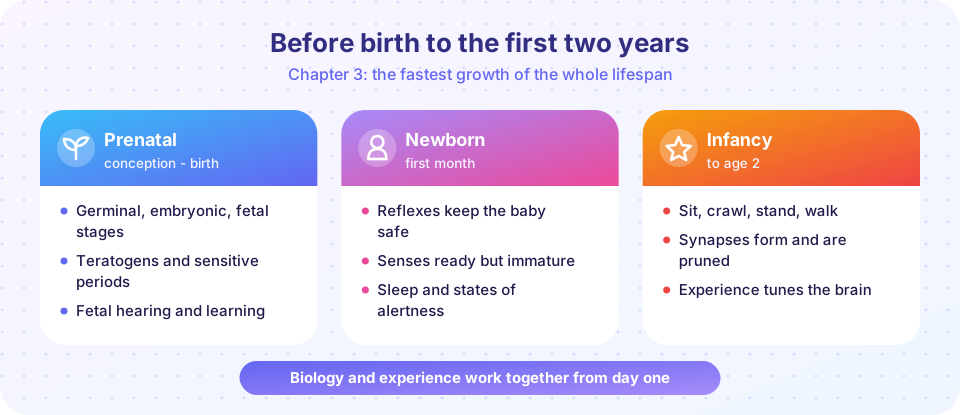
Chapter 3 overview: how a single cell becomes a newborn and then a walking, talking toddler in about three years, and why this is the fastest growth period of life.
No other stretch of life changes you as much as the first three years, counting from conception. A single cell, smaller than a grain of sand, becomes a baby with billions of neurons. A newborn who cannot lift her head becomes, within about a year, a person who walks, grasps, laughs at a game of peekaboo and knows her own name. This chapter follows that journey, asking what happens when, what can go wrong, what newborns can do and how experience and biology build the infant brain together.
Educational information only. This chapter describes research on pregnancy, birth and infancy. It is not medical advice. Anyone who is pregnant, or caring for an infant, should talk to a doctor or midwife about their own situation.
What you will learn
- see how the lessons of this chapter fit together
- preview the three stages of prenatal development
- preview what newborns can do and what shapes the infant brain
- understand why biology and experience cannot be separated even before birth
Key terms
Prenatal: before birth. Neonate: a newborn in the first month.
Gestational age: time since the last menstrual period (clinical convention). Conception age: time since conception, about two weeks less.
Sensitive period: a window of special responsiveness to certain experiences.
The big picture
Development before birth is largely a biological program, but not entirely. The womb is an environment: the mother's nutrition, health, stress hormones and exposure to substances all reach the fetus. After birth, experience gradually takes a larger role, yet the program continues. For example, newborns reflexively search for the nipple (rooting), but whether and how they will eat, sleep and bond depends on the caregiving they receive.
Before birth
What can go wrong
The newborn
The first two years
What each lesson covers
- Prenatal Stages: the germinal, embryonic and fetal stages, week by week, with a due-date calculator and what unborn babies can sense and learn.
- Teratogens and Risks: how harmful exposures work, the principles of dose, timing and genetics, and landmark cases such as thalidomide.
- The Newborn: Senses and Reflexes: reflexes, the Apgar score, what newborns see and hear, and the replication debates around neonatal imitation.
- Motor Skills and the Infant Brain: milestones, dynamic systems, cultural variation, synaptic pruning and the myth of the first three years.
- Chapter 3 Review: the chapter in one picture and a ten-question quiz.
Why this chapter matters
Early development matters because it lays foundations, but it is not destiny. A strong thread running through the research is resilience: many children who experience early adversity do well when conditions improve. Another is sensitivity to context: the same exposure can matter a great deal at one moment and little at another.
Common misconceptions
"Babies are born as blank slates." Newborns arrive with preferences, reflexes, abilities and temperament.
"By the time of birth, the brain is finished." The brain at birth has most of its neurons, but connections multiply and are pruned for years, and development continues into the twenties.
"Anything that happens before birth is fixed." The prenatal environment influences development, yet postnatal experience can change the course.
Try it
Press Run (or Ctrl + Enter) to see the result here.
Program input · what you'd type while the program runs
Type the answers before you press Run, one per line. Each time the program reads a line (with input()), it gets the next line from this box.
Check your understanding
Quick check · 3 questions
of 3 answered You scored / 3 · perfect!
-
1. What is the difference between conception age and gestational age?
Clinicians count from the last period, so gestational age is about two weeks more than the time since conception. -
2. Which statement best fits the chapter's view of the prenatal environment?
Nutrition, health, stress and exposures reach the fetus and influence development. -
3. A common misconception is that the infant brain is finished at birth. What is true?
Most neurons are made before birth. Synapse formation, pruning and myelination continue through childhood and adolescence.
Summary
- Chapter 3 covers three linked phases: prenatal development, the newborn and infancy.
- The prenatal environment affects development; postnatal experience continues to shape it.
- Early development lays foundations but is not destiny; resilience and context matter.
- Nutrition, health and care, not magic windows alone, drive outcomes.
Next: Prenatal Stages
Track your progress
Create a free account to tick off lessons and pick up where you left off on any device.
of Developmental Psychology lessons completed