


















Lesson 16 of 46 · Prenatal Development and Infancy
Motor Skills and the Infant Brain
Learn how infants gain motor skills, why milestone ages vary, how synapses form and are pruned, and why myths like the Mozart effect and 'critical first three years' mislead.
A newborn can barely lift her head. Twelve months later she may pull herself up on the sofa and take her first steps. In between, her brain has added connections faster than at any other time in life. This lesson looks at both halves of the story: how babies gain control of their bodies, and how their brains change to support that control. It also separates well-supported ideas from popular myths about "brain-building" in the first years.
Educational information only. Typical ranges are general guides. A baby who is outside them is not necessarily a cause for worry, but parents with concerns should ask a pediatrician.
What you will learn
- describe the directions of motor development and the main milestones
- explain why timing varies and what dynamic systems theory adds
- describe synapse formation, pruning, myelination and experience-expectant plasticity
- evaluate myths about early brain development
Key terms
Gross motor skills: large movements such as sitting, crawling and walking. Fine motor skills: small movements such as grasping and pinching.
Cephalocaudal: development proceeds from head to tail. Proximodistal: from the center of the body outward.
Synapse: the junction where one neuron communicates with another. Pruning: the elimination of unused connections.
Myelin: a fatty sheath that speeds up neural signals.
Motor development: directions and milestones
Motor control spreads in two directions. Cephalocaudal development means babies control the head before the trunk and legs: they lift the head first, then sit, then stand. Proximodistal development means control starts near the body's center and moves outward: shoulders before hands, hands before fingers. Skills also move from gross to fine: swiping at a toy at three months, picking up a small crumb between thumb and forefinger (the pincer grasp) at around nine to twelve months.
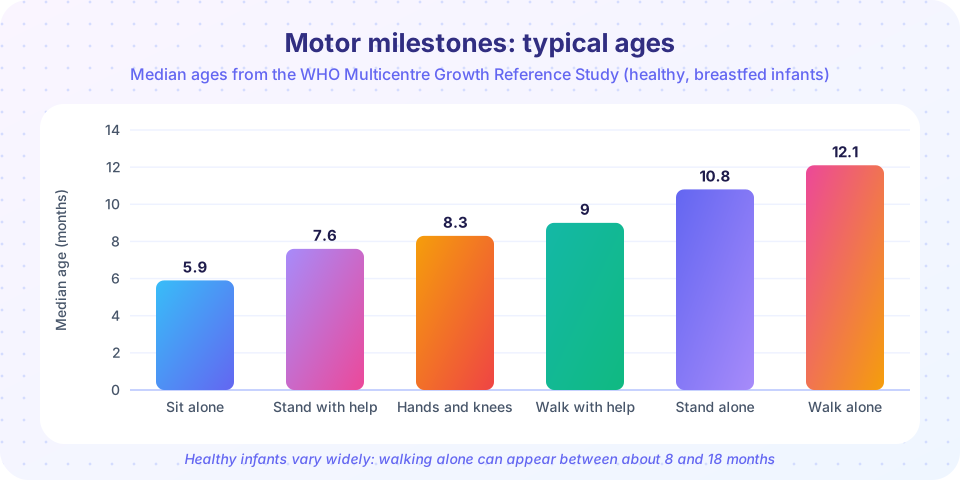
The WHO Multicentre Growth Reference Study (published 2006) followed healthy, breastfed infants in six countries and recorded when six gross-motor milestones appeared. The medians were about 5.9 months for sitting without support, 7.6 for standing with help, 8.3 for hands-and-knees crawling, 9.0 for walking with help, 10.8 for standing alone and 12.1 for walking alone. But the windows were wide: walking alone appeared anywhere from about 8 to 18 months in healthy infants. Some infants skip crawling or move by shuffling on their bottoms.
Why timing varies
Maturation matters, yet it is not the whole story.
Dynamic systems
Esther Thelen's research challenged the idea that a newborn's stepping reflex disappears because the brain "inhibits" it. She noted that the reflex fades at about two months, just when babies gain fat faster than muscle strength, so their legs become relatively heavy. When Thelen and Donna Fisher (1982) held infants in water, the stepping came back, and when small weights were attached to the legs of younger infants, stepping decreased. Seven-month-olds who no longer kicked in the air stepped well when held on a treadmill. Thelen's dynamic systems view says that motor skills emerge from the interplay of body, brain, task and environment rather than from a brain timetable alone.
Practice
Karen Adolph's studies of newly walking toddlers show that they take thousands of steps a day. Her team found that 12- to 19-month-olds took roughly 2,400 steps and fell about 17 times per hour of play (2012), covering the distance of several football fields. This enormous amount of practice, and the way infants adjust their steps after each fall, shows that learning to walk is more than waiting for maturity.
Culture and caregiving
Wayne Dennis (1940) compared Hopi infants carried on cradleboards with those not restricted and found little difference in walking age, which suggests that limited movement practice early on did not delay this skill much. In other societies, caregivers deliberately practice sitting and stepping with infants, and infants in those groups may reach some milestones earlier than Western norms, for instance Kipsigis infants in Kenya studied by Charles Super (1976). More recently, health campaigns encouraging babies to sleep on their backs meant less time on their stomachs, and studies found slightly later rolling in some babies, still within the normal range. The lesson: milestones reflect biology and the practice opportunities a culture provides.
The infant brain
At birth a baby's brain weighs about a quarter of its adult weight, and by about age 2 it reaches roughly three-quarters. Most of the roughly 86 billion neurons of the adult brain are produced before birth. What changes after birth is mostly the wiring.
- Synaptogenesis. Neurons grow branches and form huge numbers of synapses. Peter Huttenlocher's studies of human brain tissue found that synapse density in sensory areas peaks within the first year or so and in the prefrontal cortex later, in the preschool years, with peaks above adult levels.
- Pruning. Over the following years, connections that are used are strengthened and those that are not are eliminated. The end result is a more efficient network, not a bigger one.
- Myelination. Myelin wraps nerve fibers and speeds signals. It proceeds from sensory and motor regions to association areas, and continues in the frontal cortex into the twenties.
William Greenough and colleagues distinguished two kinds of plasticity. Experience-expectant plasticity relies on experiences that almost every member of the species gets (patterned light, speech sounds, touch) and that the brain "expects" in order to tune itself; when they are missing, as in congenital cataracts, development is impaired. Experience-dependent plasticity relies on experiences that vary between individuals (a particular language, an instrument) and continues throughout life.
Myths to avoid
- "Everything is decided in the first three years." John Bruer's book The Myth of the First Three Years (1999) argued that this claim goes beyond the evidence. Early experience matters, and extreme deprivation can have lasting effects, but the brain remains plastic, and many windows stay open for years.
- "Mozart makes babies smarter." A 1993 study by Frances Rauscher, Gordon Shaw and Katherine Ky found that college students briefly performed better on a spatial task after listening to a Mozart sonata. The effect was small, short-lived and not a general intelligence boost, and it has not held up as an effect on infants or on intelligence.
- "Buy products to build a bigger brain." Researchers stress ordinary experiences: conversation, play, and what the Harvard Center on the Developing Child calls "serve and return" exchanges, in which a caregiver responds to a baby's babble or gesture. Specialized products add little beyond these.
Common misconceptions
"A baby who walks later will be less intelligent." Walking age within the normal range is unrelated to later intelligence.
"Crawling is required for normal development." Some healthy infants skip it.
"More synapses means a smarter brain." Efficient pruning, not sheer numbers, marks a mature brain.
Try it
Press Run (or Ctrl + Enter) to see the result here.
Program input · what you'd type while the program runs
Type the answers before you press Run, one per line. Each time the program reads a line (with input()), it gets the next line from this box.
Press Run (or Ctrl + Enter) to see the result here.
Program input · what you'd type while the program runs
Type the answers before you press Run, one per line. Each time the program reads a line (with input()), it gets the next line from this box.
Check your understanding
Quick check · 5 questions
of 5 answered You scored / 5 · perfect!
-
1. Which principle says that motor control spreads from the center of the body outward?
Proximodistal development: shoulders before hands, hands before fingers. -
2. Thelen found that the stepping reflex returned when infants were held in water. What did this suggest?
Buoyancy reduced the load on the legs, supporting the dynamic-systems view that body and environment contribute. -
3. What best describes synaptic pruning?
Used connections are strengthened; unused ones are eliminated. -
4. Which is the best summary of the 'Mozart effect' evidence?
The original effect was small and brief and was not shown to boost infants' intelligence. -
5. Which statement about milestone ages is accurate?
Windows are wide, and some healthy babies skip crawling.
Summary
- Motor development proceeds head to tail and center outward, from gross to fine skills; healthy timing varies widely.
- Dynamic systems theory and studies of practice and culture show that milestones arise from body, brain, task and opportunity together.
- The infant brain overproduces synapses, prunes unused ones and myelinates over many years; experience-expectant and experience-dependent plasticity both matter.
- "Everything by age three" and the Mozart effect are overstatements; everyday responsive care supports development.
Next: Chapter 3 Review
Track your progress
Create a free account to tick off lessons and pick up where you left off on any device.
of Developmental Psychology lessons completed