


















Lesson 37 of 46 · Adolescence and Adulthood
Chapter review: adolescence and adulthood
Review puberty, the adolescent brain, identity, emerging adulthood, relationships and personality change with a one-picture summary, a recap table and a ten-question quiz.
You have traced development from the first signs of puberty through the search for identity to the demands of work, love and parenting. This review puts the ideas in one place: a picture, a table of names and findings, practice tools and a mixed quiz. Pay special attention to the cautions column, because the most common exam mistakes in this area come from overstating the evidence.
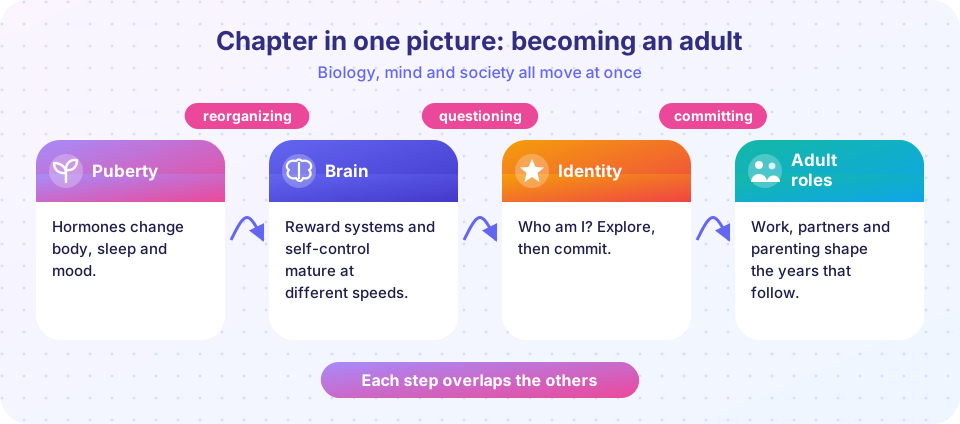
What you will learn
- A recap of key studies, terms and cautions from the chapter.
- How body, brain, identity and social roles connect.
- Which popular claims need careful wording.
Recap table
| Topic | Key names | Main idea | Caution |
|---|---|---|---|
| Puberty | Many | Timing varies; secular trend toward earlier onset | Ranges are wide |
| Formal thinking | Piaget; Elkind | Abstract reasoning; imaginary audience, personal fable | Not universal across tasks |
| Storm and stress | Hall; Arnett | Conflict and mood swings rise on average | Most teens do well |
| Dual-systems model | Steinberg; Casey | Reward sensitivity peaks before control matures | Oversimplified; "25" is a slogan |
| Peers and risk | Gardner and Steinberg, 2005 | Peers raise risk-taking in teens and young adults | Lab game; risk can aid learning |
| Identity | Erikson; Marcia | Exploration and commitment give four statuses | Not strict stages |
| Emerging adulthood | Arnett | Ages 18-29: exploration, instability, in-between | Not universal |
| Adult stages | Erikson | Intimacy, then generativity | Overlapping, not sequential |
| Relationships | Harvard Study of Adult Development; Gottman | Relationship quality predicts wellbeing | Sample limits; prediction claims overstated |
| Midlife | MIDUS | Midlife crisis is not typical | Midlife can bring heavy responsibility |
| Personality | Roberts et al., 2006 | Maturity principle on average | Big individual differences |
Common misconceptions
- "The teenage brain is a broken adult brain." It is a developing brain with strengths, including learning and social sensitivity.
- "Identity is settled by 18." It is revised throughout adulthood.
- "Everyone has a midlife crisis." Most do not.
Try it
First, a Marcia status finder. Given exploration and commitment ratings for sample people, the function returns the status.
Press Run (or Ctrl + Enter) to see the console output here.
No output.
Second, a confidence checklist. Tick what you can explain and see what to revisit.
Check your understanding
Quick check · 10 questions
of 10 answered You scored / 10 · perfect!
-
1. What is the secular trend in puberty?
Better nutrition and health are leading explanations for earlier average onset, especially in girls. -
2. Which pair is correct?
Elkind described the imaginary audience and personal fable. Marcia described identity statuses, Gottman the four horsemen. -
3. A weakness of the claim that the brain is not mature until 25 is that...
The number 25 is a slogan, not a boundary. -
4. In Gardner and Steinberg (2005), risk-taking with friends watching increased for which groups?
The peer effect was found for teenagers and college-age participants, not for adults. -
5. Which Marcia status describes exploring options without a firm commitment yet?
Moratorium means exploring, with commitment still pending. -
6. Which is a criticism of emerging adulthood?
Economic and cultural conditions shape whether the twenties are a time of exploration. -
7. What did the Harvard Study of Adult Development highlight?
Relationship quality was a strong predictor in this long-running study. -
8. Large surveys such as MIDUS find that a midlife crisis...
Most people do not report an age-tied crisis. -
9. On average, personality from young adulthood to middle age tends to become...
This is the maturity principle (Roberts, Walton and Viechtbauer, 2006). -
10. Which statement best describes teens' risk-taking?
Context, especially peers, matters, and risk-taking can sometimes support learning.
Summary
- Puberty timing varies, and teen thinking and moods change, but "storm and stress" is overstated.
- The dual-systems model is influential, with limits; peers raise risk-taking in experiments.
- Identity grows through exploration and commitment; adult life brings intimacy, work, parenting and generativity.
- Relationship quality is a strong predictor of wellbeing; the midlife crisis is not typical; personality matures on average.
Track your progress
Create a free account to tick off lessons and pick up where you left off on any device.
of Developmental Psychology lessons completed