


















Lesson 19 of 46 · Cognitive Development
Piaget's Stages of Cognitive Development
Learn Piaget's theory: schemas, assimilation and accommodation, and the sensorimotor, preoperational, concrete operational and formal operational stages with classic tasks.
Jean Piaget (1896-1980) did something unusual for a scientist of his time: he took children's wrong answers seriously. Where others saw mistakes, he saw clues about how a young mind is organized. He watched his own three children, interviewed hundreds of others, and concluded that children are not empty containers waiting to be filled with knowledge. They are active builders who construct their understanding by acting on the world, and the way they reason changes in fundamental ways as they grow. His four-stage theory remains the starting point for nearly every discussion of cognitive development.
What you will learn
- define schema, assimilation, accommodation and equilibration
- describe the four stages with their key achievements and limitations
- explain object permanence, egocentrism and conservation, and the tasks used to test them
- describe formal operational reasoning, using the pendulum problem
Key terms
Schema: an organized pattern of thought or action, such as "sucking" or "dogs are furry animals that bark".
Assimilation: fitting new experience into an existing schema.
Accommodation: changing a schema to fit new experience.
Equilibration: the process of balancing assimilation and accommodation to restore a stable understanding.
Operation: a mental action that can be reversed, such as adding and subtracting in your head.
How learning works: Piaget's engine
Piaget described development as adaptation to the world through two complementary processes. When a toddler who knows "dog" sees a cat and says "dog", she is assimilating the new animal into an old schema. When her parent says "no, that's a cat", and she creates a new schema for cats, she is accommodating. The unease between what she expects and what she meets (disequilibrium) drives her to adjust, and she reaches a new balance, or equilibrium. Repeated over years, this cycle produces qualitatively new ways of thinking: the stages.
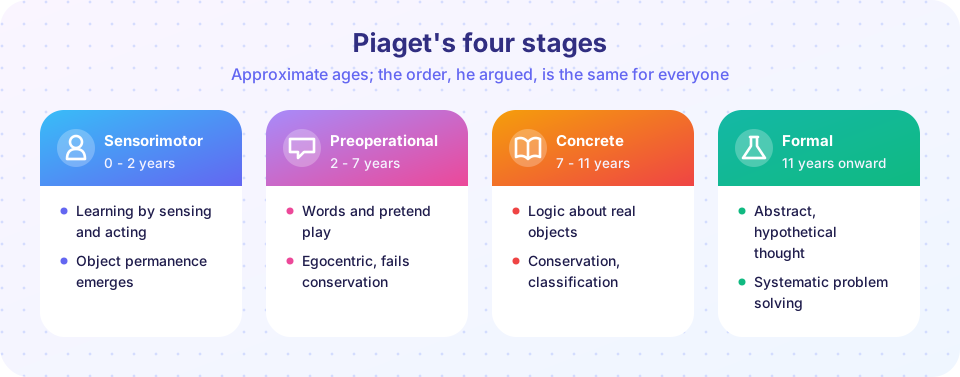
Stage 1: sensorimotor (birth to about 2 years)
Infants understand the world by sensing and acting on it: looking, sucking, grasping, banging. Piaget divided this stage into six substages, from reflexes to the first mental images. In circular reactions an infant repeats an action that produced an interesting result, such as shaking a rattle again and again. By about 8 to 12 months, she begins to combine actions to reach goals, like pushing a pillow aside to grab a toy.
The signature achievement is object permanence, the understanding that objects continue to exist when out of sight. Piaget observed that young infants lose interest when a toy is hidden, as if it ceased to exist. At about 8 to 12 months they search for it, but they often make the A-not-B error: after finding a toy repeatedly at location A, they keep searching at A even when they watch it being hidden at B. By around 18 to 24 months, children search sensibly even when objects are moved out of sight. The stage ends with mental representation: toddlers can imitate an action seen earlier (deferred imitation) and solve problems by thinking instead of trial and error.
Stage 2: preoperational (about 2 to 7 years)
Now children use symbols: words, drawings and pretend play (a banana becomes a phone). But their thinking is, in Piaget's terms, still not "operational": it cannot yet manipulate ideas through logical rules. Typical limitations include:
- Egocentrism: difficulty taking another's point of view. In the three mountains task (Piaget and Inhelder, 1948), children walked around a model of three mountains and were asked what a doll at another position would see; many under about 7 chose their own view.
- Centration: focusing on one feature of a situation and ignoring others.
- Lack of conservation: failing to understand that quantity stays the same when appearance changes. When the same amount of juice is poured from a short wide glass into a tall narrow one, a child may insist that the tall glass holds "more".
- Animism and magical thinking: attributing life or intentions to objects ("the sun is tired").
- Class inclusion problems: shown seven roses and three tulips, children may say there are more roses than flowers.
Stage 3: concrete operational (about 7 to 11 years)
Children now think logically about concrete, real things. They master conservation (of number, liquid, mass and later weight and volume), because they can decenter, attend to height and width together, and mentally reverse the pouring (reversibility). They can classify objects into nested categories, put items in order along a dimension (seriation), and infer relations (transitivity: if A is longer than B and B is longer than C, then A is longer than C). However, they struggle with abstract or hypothetical problems that are not tied to something they can imagine concretely.
Stage 4: formal operational (about 11 or 12 years and up)
Adolescents begin to reason about possibilities, abstractions and ideas themselves: justice, freedom, hypothetical worlds. They can use hypothetical-deductive reasoning: form a hypothesis, derive consequences, and test them systematically. Bärbel Inhelder and Piaget (1958) tested this with the pendulum problem: given strings of different lengths, weights of different masses, different release heights and pushes, which factor determines how fast a pendulum swings? Concrete thinkers tend to change several things at once and draw muddled conclusions. Formal thinkers vary one factor at a time while holding the rest constant, a strategy of experimental control. (It turns out that, for small swings, only the length of the string matters.)
Why the stages matter
Piaget's ideas shaped education: children learn best by exploring and experimenting, teaching should fit their level, and mistakes are windows into reasoning. These ideas live on in "discovery learning" and in the emphasis on hands-on materials in many classrooms. The next lesson asks how well the theory itself has held up.
Common misconceptions
"Piaget said children can't learn X before a certain age." He described typical patterns, and he allowed for variation among children and tasks.
"Stages mean sudden jumps." Piaget himself noted that a child may reason at a higher level on one task and a lower level on another (what he called décalage).
"Assimilation is bad and accommodation is good." Both are needed: assimilation consolidates what you know; accommodation changes it.
Try it
Press Run (or Ctrl + Enter) to see the result here.
Program input · what you'd type while the program runs
Type the answers before you press Run, one per line. Each time the program reads a line (with input()), it gets the next line from this box.
Press Run (or Ctrl + Enter) to see the result here.
Program input · what you'd type while the program runs
Type the answers before you press Run, one per line. Each time the program reads a line (with input()), it gets the next line from this box.
Check your understanding
Quick check · 5 questions
of 5 answered You scored / 5 · perfect!
-
1. A toddler who calls a horse a 'dog' because it has four legs is mainly...
She fits a new animal into an existing schema without changing the schema. -
2. In which stage do children first show a clear understanding of conservation?
Concrete operational children (about 7 to 11) can decenter and reverse operations mentally. -
3. What is the A-not-B error?
It appears at about 8 to 12 months and was interpreted by Piaget as incomplete object permanence. -
4. Why is the pendulum problem used to study formal operational thinking?
Controlling variables is a hallmark of hypothetical-deductive reasoning. -
5. A child says there are more roses than flowers in a bouquet of seven roses and three tulips. This shows difficulty with...
Class inclusion requires thinking about a whole and its parts at the same time, which is hard in the preoperational stage.
Summary
- Piaget saw children as active builders of knowledge, adapting through assimilation and accommodation toward equilibrium.
- Sensorimotor: knowing through action; object permanence. Preoperational: symbols but egocentrism and no conservation. Concrete operational: logic about real things. Formal operational: abstract, hypothetical reasoning.
- Classic tasks include A-not-B, three mountains, conservation, class inclusion and the pendulum.
- The order of stages was claimed to be universal; the ages are approximate.
Next: Evaluating Piaget
Track your progress
Create a free account to tick off lessons and pick up where you left off on any device.
of Developmental Psychology lessons completed