


















Lesson 39 of 46 · Aging and Lifespan Perspectives
Cognition and the brain in later life: fluid and crystallized abilities and the aging brain
Learn what changes and what holds in thinking as we age: fluid and crystallized abilities, the Seattle Longitudinal Study, brain changes, plasticity and normal aging versus dementia.
Does the mind decline with age? The honest answer is "some parts, from some point, in some people, and not others". Everyday experience supports both sides: older adults often struggle to recall a name on the spot but can tell a story, solve a family dispute or write a clear letter better than they could at 25. Scientists try to separate the cognitive skills that fade from those that last, and to understand why people differ so much.
This lesson shows how researchers measure cognitive aging, why the method matters enormously (a classic study design trap), what the brain does as we age, and how normal aging differs from dementia.
What you will learn
- The difference between fluid and crystallized abilities and which tend to decline.
- Why cross-sectional and longitudinal studies of aging give different answers.
- What the Seattle Longitudinal Study found.
- What happens in the aging brain, what protects it, and how normal aging differs from dementia.
Key terms
- Fluid intelligence: reasoning with new problems, independent of learned knowledge.
- Crystallized intelligence: accumulated knowledge and skills, such as vocabulary and general knowledge.
- Processing speed: how quickly simple mental operations are performed.
- Cohort effect: a difference caused by the era in which people were born, not by age.
- Cognitive reserve: the brain's resilience, built by education, challenging work and activity, that helps it cope with damage.
Two kinds of intelligence
Raymond Cattell and John Horn distinguished fluid from crystallized intelligence. Solving a new puzzle, spotting a pattern, or holding several pieces of information in mind while manipulating them (working memory) use fluid skills. Knowing the meaning of "prudent", remembering historical facts or knowing how to run a household use crystallized skills.
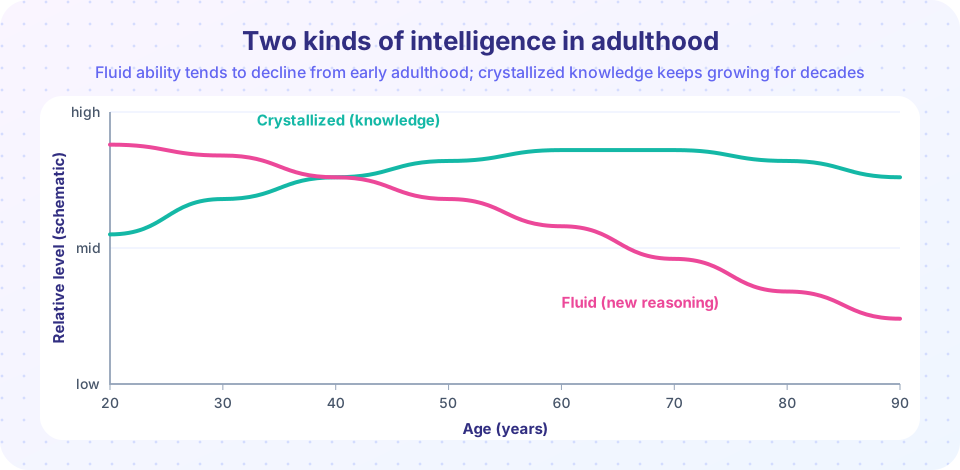
On average, fluid abilities peak in early adulthood and then decline gradually, while crystallized abilities increase for decades. One basic ingredient of fluid performance is processing speed, which slows with age and explains part of the decline in many other tasks (a theory developed by Timothy Salthouse). Within memory, episodic memory (remembering specific events, such as where you parked this morning) declines more than semantic memory (general knowledge) and procedural memory (how to ride a bike).
Older adults often use experience to compensate. A chess expert or an experienced pilot may match or beat younger people because knowledge helps them find the right action quickly.
A trap: cross-sectional versus longitudinal
How would you find out how thinking changes with age?
- A cross-sectional study tests different age groups at the same time: 20-year-olds, 50-year-olds, 70-year-olds. It is fast and cheap. Its flaw is that the groups differ in birth cohort as well as age. Older cohorts often had less schooling and different nutrition and health care, so they may score lower for reasons unrelated to aging.
- A longitudinal study tests the same people repeatedly over many years. It avoids cohort mix-ups but is slow and expensive, loses participants over time (often those in poorer health), and people improve at tests with practice.
K. Warner Schaie designed the Seattle Longitudinal Study, begun in 1956, which combined both approaches in a sequential design: new samples were added every seven years and earlier participants retested. Main findings:
- Cross-sectional data suggested earlier and larger declines, while longitudinal data showed that for many abilities, performance held up or rose into the fifties or sixties.
- Reliable average declines for most abilities appeared in the sixties and became broader in the eighties.
- There were large individual differences: many 80-year-olds outperformed the average 40-year-old on some tests, and later-born cohorts did better on some measures (for example, inductive reasoning) than earlier ones.
The lesson is about method: when you read a claim about "age differences", ask what kind of study produced it.
The aging brain
Brain changes with age are real but vary widely.
- Volume. Total brain volume shrinks slowly, and the prefrontal cortex and the hippocampus (important for forming new memories) are among the regions that tend to lose volume.
- White matter. The insulation on nerve fibers can degrade, slowing communication between regions.
- Neurotransmitters. Some chemical systems, notably dopamine, decline, which is linked to slower processing and some memory changes.
- Compensation. Brain imaging studies by Roberto Cabeza and others found that older adults often use both sides of the prefrontal cortex for tasks that young adults do with one side. This pattern (nicknamed HAROLD) may reflect compensation, though it is debated whether it always helps.
Plasticity and protection
The brain stays plastic in later life. Factors linked with healthier cognitive aging include education and mentally demanding work (which build cognitive reserve), physical exercise, good sleep, managing blood pressure, social engagement, and not smoking. In a 2011 randomized trial led by Kirk Erickson, older adults who did a year of moderate aerobic walking showed a small increase in hippocampal volume, while a stretching group showed a small decrease. Exercise is one of the best-supported protective factors, though effects on thinking in trials are modest.
"Brain training" games improve performance on the trained tasks. Whether they transfer to everyday life is much debated, and a major review in 2016 by Daniel Simons and colleagues concluded that evidence for broad benefits was limited. Large trials such as ACTIVE found that speed-of-processing training had some lasting effects, but results differ by program, so claims should be evaluated carefully.
Normal aging versus dementia
This section is educational information, not a way to diagnose anyone. If you are worried about memory in yourself or a relative, a doctor can arrange assessments and explain options.
Dementia is a group of conditions, of which Alzheimer's disease is the most common, in which memory and thinking decline enough to interfere with daily life. Several differences help to describe it:
| Normal aging | Dementia |
|---|---|
| Occasionally forgetting a name or appointment, remembering it later | Forgetting recent events or conversations repeatedly |
| Taking longer to learn new things | Difficulty with familiar tasks such as managing money or cooking |
| Occasional word-finding pauses | Frequent trouble following or joining conversations |
| Independent in daily life | Increasing need for help |
Dementia is not an inevitable part of aging: the large majority of older adults do not have dementia, though risk rises steeply in the eighties and nineties. Researchers estimate that a sizeable share of dementia cases worldwide may be linked to modifiable factors, such as hearing loss, high blood pressure, physical inactivity, smoking, depression and social isolation. The Lancet Commission on dementia prevention has published estimates of this kind, and exact percentages are revised as evidence accumulates.
Common misconceptions
- "Forgetting a name means Alzheimer's." Occasional lapses are common at every age.
- "Everything declines with age." Vocabulary and general knowledge typically increase.
- "Brain games prevent dementia." Evidence for this is limited.
- "Cross-sectional data show how you will change." They mix age with cohort differences.
Try it
First, a simulation of the cross-sectional versus longitudinal trap. The imaginary population has a slow, gentle decline with age, but every later-born cohort scores a bit higher (as better schooling and health raise scores over generations). Compare the two kinds of studies on the same population. All numbers are invented.
Press Run (or Ctrl + Enter) to see the result here.
Program input · what you'd type while the program runs
Type the answers before you press Run, one per line. Each time the program reads a line (with input()), it gets the next line from this box.
Second, a simple reaction-time demonstration. Press Start, wait for the green signal and click as fast as you can. Reaction time varies a lot between people and from trial to trial, so it is only a demonstration of what "processing speed" tasks look like, not a test of anything.
Third, which kind of task is it? This code labels everyday tasks as mostly fluid or mostly crystallized. It is a teaching sorter and real tasks often mix both.
Press Run (or Ctrl + Enter) to see the console output here.
No output.
Check your understanding
Quick check · 6 questions
of 6 answered You scored / 6 · perfect!
-
1. Which type of ability generally keeps increasing into the sixties?
Accumulated knowledge tends to rise for decades. -
2. Why can a cross-sectional study exaggerate age decline?
Age and cohort are mixed up in cross-sectional comparisons. -
3. What was special about Schaie's Seattle Longitudinal Study design?
New cohorts were added at intervals while earlier participants were retested. -
4. Which memory type tends to decline more with age?
Remembering specific events usually declines more than general knowledge or skills. -
5. What does cognitive reserve refer to?
Education and stimulating activity are linked to better coping with age-related brain changes. -
6. Which statement about dementia is best?
Dementia is not inevitable, and it differs from occasional lapses.
Summary
- Fluid abilities (new reasoning, speed) tend to decline from early adulthood; crystallized abilities (knowledge) tend to grow for decades.
- Study design matters: cross-sectional studies mix age and cohort; sequential designs such as Seattle help separate them.
- The aging brain loses some volume and white-matter quality but stays plastic; exercise, education and social engagement are linked to healthier aging.
- Dementia differs from normal aging and is not inevitable; evidence for brain-training transfer is limited.
Track your progress
Create a free account to tick off lessons and pick up where you left off on any device.
of Developmental Psychology lessons completed