


















Lesson 2 of 45 · Getting Started
What corporate finance is
Learn what corporate finance is, the three decisions every firm makes (investing, financing, payout), and how cash flows round a company.
Imagine you start a business that makes electric bikes. You need a workshop, tools and a first batch of parts. You borrow some money from a bank and ask two friends to put in cash for a share of the business. Months later the bikes sell, money comes in, and you face a new set of choices: pay back the bank early, buy a second workshop, or take some profit for yourself and your friends.
Each of those choices is corporate finance. The field is simply the study of how businesses make decisions about money, and the best way to learn it is to see that all the decisions fit into one repeating loop.
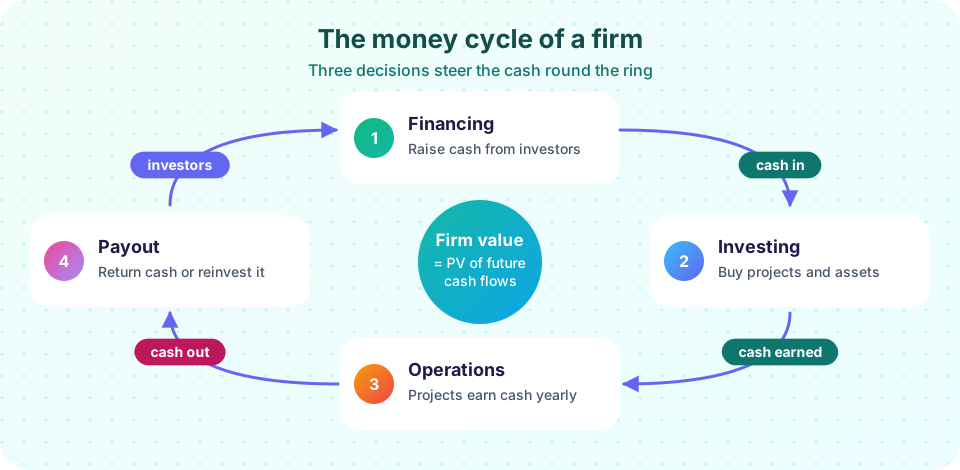
What you will learn
- Define corporate finance and say what it does for a company.
- Name the three decisions: investing, financing and payout.
- Explain how cash moves between a firm, its investors and its projects.
- Tell the difference between real assets and financial assets.
- Describe what a financial manager actually does.
Key terms
Corporation: a legal entity that can own assets, borrow, sign contracts and be sued, separate from its owners.
Real asset: something the firm uses to produce goods or services, such as a machine, a building or a patent.
Financial asset: a legal claim on cash flows, such as a share of stock or a bond.
Capital: the long-term money a firm raises, from owners (equity) and from lenders (debt).
Cash flow: money that actually moves in or out of the firm in a period.
The three decisions
Every finance textbook organizes the field around the same three decisions. We will meet them in this order, because it follows the money.
1. The investment decision (capital budgeting)
Which projects and assets should the firm buy? A bike maker might consider a new paint line, a bigger workshop or a battery research program. Each costs money now and promises cash later. Deciding which of these are worth their cost is called capital budgeting, and it is the subject of chapter 4. It is usually the most important decision, because it determines what the business actually is.
2. The financing decision (capital structure)
Where does the money come from? The firm can sell ownership (equity), borrow (debt) or reinvest its own profits. The mix is the firm's capital structure. Debt is cheaper but comes with fixed payments that must be met even in a bad year; equity is more flexible but owners expect a higher return. Chapters 6 and 7 study this trade-off.
3. The payout and working capital decisions
Once the firm earns cash, it can reinvest it, pay it to owners as dividends, buy back shares, or repay debt. A second, quieter decision is the day-to-day management of working capital: how much cash to hold, how fast customers pay, how much stock to keep. These decisions are covered in chapters 7 and 8.
Invest
This is capital budgeting.
Finance
This is capital structure.
Pay out
This is payout policy.
Cash round the ring: an example
Let us follow one year at an invented company, Brightway Bikes. The numbers are in thousands of dollars.
- Financing. Brightway raises 500 from owners and 300 from a bank loan. Cash in: 800.
- Investing. It spends 700 on tools, a workshop lease deposit and parts. Cash out: 700.
- Operations. The bikes sell, and the business generates 260 of cash after paying suppliers and staff.
- Payout. It pays 40 in interest to the bank and 60 as dividends to the owners, and keeps the rest.
Net change in cash for the year: 800 - 700 + 260 - 40 - 60 = 260.
The key insight is that the value of Brightway is not the 700 it spent; it is what the 260 a year (and its growth) is worth today. The ring in the picture always has the same centre: the value of the firm is the present value of its future cash flows. You will learn how to compute that in chapter 2. Until then, remember the direction: finance is about cash that arrives in the future.
Who does this in a company?
In a large corporation, the senior finance person is often called the chief financial officer (CFO). Two roles sit below, with different jobs:
| Role | Main questions |
|---|---|
| Treasurer | How do we raise money, hold cash safely and manage currency and interest rate exposure? |
| Controller | How do we record and report what happened (accounting, taxes, audits)? |
Corporate finance is mostly the treasurer's side: choosing projects and financing, not recording history. In a small company the owner does all of these jobs.
Real assets and financial assets
It helps to separate two kinds of asset. A real asset (a paint line) is what the firm uses to make things. A financial asset (a bond, a share) is a piece of paper that says someone has a claim on cash flows. Firms create real assets by investing, and they sell financial assets to investors to pay for them. The investors hold the financial assets; the firm holds the real assets. This is the two-sided nature of the ring in the picture.
Common misconceptions
"Finance is about the stock market." The stock market is one place where prices of the firm's shares are set. Most corporate finance decisions happen inside the firm, about projects and funding, and many firms are not listed on any exchange.
"Profit and cash are the same thing." They are not. A sale on credit is profit today but cash later; buying a machine is cash out today but an expense spread over many years. Finance follows cash because cash can be spent and paid out.
"Finance is only for big companies." The same three decisions face a one-person shop. The numbers are smaller, but the logic is identical.
Try it
The first program traces the cash ring for Brightway and shows how each decision changes cash. It is a simple bookkeeping calculator, not a forecast.
Press Run (or Ctrl + Enter) to see the result here.
Program input · what you'd type while the program runs
Type the answers before you press Run, one per line. Each time the program reads a line (with input()), it gets the next line from this box.
The second program draws the cash balance as a bar chart so the ring becomes visible. Try changing the dividend to 200 and see what happens.
Press Run (or Ctrl + Enter) to see the result here.
Program input · what you'd type while the program runs
Type the answers before you press Run, one per line. Each time the program reads a line (with input()), it gets the next line from this box.
Check your understanding
Quick check · 5 questions
of 5 answered You scored / 5 · perfect!
-
1. A firm builds a new factory. Which decision is this?
Choosing which real assets to buy is the investment decision. How to pay for it is a separate financing decision. -
2. Which is a financial asset?
A bond is a legal claim on cash flows. Trucks, patents and warehouses are real assets used to produce goods or services. -
3. What gives a firm its value, according to corporate finance?
Cost is what was paid; value is what the assets will produce, discounted for time and risk. -
4. Brightway raises 500 of equity and 300 of loans, spends 700 on assets and then has 260 of operating cash flow. Ignoring payouts, its cash is:
800 - 700 + 260 = 360. -
5. Which pair best describes treasurer versus controller?
Corporate finance is mainly the treasurer's side: financing, investing and cash management.
Summary
- Corporate finance studies how firms make decisions about money.
- Three decisions: investing (which assets), financing (debt, equity or retained cash) and payout (and working capital).
- Cash moves round a ring between investors, the firm, and its projects.
- A firm's value is the present value of the cash flows its assets will produce.
- Firms hold real assets; investors hold financial claims on the firm.
Track your progress
Create a free account to tick off lessons and pick up where you left off on any device.
of Corporate Finance lessons completed