


















Lesson 21 of 45 · Risk and Return
Chapter overview: Risk and Return
A map of the risk and return chapter: why bigger rewards need bigger risks, how diversification works, and how beta and the CAPM put a price on risk.
Every financial decision is a bet on the future, and the future is uncertain. A company that builds a factory, a family that buys shares, a bank that lends to a start-up: each hopes to be paid back with a reward, and each knows the outcome might be worse than hoped. This chapter turns that vague unease into numbers. By the end you will be able to measure how risky an asset is, explain why holding many assets is safer than holding one, and compute the return investors should demand for the risk they cannot avoid.
The big picture
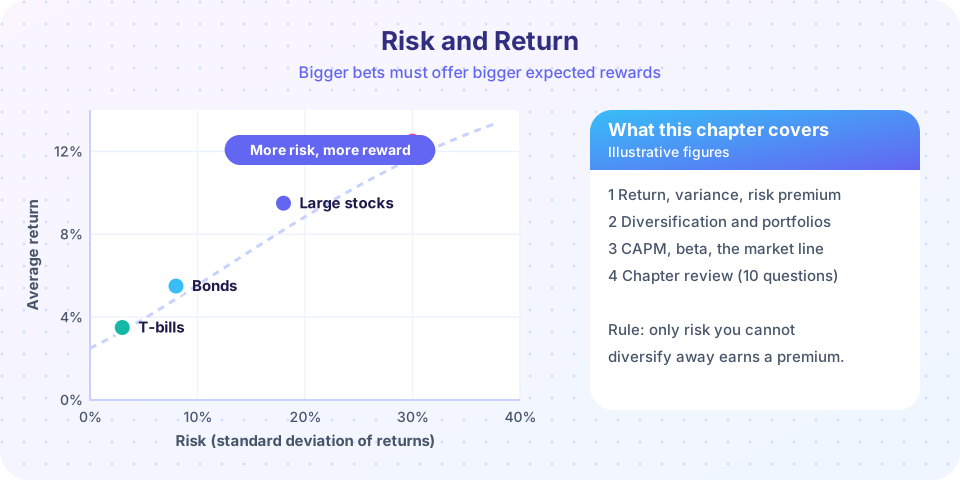
Imagine three friends. Ana lends money to the government for one year and is paid a small but nearly certain interest. Ben buys shares in a large, stable company. Chloe buys shares in a young company that might triple or vanish. If the government, Ben's company and Chloe's company all offered the same expected reward, nobody would hold Chloe's. Prices adjust until riskier assets are expected to pay more. That adjustment is the first big idea of the chapter: expected return rises with risk.
The second idea is more surprising. Not all risk is rewarded. If Chloe also owned shares in forty other companies, the failure of one would barely dent her wealth. Risk that can be removed by holding a mix of assets is called diversifiable (or unique) risk, and the market does not pay you for bearing it, because you could avoid it for almost nothing. Only the risk that cannot be diversified, called market risk, earns a premium.
The third idea turns that insight into a tool. The capital asset pricing model (CAPM) measures an asset's market risk with a single number, beta, and says the required return is the risk-free rate plus beta times the market risk premium. That required return is the foundation of the next chapter, where it becomes the cost of equity inside a company's cost of capital.
Risk is uncertainty about returns
Diversification removes some risk
Beta prices market risk
What each lesson covers
- Return and variance defines holding-period returns, expected return, variance and standard deviation, shows the difference between arithmetic and geometric averages, and explains what a risk premium is.
- Diversification shows with a worked two-asset example why combining assets lowers risk, how correlation controls the benefit, and why the benefit stops at market risk.
- CAPM and beta defines beta, draws the security market line, and uses it to decide whether an asset is fairly priced. It also states honestly where the model is weak.
- Chapter review gathers everything in one picture, a recap table and a ten-question quiz.
How experts reason about risk
Financial professionals ask three questions in order. First: what could happen, and how likely is each outcome? That is a distribution of returns. Second: how much of this risk would disappear inside a diversified portfolio? Only what is left matters for pricing. Third: what return do investors require for that leftover risk? The answer becomes the discount rate for valuing cash flows.
Notice that nothing here needs a crystal ball. We do not predict next year's return. We describe a range of possibilities with a few numbers and then reason about how those numbers combine. This is why the chapter has so much arithmetic: the arithmetic is the tool that lets you think about uncertainty without pretending to know the future.
Key terms for the chapter. Return: gain or loss as a fraction of the amount invested. Risk: uncertainty about return, measured by standard deviation. Diversification: spreading money over assets that do not move together. Beta: how strongly an asset moves with the overall market. Risk premium: the extra expected return paid for bearing risk.
Check your understanding
Quick check · 3 questions
of 3 answered You scored / 3 · perfect!
-
1. Why must a riskier asset offer a higher expected return?
Competition among investors adjusts prices so that expected return compensates for risk. Nothing guarantees the higher return will actually arrive. -
2. Which kind of risk is rewarded with a premium?
Investors can remove diversifiable risk cheaply, so the market pays nothing for bearing it. -
3. What is the CAPM used for in this course?
CAPM gives a required return from beta. It is not a price forecast.
Summary
- Expected return rises with risk because investors compare alternatives.
- Risk is measured by the spread of possible returns.
- Diversification removes unique risk but not market risk.
- Beta and the CAPM turn market risk into a required return.
Next: Return and variance
Track your progress
Create a free account to tick off lessons and pick up where you left off on any device.
of Corporate Finance lessons completed