


















Lesson 18 of 45 · Capital Budgeting
IRR, payback and other investment rules
Learn the internal rate of return, payback and discounted payback rules, see where IRR misleads (multiple IRRs, mutually exclusive projects) and why NPV wins.
The NPV rule gives an answer in dollars. Many managers prefer an answer in percent: "this project earns 15%". That is the internal rate of return (IRR), and it is the second most-used rule in practice. Others like to ask a simpler question: "how soon do we get our money back?" That is the payback period.
Both rules are popular because they are easy to explain. Both can also mislead. In this lesson, you will compute each, see exactly when they agree with NPV and when they do not, and finish with a ranking of the rules that explains why finance theory puts NPV on top.
What you will learn
- Define the IRR and compute it by trial and error.
- Apply the IRR rule and understand its link to the NPV profile.
- Recognize three problems: multiple IRRs, scale and timing conflicts, and lending-type cash flows.
- Compute payback and discounted payback and name their flaws.
- Explain why NPV is the preferred rule.
Key terms
Internal rate of return (IRR): the discount rate that makes a project's NPV equal to zero.
NPV profile: a graph of NPV against the discount rate.
Payback period: the time needed for the cumulative cash flows to repay the initial investment.
Discounted payback: payback computed with discounted cash flows.
Crossover rate: the discount rate at which two projects have the same NPV.
The internal rate of return
Take project A from the last lesson: cost 1,000, inflows 300, 400, 500 and 200. We computed an NPV of +115.57 at 10%. As the discount rate rises, the NPV falls (at 12% it is 69.73, at 20% it is -86.42). Somewhere in between the NPV is zero. That discount rate is the IRR:
0 = -1,000 + 300 / (1 + IRR) + 400 / (1 + IRR)^2 + 500 / (1 + IRR)^3 + 200 / (1 + IRR)^4
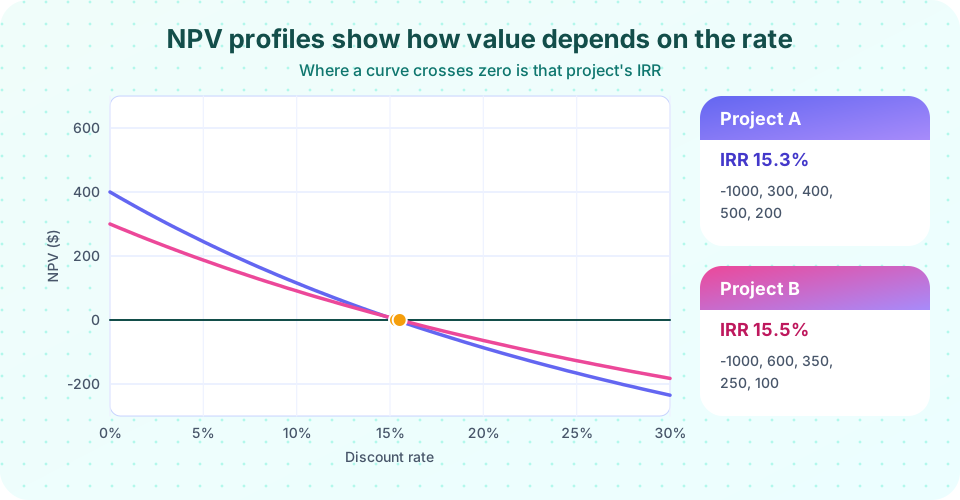
There is no algebraic formula for IRR in general (it is a polynomial equation), so we use trial and error, exactly as for the bond yield. The answer: IRR = 15.32%. In the picture, this is where the blue curve crosses the zero line.
The IRR rule: accept the project if IRR is greater than the required return. Here 15.32% > 10%, so accept, which agrees with NPV. The logic is easy to remember: a project that earns more than the hurdle rate is worth doing. For a conventional project (an outlay first, then only inflows), the NPV profile slopes downward and crosses zero once, so the two rules give the same accept/reject answer.
The IRR is closely related to the yield to maturity of a bond: it is the YTM of the project. Both are the return that makes the present value of the flows equal to what you pay.
Problems with IRR
IRR is useful as a summary, but it can fail in situations that occur regularly.
1. Multiple IRRs
If the cash flows change sign more than once (for example, a mine that costs money again at the end to restore the land), there can be several IRRs. The flows -100, +230, -132 have an NPV of zero at both 10% and 20%. Which is "the" IRR? Neither is meaningful. The NPV rule has no such problem: just compute the NPV at your discount rate. (For this project at 15%, the NPV is +0.19, a tiny gain.)
2. Mutually exclusive projects: scale and timing
The IRR can rank projects in the wrong order. Compare project A with project B, which costs 1,000 and returns 600, 350, 250 and 100:
| A | B | |
|---|---|---|
| IRR | 15.32% | 15.52% |
| NPV at 10% | $115.57 | $90.84 |
| NPV at 0% | $400 | $300 |
B has the higher IRR, but A has the higher NPV at 10%. Which is right? The NPV, since it measures value added. The NPV profiles in the picture explain why: they cross at the discount rate of 14.68%. Below this rate A is better; above it B is better. B returns cash faster, so it does relatively better at high discount rates. The IRR ranking depends on only one number, the point where each curve hits zero, and ignores the shape of the profile.
Scale causes a similar problem. A project earning 50% on $100 has a higher IRR than one earning 20% on $10,000, but the second creates far more value. When ranking mutually exclusive projects, use NPV, or use the IRR on the incremental cash flows (A minus B): if the incremental IRR (the crossover rate) exceeds the discount rate, take the larger project.
3. Lending versus borrowing
If a project brings in cash first and pays costs later (for example, a customer pays in advance), it is like borrowing, and the rule reverses: accept if IRR is below the discount rate. Mechanical use of the rule can give the wrong answer.
4. The reinvestment assumption
The IRR implicitly assumes that the project's interim cash flows are reinvested at the IRR itself. For a high-IRR project that is optimistic. The modified IRR (MIRR) fixes this by compounding the inflows at an explicit reinvestment rate and discounting the outlay at a financing rate. For project A with both rates at 10%: the inflows grow to 300 x 1.331 + 400 x 1.21 + 500 x 1.1 + 200 = 1,633.30 at year 4, so MIRR = (1,633.30 / 1,000)^(1/4) - 1 = 13.05%, lower than the 15.32% IRR.
Payback
The payback period is the time it takes for cumulative cash flows to repay the investment. For A: after year 1 you have 300, after year 2, 700, after year 3, 1,200. The money is recovered in year 3: 2 + 300 / 500 = 2.6 years. For B: 600, 950, 1,200, so 2 + 50 / 250 = 2.2 years.
A firm might use a rule such as "accept if payback is under 3 years". Its appeal: simple, and it favors quick returns and so reduces exposure to far-future uncertainty. Its flaws:
- It ignores the time value of money within the payback period.
- It ignores all cash flows after the payback date. A project with a huge payoff in year 5 can fail the test.
- The cutoff is arbitrary.
Discounted payback repairs the first flaw: use present values. For A at 10%, cumulative PVs are 272.73, 603.31, 978.96 and 1,115.57, so the payback is 3 + 21.04 / 136.60 = 3.15 years. It still ignores flows after payback, so it can reject positive-NPV projects.
Payback survives in practice for good reasons: for small decisions it saves time; for risky ventures, liquidity matters; and for firms that are short of cash, speed of recovery is a real constraint. Use it as a side-check, not as the decision rule.
A ranking of the rules
| Rule | Uses all cash flows? | Time value? | Directly measures value added? |
|---|---|---|---|
| NPV | Yes | Yes | Yes |
| IRR | Yes | Yes | No; can mis-rank projects |
| Profitability index | Yes | Yes | Per dollar, with a budget |
| Discounted payback | No | Yes | No |
| Payback | No | No | No |
Surveys of US and European CFOs, such as the study by Graham and Harvey, find that most firms use NPV and IRR, and many still use payback. A sensible practice is to compute NPV as the decision rule and report the IRR as a more intuitive summary.
Common misconceptions
"The project with the highest IRR is best." Only among projects of equal size and timing. Compare NPVs for mutually exclusive projects.
"IRR is the project's actual return." It assumes reinvestment at the IRR. Real returns depend on actual reinvestment rates.
"Payback of 2 years means the project is good." It says nothing about what happens afterwards.
Try it
The first program finds IRRs by bisection, computes payback and discounted payback, MIRR, the crossover rate and the multiple-IRR example.
Press Run (or Ctrl + Enter) to see the result here.
Program input · what you'd type while the program runs
Type the answers before you press Run, one per line. Each time the program reads a line (with input()), it gets the next line from this box.
The second program draws the NPV profile of both projects, marks the IRRs and the crossover rate, and shades the area where A is better. Move the cursor of your eye along the rate axis: at which discount rates would you prefer A?
Press Run (or Ctrl + Enter) to see the result here.
Program input · what you'd type while the program runs
Type the answers before you press Run, one per line. Each time the program reads a line (with input()), it gets the next line from this box.
Check your understanding
Quick check · 5 questions
of 5 answered You scored / 5 · perfect!
-
1. The internal rate of return is the discount rate at which:
By definition the IRR makes NPV zero. -
2. A conventional project has an IRR of 18% and the required return is 12%. The IRR rule says:
IRR above the required return means accept; for conventional cash flows this agrees with NPV. -
3. Cash flows of -50, +100, -60 can produce more than one IRR because:
Several sign changes can give the NPV equation several roots. -
4. Cash flows: -300 now, then 100, 150 and 200 at the end of years 1 to 3. The payback period is:
After year 2 the cumulative cash flow is -50. Year 3 brings 200, so payback = 2 + 50 / 200 = 2.25 years. -
5. Two mutually exclusive projects: which should the firm choose?
NPV measures the value added in today's dollars, so it is the right way to rank mutually exclusive projects.
Summary
- IRR is the discount rate that makes NPV zero; accept a conventional project if IRR exceeds the required return.
- IRR can fail: multiple IRRs, scale and timing conflicts among mutually exclusive projects, and the reinvestment assumption (MIRR helps).
- NPV profiles show where two projects cross; use NPV (or the incremental IRR) to choose.
- Payback and discounted payback ignore later cash flows and are only side-checks.
- Prefer NPV as the decision rule; report IRR as a summary.
Next: Project cash flows
Track your progress
Create a free account to tick off lessons and pick up where you left off on any device.
of Corporate Finance lessons completed