


















Lesson 27 of 45 · Cost of Capital
Cost of equity and cost of debt
Estimate the cost of equity with CAPM, the dividend growth model and bond yield plus premium, find the cost of debt from yield to maturity, and apply the tax shield.
Ask a bank what it charges for a loan and you get a number. Ask shareholders what they charge for their money and you get silence: nobody sends the company a bill for equity. Yet shareholders do expect a return, and if the company cannot deliver it, they sell the shares and the price falls. The cost of equity is that unwritten price. The cost of debt, in contrast, is visible but needs care, because the rate printed on a bond is not what the firm pays today, and because interest reduces the firm's tax bill.
What you will learn
- Estimate the cost of equity with the CAPM, the dividend growth model and the bond-yield-plus-premium method.
- Reconcile the methods into a defensible range.
- Compute a cost of debt from a bond's yield to maturity.
- Apply the tax adjustment and explain why it is used.
- Handle preferred stock.
Key terms
Cost of equity (Re): the return shareholders require. Dividend growth model: values a share as next year's dividend over (required return minus growth). Yield to maturity (YTM): the discount rate that equates a bond's price to its promised cash flows. Marginal tax rate (T): the rate on the next dollar of profit. Interest tax shield: the tax saved because interest is deductible.
Cost of equity, method 1: CAPM
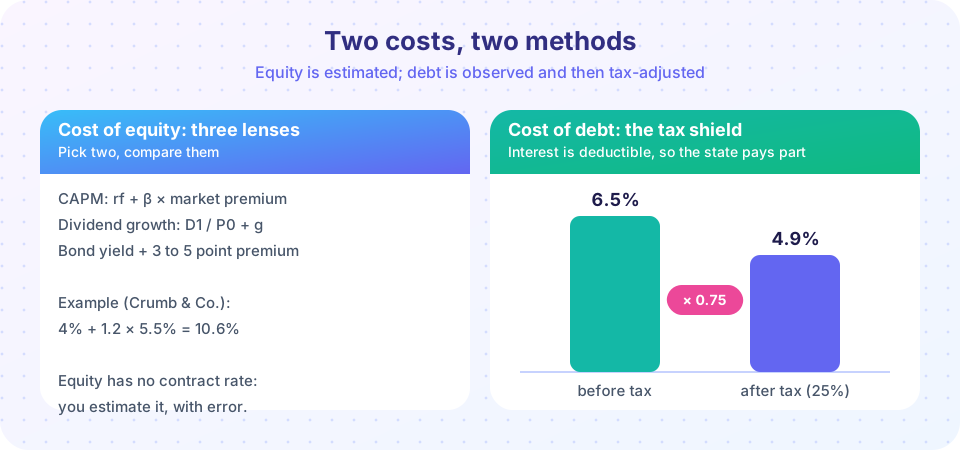
From the last chapter: Re = rf + β × MRP. Take Crumb & Co., an invented cafe chain. The yield on long-term government bonds (our risk-free rate) is 4%, a regression of its returns on the market gives β = 1.2, and we assume a market risk premium of 5.5%:
Re = 4% + 1.2 × 5.5% = 10.6%
Inputs matter. Use a long-term government yield matching the horizon of the cash flows, and be consistent about currency: a euro cash flow needs a euro risk-free rate. The MRP is the least certain input; sensible analysts use somewhere between 4% and 7%, and each half-point changes Re by β/2 points.
Method 2: dividend growth model
If a company pays dividends that grow at a steady rate g, its share price is the present value of that growing stream:
P0 = D1 / (Re − g), so Re = D1 / P0 + g
Suppose Crumb pays a dividend of $2.00 (this year's, D0), is expected to grow it 5% a year, and trades at $40. Next year's dividend is D1 = 2.00 × 1.05 = 2.10, so
Re = 2.10 / 40 + 5% = 5.25% + 5% = 10.25%
The weak point is g. One way to estimate it is the sustainable growth rate: g = retention ratio × return on equity. A firm that keeps 40% of earnings and earns 12.5% on equity grows at 0.40 × 12.5% = 5%. The model only suits firms that pay steady, growing dividends; it is useless for a company that pays none, and a small change in g moves the answer a lot.
Method 3: bond yield plus premium
When you lack a good beta or dividend history, start from the company's own long-term debt yield and add a premium of 3 to 5 percentage points to reflect that shareholders rank behind lenders. For Crumb, with a debt yield of 6.5%: Re ≈ 6.5% + 4% = 10.5%. It is crude, but it cross-checks the others.
Reconciling the answers
The three estimates are 10.6%, 10.25% and 10.5%. They agree within about half a point, which gives confidence that the true cost of equity is somewhere near 10.5%. Practitioners usually choose a value inside the range, weighting the method they trust most (often the CAPM, with the others as sanity checks). If your methods disagree by several points, investigate the inputs rather than averaging blindly.
Press Run (or Ctrl + Enter) to see the result here.
Program input · what you'd type while the program runs
Type the answers before you press Run, one per line. Each time the program reads a line (with input()), it gets the next line from this box.
Cost of debt: use yield, not coupon
Imagine Crumb issued a bond years ago with a coupon of 6%. Interest rates have since risen and the bond now trades below face value. What does it cost Crumb to borrow now? Not 6%. The cost is the rate at which the market currently prices the debt: the yield to maturity, the discount rate y that solves
Price = Σ Coupon / (1 + y)^t + Face / (1 + y)^n
For a different example, a bond with a $1,000 face value, a 6% annual coupon, ten years to maturity and a market price of $950, the solution is y ≈ 6.70%. Past promises are history; today's yield is what new lenders require. If the company has no traded bonds, use the yield on traded bonds with the same credit rating and maturity, or the rate on a fresh bank loan.
Floating-rate or very short-term loans complicate matters, but the principle holds: use the long-term, marginal cost.
Press Run (or Ctrl + Enter) to see the result here.
Program input · what you'd type while the program runs
Type the answers before you press Run, one per line. Each time the program reads a line (with input()), it gets the next line from this box.
The tax adjustment
Interest is usually deductible from taxable profit; dividends are not. If Crumb borrows at 6.5% and pays tax at 25%, each $100 of interest cuts the tax bill by $25, so the net cost is $75, an after-tax rate of
Rd × (1 − T) = 6.5% × 0.75 = 4.875% ≈ 4.9%
That is the number that goes into WACC, because WACC describes what funds cost the firm in cash terms after the tax authority's contribution. Two cautions: use the marginal tax rate (what the next dollar of interest actually saves), and remember that a loss-making company cannot use the deduction now, so its effective shield is smaller or delayed.
Preferred stock
Preferred shares pay a fixed dividend and rank between debt and common equity. With a perpetual fixed dividend Dp and price Pp, the cost is Rp = Dp / Pp. If a $25 preferred pays $1.75 a year, Rp = 7%. Preferred dividends are not deductible, so there is no tax adjustment.
Common misconceptions
"Debt is cheaper than equity because interest rates are lower than my share return, so a company should use all debt." Debt is cheaper per dollar, but more debt makes the remaining equity riskier, which raises its cost. The next chapter explains the balance.
"The coupon rate is the cost of debt." The coupon is a historic promise. The cost is today's market yield.
"Equity is free because there is no interest." Shareholders require a return, and it is usually the largest component of a company's cost of capital.
Check your understanding
Quick check · 6 questions
of 6 answered You scored / 6 · perfect!
-
1. rf = 3%, β = 0.8, MRP = 6%. What is the CAPM cost of equity?
3% + 0.8 × 6% = 3% + 4.8% = 7.8%. -
2. D0 = $1.50, g = 4%, P0 = $30. What is the dividend growth cost of equity?
D1 = 1.50 × 1.04 = 1.56. Re = 1.56 / 30 + 4% = 5.2% + 4% = 9.2%. -
3. A firm retains 50% of earnings and earns 10% on equity. What is its sustainable growth rate?
g = retention × ROE = 0.5 × 10% = 5%. -
4. A company pays 8% on debt and has a 30% marginal tax rate. What is the after-tax cost of debt?
8% × (1 − 0.30) = 5.6%. -
5. Why should the cost of debt come from market yields rather than the coupon on old bonds?
Capital budgeting looks forward, so it needs the current marginal cost of funds. -
6. A preferred share pays $2.40 a year and costs $30. What is its cost?
Rp = 2.40 / 30 = 8%, with no tax adjustment.
Summary
- Cost of equity: CAPM, dividend growth (
D1/P0 + g) or bond yield plus a premium; reconcile into a range. - Cost of debt: today's market yield to maturity, not the old coupon.
- After-tax cost of debt = Rd × (1 − T), using the marginal tax rate.
- Preferred:
Dp / Pp, with no tax shield.
Next: WACC and project rates
Track your progress
Create a free account to tick off lessons and pick up where you left off on any device.
of Corporate Finance lessons completed