


















Lesson 31 of 45 · Capital Structure and Payout
Modigliani-Miller: does capital structure matter?
Understand MM Proposition I and II with and without taxes: why debt does not change firm value in perfect markets, why Re rises with leverage, and what the tax shield adds.
Borrowing money is a bet that you can earn more on it than it costs. If the business earns 12% and the loan costs 6%, surely more loans mean more profit for shareholders? Modigliani and Miller showed that this reasoning is incomplete, and understanding why is the best way to understand capital structure. Their argument is one of the most elegant in all of economics, and the exact way it fails in the real world (through taxes and distress) is what makes financing decisions interesting.
What you will learn
- State the assumptions of a perfect capital market.
- Explain MM Proposition I (value is independent of structure) with a homemade-leverage argument.
- Derive and use MM Proposition II: the cost of equity rises with leverage.
- Add corporate taxes and compute the value of the interest tax shield.
- Explain why WACC falls with debt in the tax case.
Key terms
Unlevered firm (U): financed only with equity. Levered firm (L): financed with debt and equity. R0: the required return on the unlevered firm's assets (the unlevered cost of capital). Homemade leverage: an investor borrowing on their own account to mimic a levered firm. Interest tax shield: the tax saved by deducting interest.
The perfect market assumptions
MM work in a stripped-down world: no taxes, no bankruptcy costs, no transaction costs, and investors and firms borrow at the same rate with equal information. Real markets violate every assumption. The point of the model is not realism but clarity: if capital structure matters in this clean world, the reason must lie within the firm's operations; if not, any effect must come from a friction we can name.
MM Proposition I (no taxes): value is independent of structure
Take Firm U, financed entirely with equity, earning a perpetual operating profit (EBIT) of $100 million a year. At an unlevered required return R0 = 10%, it is worth V_U = 100 / 0.10 = $1,000 million.
Firm L is identical except that it borrowed $400 million at 5% interest, using the money to repurchase shares. Its cash flows to lenders are $20 million of interest; the remaining $80 million goes to shareholders. Proposition I says V_L = V_U = $1,000 million, so L's equity is worth $600 million.
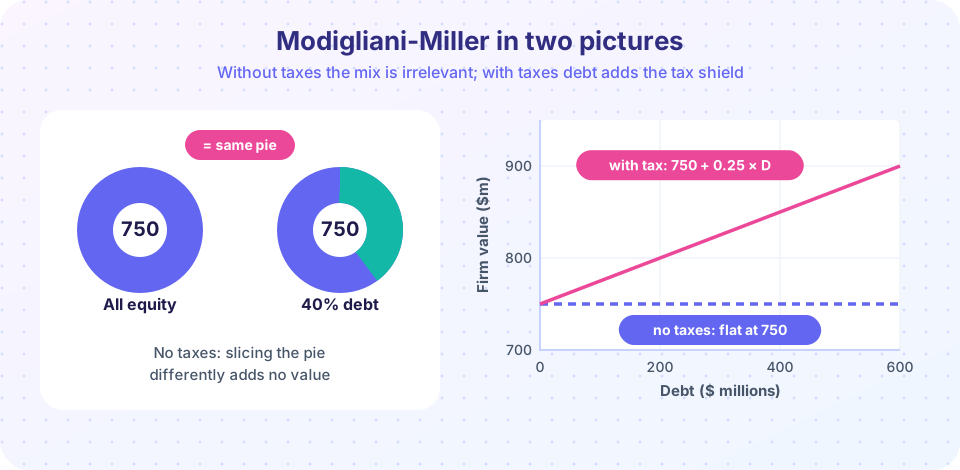
Why must this be true? Suppose instead L were worth $1,100 million and U $1,000 million. An investor could buy a 10% slice of U's equity ($100 million) and combine it with personal borrowing to replicate any pattern of payoffs L's shareholders receive, at a lower cost. Investors would sell L and buy U, pushing prices back together. In a perfect market, investors can create or undo leverage themselves ("homemade leverage"), so the firm gains nothing by doing it for them. Slicing the same cash flows into a debt slice and an equity slice cannot change the size of the pie.
MM Proposition II (no taxes): risk shifts to equity
If value does not change but the firm's debt is cheaper (5%) than its equity, where does the extra return go? Into the cost of equity. Shareholders of L bear all the risk of the business plus the fixed obligation to lenders, so they demand more:
Re = R0 + (R0 − Rd) × (D/E)
For L: Re = 10% + (10% − 5%) × (400/600) = 13.33%. Check against the cash flows: $80 million of equity income on $600 million of equity is 80/600 = 13.33% ✓.
Now compute the WACC with these weights: 0.6 × 13.33% + 0.4 × 5% = 8% + 2% = 10%. WACC equals R0 at every level of debt. Cheap debt is exactly offset by rising equity cost. This resolves our opening puzzle: the 12% business earning on a 6% loan does raise shareholders' expected return, but it also raises their risk, and the two effects cancel in value.
Press Run (or Ctrl + Enter) to see the result here.
Program input · what you'd type while the program runs
Type the answers before you press Run, one per line. Each time the program reads a line (with input()), it gets the next line from this box.
Adding corporate taxes
Now let the company pay tax at rate T on profit after interest. Because interest is deductible, a firm with debt pays less tax than an identical unlevered firm. For each dollar of interest, the state gives back T dollars. With permanent debt D, that tax saving is perpetual. Its present value, discounted at the cost of debt, is
PV(tax shield) = (T × Rd × D) / Rd = T × D
so, with taxes,
V_L = V_U + T × D
Use T = 25%. The unlevered firm's after-tax cash flow is 100 × 0.75 = 75, so V_U = 75 / 0.10 = $750 million (this is the 750 in the picture). If the firm borrows $300 million permanently, it gains a shield of 0.25 × 300 = $75 million, so V_L = 750 + 75 = $825 million. Debt equal to the whole firm's value (impossible in practice) would suggest the shield could be enormous, which is the model's first hint that a force pushes the other way.
The cost of equity now follows
Re = R0 + (R0 − Rd) × (1 − T) × (D/E)
With Rd = 5%, D = 300 and E = 825 − 300 = 525: Re = 10% + 5% × 0.75 × (300/525) = 12.14%. The WACC is
0.636 × 12.14% + 0.364 × 5% × 0.75 = 7.73% + 1.36% = 9.09%
(using weights 525/825 and 300/825). WACC, 9.09%, is below R0 = 10%: the tax shield lowers the blended cost, and the more debt, the lower it goes. This is the formal reason why debt gets so much attention in valuation, and why leverage can add real value.
Press Run (or Ctrl + Enter) to see the result here.
Program input · what you'd type while the program runs
Type the answers before you press Run, one per line. Each time the program reads a line (with input()), it gets the next line from this box.
What MM does and does not tell us
Proposition II explains something people often miss: cheap debt does not make the firm better, because the risk moves to the equity holders. And the tax-case result tells us what makes debt attractive. But a model that says "borrow without limit" is obviously missing something. In practice lenders ration credit, firms avoid very high leverage, and some of the most successful companies carry little debt. The missing force is the cost of financial distress, covered in the next lesson.
Also remember what we assumed. The T × D formula treats debt as permanent and risk-free enough to discount at Rd; with finite debt or variable debt the shield is worth somewhat less. And personal taxes can offset part of the corporate benefit (Miller, 1977), because investors may pay higher tax on interest income than on equity income. The simple formula is a first-order guide, not a precise prediction.
Common misconceptions
"Debt is cheaper than equity, so it lowers the cost of capital." Without taxes, the saving is exactly offset by a higher cost of equity. Only the tax shield (and other frictions) changes value.
"MM says capital structure never matters." It says it does not matter in a perfect market. The theory's value is in identifying which frictions create an effect.
"Leverage always raises earnings per share, so it creates value." It may raise EPS, but also its variability. Value depends on cash flows and risk, not on EPS alone (next lesson).
Check your understanding
Quick check · 5 questions
of 5 answered You scored / 5 · perfect!
-
1. In a perfect market with no taxes, what happens to firm value if the firm replaces equity with debt?
MM Proposition I: V_L = V_U because investors can undo leverage themselves. -
2. R0 = 9%, Rd = 5%, D/E = 0.5, no taxes. What is the cost of equity?
Re = 9% + (9% − 5%) × 0.5 = 9% + 2% = 11%. -
3. With taxes, T = 30%, permanent debt of $200m. What does the tax shield add to value?
T × D = 0.30 × 200 = $60m. -
4. With taxes, what happens to WACC as debt rises (in the MM model)?
The tax shield lowers WACC below the unlevered cost R0; this is the formal pull toward debt. -
5. Why does the cost of equity rise with leverage?
Equity is the residual claim; leverage amplifies its variability, so investors demand a higher return.
Summary
- In a perfect market, V_L = V_U (Proposition I) and
Re = R0 + (R0 − Rd) × D/E(Proposition II); WACC is constant. - With corporate tax and permanent debt,
V_L = V_U + T × D, and WACC falls as debt rises. - The theory is a benchmark: it points to taxes, distress and information as the real drivers.
Next: The trade-off theory
Track your progress
Create a free account to tick off lessons and pick up where you left off on any device.
of Corporate Finance lessons completed