


















Lesson 29 of 45 · Cost of Capital
Chapter review: Cost of Capital
Review the cost of capital chapter: cost of equity, after-tax cost of debt, WACC with market weights and project-specific rates, with a recap table and ten-question quiz.
The cost of capital looks like a single number, but it is the end of a short chain of estimates, each with its own judgment calls. This review lays the chain out on one page, recaps the formulas and then tests whether you can run the whole machine from raw inputs to a project hurdle rate.
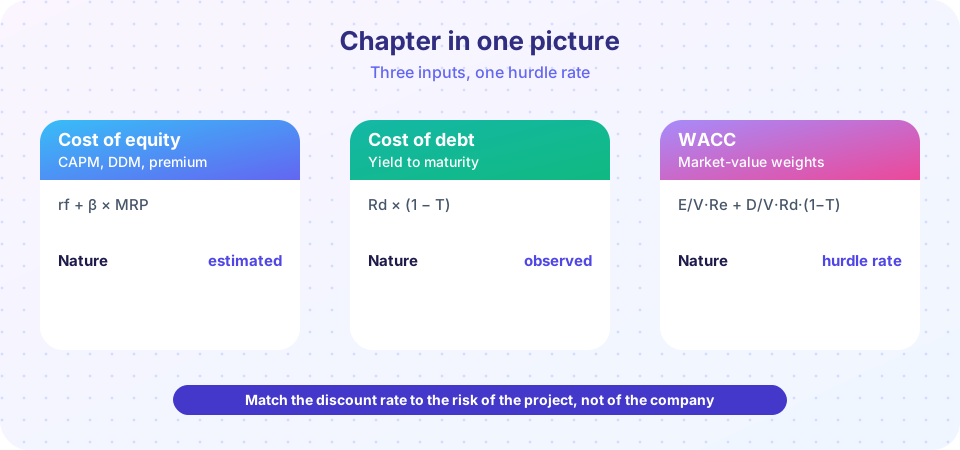
The chain in words
Shareholders' required return is estimated, not observed: the CAPM gives a first answer, the dividend growth model and the bond-yield-plus-premium rule check it (cost of equity and debt). Lenders' required return is read from today's yield to maturity and reduced by the tax shield. The two costs are blended with market-value weights to get WACC. Finally, if a project's risk differs from the firm's average, you replace the firm's rate with one built from pure-play betas, unlevered and relevered to the project's financing (WACC and project rates).
Recap table
| Item | Formula | Watch out for |
|---|---|---|
| Cost of equity (CAPM) | rf + β × MRP | MRP is the shakiest input |
| Cost of equity (DGM) | D1/P0 + g | only for steady dividend payers |
| Sustainable growth | retention × ROE | not a forecast of luck |
| Cost of debt | YTM of current bonds | not the old coupon |
| After-tax debt | Rd × (1 − T) | marginal tax rate; needs taxable profit |
| Preferred | Dp / Pp | no tax shield |
| WACC | E/V·Re + D/V·Rd·(1 − T) | market values, target mix |
| Unlevered beta | βL / [1 + (1 − T)D/E] | assumes zero debt beta |
| Relevered beta | βu × [1 + (1 − T)D/E] | use the project's target D/E |
| Flotation | outlay / (1 − f) | goes in the cash flows |
Traps that catch people
- Using the coupon, not the yield. An old bond's coupon records the past. The cost of debt is what lenders demand today.
- Forgetting the tax adjustment, or applying it twice. The (1 − T) factor belongs on debt only. Do not also add the tax shield to the cash flows when you discount at WACC.
- Book-value weights. Book equity is an accounting remainder. Market values show what each claim is worth now.
- One rate for every project. A safe project discounted at a high rate is rejected, a risky one discounted at a low rate is accepted. Both mistakes destroy value over time.
- Skipping the relevering step. An observed beta mixes business risk with the comparable's own debt. Unlever, average, then relever at your target structure.
- Mixing nominal and real. A nominal discount rate needs nominal cash flows.
Explain it in one minute
"Every dollar a firm uses has an owner who wants a return. Lenders want interest, and because interest is tax deductible, the cost to the firm is smaller. Shareholders want more, since they carry more risk, and we estimate their return with the CAPM and cross-check it. Blend the two with weights equal to what each claim is worth in the market and you get the WACC, the minimum average return the firm's existing business must earn. For a project in a riskier line of business, borrow the beta of a pure-play company, adjust it for debt and rebuild the rate." Practise this until it flows.
Try it
A compact tool: enter the market inputs and get the WACC along with a sensitivity table that shows how the answer moves when the market risk premium changes. It makes the point that WACC is a range.
Press Run (or Ctrl + Enter) to see the result here.
Program input · what you'd type while the program runs
Type the answers before you press Run, one per line. Each time the program reads a line (with input()), it gets the next line from this box.
Check your understanding
Quick check · 10 questions
of 10 answered You scored / 10 · perfect!
-
1. rf = 3.5%, β = 1.1, MRP = 5%. What is the CAPM cost of equity?
3.5% + 1.1 × 5% = 3.5% + 5.5% = 9.0%. -
2. D1 = $3, P0 = $60, g = 6%. What is the DGM cost of equity?
3 / 60 = 5%, plus g of 6%: 11%. -
3. A bond's coupon is 5% but the market yield is 7%. For WACC you should use:
Use the current market yield and apply (1 − T). -
4. Rd = 9%, T = 30%. After-tax cost of debt?
9% × 0.7 = 6.3%. -
5. E = $700m, D = $300m, Re = 10%, Rd = 6%, T = 25%. WACC?
0.7 × 10% = 7.0%; 0.3 × 6% × 0.75 = 1.35%; WACC = 8.35%. -
6. Why are market-value weights preferred over book-value weights?
The cost of capital is a forward-looking opportunity cost. -
7. A pure-play has βL = 1.4, D/E = 0.5, T = 20%. What is βu?
βu = 1.4 / (1 + 0.8 × 0.5) = 1.4 / 1.4 = 1.00. -
8. Where do flotation costs belong?
They are actual cash outflows at the time of financing. -
9. A division is much riskier than the rest of the firm. Which rate should evaluate its projects?
Discount rates should match project risk, not company averages. -
10. Preferred stock pays $4 a year and sells for $50. Its cost is:
4 / 50 = 8%, with no tax adjustment.
Summary
- Estimate Re with several methods and settle on a range.
- Debt cost = today's yield, after tax.
- WACC uses market-value, target-mix weights.
- Match the rate to project risk with unlevered and relevered pure-play betas.
Track your progress
Create a free account to tick off lessons and pick up where you left off on any device.
of Corporate Finance lessons completed