


















Lesson 16 of 45 · Capital Budgeting
Capital budgeting: the big picture
Chapter 4 overview: what capital budgeting is, the kinds of projects a firm faces, the four steps from idea to decision, and a map of the lessons on NPV, IRR and cash flows.
Every large business decision is a bet on the future. A brewery considers a second plant. An airline decides whether to buy twenty new planes. A software firm weighs a three-year project to rebuild its core product. Each costs a lot of money now and promises cash over many years. Capital budgeting is the process of deciding which of these bets to make.
It is the most important decision in corporate finance, because it shapes what the company will be in ten years, and because mistakes are expensive and hard to reverse. This chapter gives you a simple, well-tested way to decide: estimate the cash flows, discount them at the right rate, and accept the projects that create value.
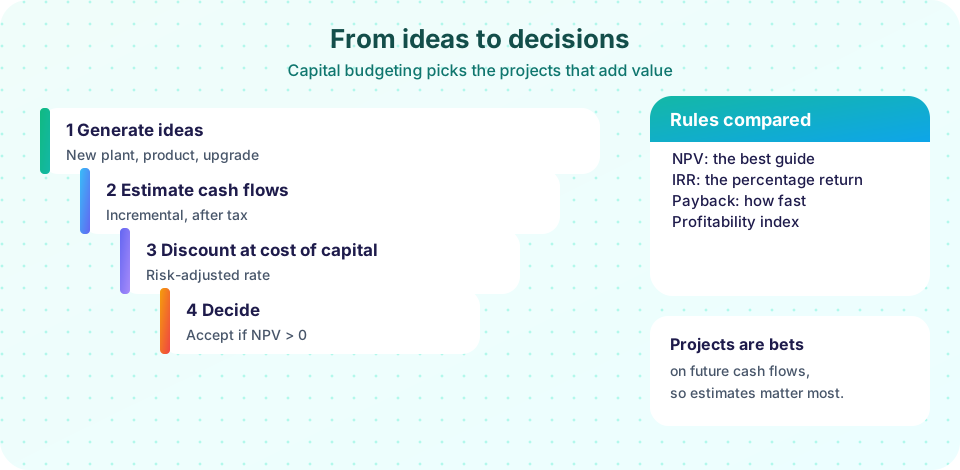
The decision, step by step
- Generate ideas
Ideas come from every part of the company.
- Estimate cash flows
This is the hardest and most important step.
- Discount
Chapter 2 tools, chapter 6 rates.
- Decide and review
Learn from every project.
Kinds of projects
Project types matter because they change how you compare options.
- Independent projects. Accepting one does not affect the others. If you have enough money, accept every one that adds value.
- Mutually exclusive projects. You can do only one: a machine from supplier A or from supplier B, a bridge in this place or that place. You must choose the best.
- Replacement versus expansion. Replacing an old machine compares two cash flow streams; expanding adds a new one.
- Capital rationing. Sometimes the firm cannot fund every good project because money, people or management time is limited. Then it ranks projects by value per unit of scarce resource.
- Contingent and strategic projects. Some projects are only possible after another succeeds, or they create future choices (a pilot plant that opens a market). These "options" can add value beyond the simple forecast.
The rules you will meet
Over this chapter, you will compare several decision rules, from best to weakest:
| Rule | Question it answers | Verdict |
|---|---|---|
| Net present value (NPV) | How much value does the project add, in today's dollars? | The best guide; accept if positive |
| Internal rate of return (IRR) | What percentage return does the project earn? | Intuitive, but can mislead |
| Payback period | How fast do we get our money back? | Simple; ignores time value and later cash |
| Profitability index | NPV per dollar invested | Useful when money is limited |
You will also learn how to build the cash flows themselves in project cash flows. It is tempting to skip that to reach the rules, but good rules applied to bad cash flows still give bad answers.
Why most mistakes are in the forecast
Real projects fail less from the wrong rule than from wrong inputs: sales that were too optimistic, costs that were left out, working capital that was forgotten, or cash flows that would have happened anyway. A few habits help:
- Think incremental. The only cash flows that count are those that change if the project goes ahead. Money already spent (sunk costs) does not count.
- Test the forecast. Ask what happens if sales are 20% lower or costs 10% higher (sensitivity and scenario analysis, chapter 9).
- Be consistent. Use nominal cash flows with nominal rates.
- Beware optimism. Studies of large projects, such as the work of Bent Flyvbjerg on infrastructure, find that costs are underestimated and benefits overestimated far more often than the opposite.
A first try
The program below is the whole chapter in miniature. Give it a cost and a list of yearly cash flows, plus a discount rate, and it returns the NPV and a decision.
Press Run (or Ctrl + Enter) to see the result here.
Program input · what you'd type while the program runs
Type the answers before you press Run, one per line. Each time the program reads a line (with input()), it gets the next line from this box.
The same project is attractive at low rates and unattractive at high ones. The discount rate is the hurdle the project must clear. Try it in the interactive demonstration: change the cost or one cash flow and watch the verdict flip.
The flip happens at about 15.3%. That number has a name, the internal rate of return, and you will meet it in the lesson after next.
Check your understanding
Quick check · 4 questions
of 4 answered You scored / 4 · perfect!
-
1. Which pair are mutually exclusive projects?
Mutually exclusive means choosing one rules out the other. -
2. Which cash flows should be included in a project analysis?
Only incremental cash flows matter. Sunk costs are paid whatever you decide. -
3. A higher discount rate generally makes a project's NPV:
Higher rates shrink the present value of the inflows, which come after the cost. -
4. Which problem do project forecasts often have in practice?
Optimism bias is well documented in large projects.
Summary
- Capital budgeting selects projects that create value: estimate incremental cash flows, discount at the cost of capital, decide.
- Projects can be independent, mutually exclusive, or subject to capital rationing.
- The main rules are NPV (best), IRR, payback and the profitability index.
- Most failures come from bad forecasts, not bad formulas.
Next: The NPV rule
Track your progress
Create a free account to tick off lessons and pick up where you left off on any device.
of Corporate Finance lessons completed