


















Lesson 9 of 45 · Time Value of Money
Rates, compounding and loans
Understand APR versus effective annual rate, compounding frequency, real versus nominal rates, and how loan payments split into interest and principal.
A bank advertises a loan at "12% APR, compounded monthly". Another offers 12.5% compounded once a year. Which costs less? You cannot tell by comparing 12 with 12.5, because the quoted rates use different compounding periods. This lesson gives you the tools to compare rates fairly: the effective annual rate, the periodic rate, and the real rate after inflation.
We then apply them to loans. You will see why a mortgage payment is level, even though the interest part of it falls every month, and you will build an amortization schedule yourself. This is the lesson where the abstract formulas touch daily life: credit cards, car loans, student loans and mortgages all work this way.
What you will learn
- Distinguish the APR (a quoted rate) from the effective annual rate (EAR).
- Convert between periodic rates and effective annual rates.
- Compute the payment on an amortizing loan and the balance after any payment.
- Build a loan amortization schedule.
- Convert between nominal and real rates using the Fisher relation.
Key terms
APR (annual percentage rate): the quoted yearly rate, equal to the periodic rate times the number of periods per year; it ignores compounding.
EAR (effective annual rate): the rate you actually earn or pay over a full year after compounding.
Periodic rate: the rate per compounding period, APR / m.
Amortization: paying off a loan with regular payments that cover interest and part of the principal.
Real rate: the return after removing inflation.
APR versus EAR
A quoted rate such as 12% "compounded monthly" is really a recipe: charge 1% every month. A dollar grows to (1.01)^12 = 1.12683 after a year, so you actually pay 12.683%. That is the EAR. The general formulas for m compounding periods per year are
- periodic rate =
APR / m EAR = (1 + APR / m)^m - 1
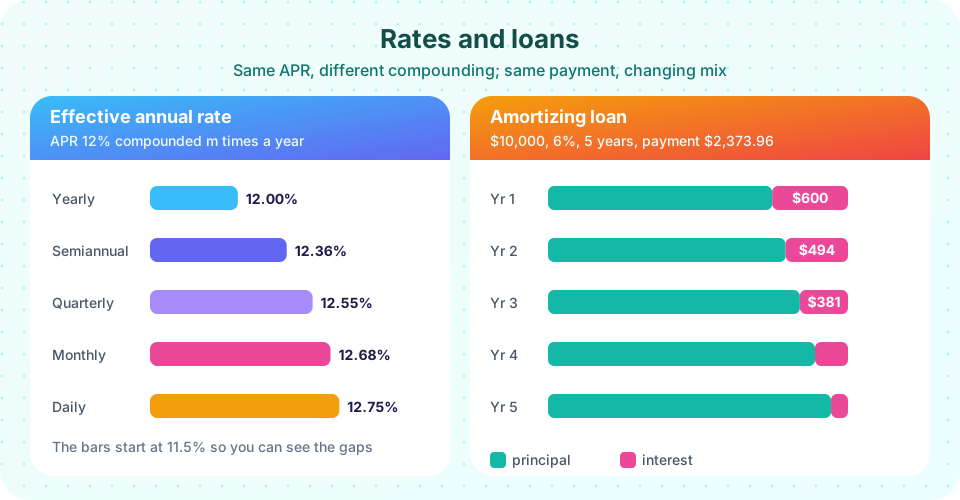
Here is the effect of compounding frequency at a 12% APR:
| Compounding | m | EAR |
|---|---|---|
| Yearly | 1 | 12.000% |
| Semiannual | 2 | 12.360% |
| Quarterly | 4 | 12.551% |
| Monthly | 12 | 12.683% |
| Daily | 365 | 12.747% |
| Continuous | infinite | 12.750% |
The gain from more frequent compounding shrinks quickly. The limit is continuous compounding, where EAR = e^APR - 1. For 12%, that is e^0.12 - 1 = 12.750%. Continuous compounding is mostly a mathematical convenience, used in options pricing and some finance theory.
The answer to the opening puzzle: 12% compounded monthly has an EAR of 12.68%, which is higher than 12.5% compounded yearly. The cheaper loan is the second one, even though its headline number is larger. Always compare EARs.
From an annual rate to a period rate
You also need to go the other way. If you want the monthly rate that corresponds to an effective annual rate of 10%, solve (1 + r_m)^12 = 1.10, which gives r_m = 1.10^(1/12) - 1 = 0.797%. Do not divide 10% by 12 (0.833%), unless the 10% is an APR.
Rule for every problem: the rate and the number of periods must use the same time unit. Monthly payments need a monthly rate and a count of months.
Amortizing loans
Most loans are repaid with equal payments. Each payment first covers the interest that has accrued, and the rest reduces the principal. Because the balance shrinks, so does the interest, and a growing share of each payment goes to principal.
The payment on a loan is simply the annuity formula solved for C:
Payment = PV x r / [1 - (1 + r)^-n]
Example. You borrow $10,000 for 5 years at 6%, with yearly payments. Payment: 10,000 x 0.06 / (1 - 1.06^-5) = 600 / 0.25274 = $2,373.96. The first year's interest is 10,000 x 0.06 = 600, so principal repaid is 2,373.96 - 600 = 1,773.96, and the balance falls to 8,226.04. In year 2, interest is 8,226.04 x 0.06 = 493.56, principal is 1,880.40 and the balance is 6,345.63. The second set of bars in the picture shows this shift from interest (pink) to principal (green).
A mortgage example
A $200,000 loan over 30 years at 6% APR with monthly payments uses r = 0.06 / 12 = 0.5% and n = 360:
Payment = 200,000 x 0.005 / (1 - 1.005^-360) = $1,199.10
Over 30 years you pay 1,199.10 x 360 = $431,676, of which about $231,676 is interest. Early on, most of each payment is interest: the first month's interest is 200,000 x 0.005 = 1,000, so only 199.10 reduces the debt. That is why extra payments early in a mortgage have such a strong effect.
The balance of a loan
The outstanding balance after k payments is the present value of the remaining payments: Balance = Payment x [1 - (1 + r)^-(n-k)] / r. After 5 years of the mortgage above (60 payments), the balance is 1,199.10 x (1 - 1.005^-300) / 0.005 = $186,108, only about $13,900 below the original amount. Early payments mostly pay interest.
Real and nominal rates
Interest rates quoted in the market are nominal: they ignore the loss of purchasing power. The real rate removes inflation. The exact relation, due to the economist Irving Fisher, is
1 + nominal = (1 + real) x (1 + inflation)
If a deposit pays 8% and inflation is 3%, the real rate is 1.08 / 1.03 - 1 = 4.85%. The common approximation real = nominal - inflation gives 5%, close for small rates. In project analysis you must be consistent: either discount nominal cash flows at a nominal rate, or real cash flows at a real rate. Mixing them is a frequent error.
Common misconceptions
"APR is what I actually pay." APR is a quoted rate that ignores compounding within the year. The EAR is what you actually pay.
"Divide the annual rate by 12 to get the monthly rate." That works only for APR. An effective annual rate needs the 12th root.
"Each loan payment is half interest and half principal." The split changes every period: the interest portion is largest at the start.
Try it
The first program is a rate and loan toolbox: EAR for any compounding, a loan payment, and the Fisher relation.
Press Run (or Ctrl + Enter) to see the result here.
Program input · what you'd type while the program runs
Type the answers before you press Run, one per line. Each time the program reads a line (with input()), it gets the next line from this box.
The second program draws how the balance of a 30-year mortgage falls, and how the interest share of each payment shrinks.
Press Run (or Ctrl + Enter) to see the result here.
Program input · what you'd type while the program runs
Type the answers before you press Run, one per line. Each time the program reads a line (with input()), it gets the next line from this box.
Check your understanding
Quick check · 5 questions
of 5 answered You scored / 5 · perfect!
-
1. A card charges 18% APR compounded monthly. The monthly rate is:
Periodic rate = APR / m = 18% / 12 = 1.5%. -
2. Which loan is cheapest? A: 9.0% compounded yearly. B: 8.8% compounded monthly. C: 8.9% compounded quarterly.
EARs: A = 9.000%, B = (1 + 0.088/12)^12 - 1 = 9.163%, C = (1 + 0.089/4)^4 - 1 = 9.201%. A has the lowest EAR even though its headline rate is the highest. -
3. What is the EAR of 8% APR compounded quarterly?
(1 + 0.08/4)^4 - 1 = 1.02^4 - 1 = 8.243%. The value 8.160% is the semiannual EAR. -
4. A deposit pays 6% nominal and inflation is 2%. The real rate is closest to:
Fisher: 1.06 / 1.02 - 1 = 3.92%. Subtracting gives the 4% approximation. -
5. In the first years of a long mortgage, most of each payment goes to:
The balance is large, so interest is large; the principal share grows later.
Summary
- APR is a quoted rate; EAR
= (1 + APR/m)^m - 1is what you really pay or earn. - Continuous compounding gives
EAR = e^APR - 1. - Loan payment
= PV x r / [1 - (1 + r)^-n]; the interest share falls and the principal share rises. - The balance after
kpayments is the PV of the remaining payments. - Fisher:
1 + nominal = (1 + real)(1 + inflation); keep nominal with nominal and real with real.
Next: Chapter 2 review
Track your progress
Create a free account to tick off lessons and pick up where you left off on any device.
of Corporate Finance lessons completed