


















Lesson 3 of 45 · Getting Started
Goals, agency and financial markets
Why financial managers aim to maximize firm value, how agency conflicts between owners and managers arise, and how financial markets price risk and capital.
A decision rule needs a goal. If you do not know what you are trying to achieve, you cannot say whether a project is good. Corporate finance picks one goal and builds everything on it: maximize the value of the firm for its owners. This lesson explains why that goal is chosen, what stands in its way, and how financial markets make it possible to measure.
The surprising part is not the goal itself, which sounds obvious, but the machinery needed to make real people pursue it. Owners cannot run a large company themselves, so they hire managers. Managers are people with their own careers, bonuses and comforts. The gap between what owners want and what managers do is the subject of agency theory, and it shapes pay packages, boards, takeovers and even how companies borrow.
What you will learn
- Explain why maximizing firm (or share) value is the standard goal.
- Describe the principal-agent problem and give examples of agency costs.
- List four ways companies align managers' interests with owners'.
- Distinguish primary and secondary financial markets.
- Explain why efficient markets matter for the goal of the firm.
Key terms
Shareholder: an owner of shares in a corporation, entitled to a residual claim on its cash flows.
Principal and agent: the principal hires an agent to act for them; here shareholders are principals and managers are agents.
Agency cost: the loss of value that arises because the agent's interests differ from the principal's, including the cost of watching the agent.
Primary market: where firms sell new securities to investors and receive the cash.
Secondary market: where existing securities are traded between investors, such as a stock exchange.
Why "maximize value"?
Several goals sound reasonable: maximize profit, maximize sales, survive, grow market share. Each has a flaw.
| Goal | The flaw |
|---|---|
| Maximize profit | Which year's profit? Profit ignores timing and risk, and accounting profit can be changed by accounting choices. |
| Maximize sales or market share | You can sell more by selling below cost. |
| Avoid financial trouble | A firm that never takes risk gives up good projects. |
| Maximize earnings per share | Ignores when cash arrives and how risky it is. |
Value solves these problems because it is built from cash flows, timing and risk together. The value of the firm today is the present value of everything it will pay its investors in the future. A project that raises that number is a good one; a project that lowers it is a bad one. If the firm is public, the value of the firm is reflected in its share price, so a good rule of thumb is: a decision is good if it increases the value of the shares.
A subtle point is that "owners" means all owners, not just the current ones. A strategy that raises this year's profit by cutting the research budget can hurt the share price if the market understands that the cuts reduce the firm's future. The market looks forward, so value maximization is naturally long-term.
What about everyone else?
Customers, employees, suppliers, communities and the environment are not irrelevant. A firm that cheats its customers or pollutes can lose value through lawsuits, fines, lost reputation and the departure of good workers. In most cases doing right by stakeholders is part of building long-term value. Where law and ethics set limits, such as safety rules, the firm maximizes value within those limits. Society also uses laws and taxes to make sure that private value maximization does not come at everyone else's expense.
The agency problem
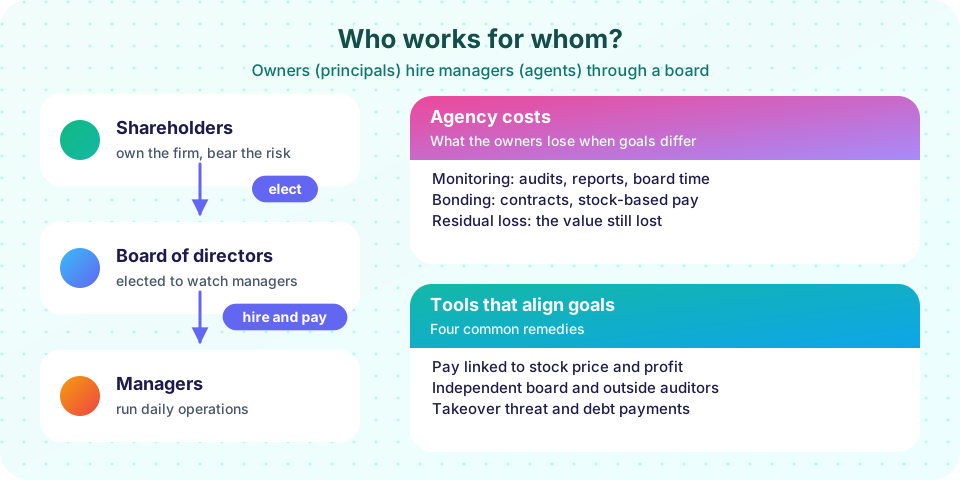
In a small business, the owner is the manager. In a large corporation, thousands of shareholders own the firm but hire professional managers to run it. This separation of ownership and control creates an agency relationship: shareholders (principals) rely on managers (agents).
Managers may be tempted to:
- build bigger empires, since pay and status often rise with company size even when profits do not;
- choose a quiet life, avoiding risky projects that would benefit shareholders;
- spend on perks such as lavish offices and jets;
- focus on short-term numbers that trigger their own bonuses;
- resist a takeover that would help owners but cost the managers their jobs.
None of this needs bad intentions; people respond to their incentives. Economists Michael Jensen and William Meckling named the resulting costs in their 1976 paper on the theory of the firm. They identify three kinds:
- Monitoring costs: audits, reports, board time, analysts' work.
- Bonding costs: the price of promises, for example the contracts that tie manager pay to results.
- Residual loss: the value still lost even after monitoring and bonding.
Aligning incentives
Firms and markets use several tools, usually in combination.
- Pay tied to value. Stock options and shares granted to managers make them gain when the share price rises. The risk is that managers may focus on the share price in the short run, or that the pay is badly designed and rewards luck.
- The board of directors. Shareholders elect the board, which hires, pays and can fire the top managers. A board works best when it contains independent directors, and when it has real access to information.
- The market for corporate control. If a firm is badly run, its share price falls, and an outsider can buy the company and replace the managers. The mere threat disciplines management.
- Debt. Borrowing commits the firm to fixed payments, which reduces the "free cash" a manager can waste. A manager who must pay interest cannot easily fund pet projects.
- Outside monitors. Auditors, credit rating agencies, analysts, regulators and active investors all watch managers.
Real life offers famous failures, such as fraud scandals where managers hid losses to protect bonuses. These led to tighter rules on auditing and disclosure in many countries. The main lesson is practical: when you design or judge an incentive scheme, ask, "What would a rational manager do under this rule?"
Financial markets
Financial markets are the places where cash flows are bought and sold.
- In the primary market a firm sells new shares or bonds directly and receives the money. An initial public offering (IPO) is a primary market sale.
- In the secondary market investors trade existing securities among themselves. The firm gets no money from these trades, but they matter: they give investors a way out, and they set the price.
Secondary markets matter for corporate finance for three reasons. They provide liquidity, so investors will pay more for shares they can sell easily. They provide prices, an up-to-date estimate of what the market thinks the firm is worth. And they provide information, because all the investors' opinions flow into a single number.
Efficient markets, briefly
Eugene Fama's efficient markets hypothesis says that prices quickly reflect available information. In its weak form, past prices cannot be used to predict returns. In its semi-strong form, all public information is already in prices. Evidence is mixed: prices are usually hard to beat, but there are bubbles and anomalies. For us, the practical lesson is that a share price is the market's best available estimate, so managers should expect no easy gains from fooling the market, and should expect no free lunch from choosing financing at the "right time".
Common misconceptions
"The goal is to maximize profit." Profit ignores timing, risk and the money tied up to earn it. Two projects with the same profit can have very different values.
"Managers always act in owners' interests." Usually they try, but incentives matter. Agency costs are normal, not a sign of fraud.
"Secondary market trades bring cash to the firm." They do not. Only the primary market sale (the original issue) gives cash to the company.
Try it
The first example shows why profit is a poor goal. Two projects both earn the same total profit of 300, but project B pays its cash much later. The program compares present values at a 10% rate.
Press Run (or Ctrl + Enter) to see the result here.
Program input · what you'd type while the program runs
Type the answers before you press Run, one per line. Each time the program reads a line (with input()), it gets the next line from this box.
The second example is a small interactive demonstration of an agency problem. A manager chooses between a risky but valuable project and a safe one. Move the slider to change how much of any gain the manager keeps (the bonus share).
With a small bonus share, the manager's fear of failure beats the reward, so a good project is rejected. Raising the share fixes it. Real pay design is far more complex, but this is the heart of the problem.
Check your understanding
Quick check · 5 questions
of 5 answered You scored / 5 · perfect!
-
1. The standard goal of corporate finance is to:
Value combines cash flow, timing and risk, so it avoids the flaws of profit, sales or tax minimization on their own. -
2. Which is an example of an agency cost?
Audits and reports are monitoring costs: owners pay to watch the agent. -
3. When an investor sells shares to another investor on an exchange, the firm:
Secondary market trades move shares between investors. Only a primary market issue brings cash to the company. -
4. Which tool disciplines managers through the threat of being replaced by an outsider?
If a poorly managed firm's price falls, an acquirer can buy it and replace the managers; the threat itself changes behavior. -
5. Why can debt reduce agency costs?
Interest and principal payments must be met, so managers have less cash to waste on pet projects.
Summary
- The goal is to maximize the value of the firm (for a public company, its share price), within legal and ethical limits.
- Value uses cash flow, timing and risk; profit, sales or market share do not.
- The separation of ownership and control creates agency costs: monitoring, bonding and residual loss.
- Pay linked to value, boards, takeover threat, debt and outside monitors align incentives.
- Primary markets raise cash for firms; secondary markets give liquidity, prices and information.
Track your progress
Create a free account to tick off lessons and pick up where you left off on any device.
of Corporate Finance lessons completed