


















Lesson 26 of 45 · Cost of Capital
Chapter overview: Cost of Capital
A map of the cost of capital chapter: the cost of equity, the after-tax cost of debt, the weighted average cost of capital and how to adjust it for project risk.
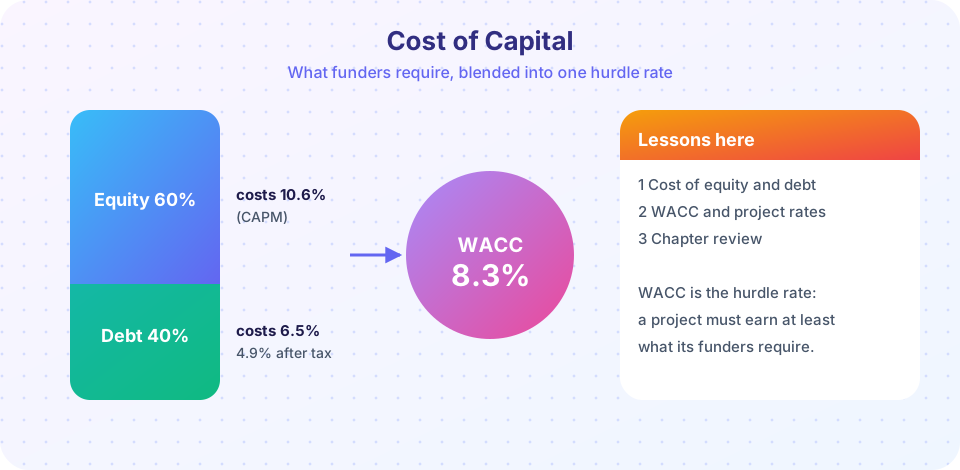
A company raises money from two broad kinds of funders: lenders and owners. Each expects a return. The lender wants interest; the owner wants dividends and share-price growth. Neither provides money for free, and the blended price of all that money is the company's cost of capital. It is the single most important rate in corporate finance because it is the line every project must clear: if an investment earns less than what its funders demand, it destroys value no matter how profitable it looks on paper.
The big picture
The last chapter ended with a promise: the CAPM gives the return that shareholders require. This chapter finishes the job. You will learn how to estimate the cost of equity from the CAPM and two cross-checks, the cost of debt from market yields (and why it is quoted after tax), and how to combine them with market-value weights into the weighted average cost of capital (WACC).
Then comes the subtle part. WACC describes the firm's average risk. A cafe chain opening a new location faces about the same risk as its existing cafes. The same chain launching a software start-up faces very different risk. Using one rate for both would be wrong: it would approve too many risky projects and reject too many safe ones. So the second lesson also covers project-specific rates, using the betas of comparable companies, and the cost of raising new money (flotation costs).
Investors set the price of money
Three costs to estimate
Blend with market weights
What each lesson covers
- Cost of equity and cost of debt: three methods for the cost of equity, how to find a cost of debt from a bond's yield to maturity, and the tax adjustment.
- WACC and project rates: market-value weights, a full WACC calculation, unlevering and relevering beta, pure-play comparisons and flotation costs.
- Chapter review: one-picture summary and a ten-question quiz.
Why the cost of capital matters
Capital budgeting (which you met in the previous part of the course) compares a project's cash flows with the rate at which they must be discounted. That rate is a cost of capital. A mistake of one percentage point can flip decisions: a project with a net present value of +$2 million at 8% may be worth −$0.5 million at 10%. Cost of capital also drives how companies are valued, how regulators set utility prices and how managers are judged (is the business earning more than it costs to fund?).
Key terms for the chapter. Cost of equity: the return shareholders require. Cost of debt: the return lenders require; after tax, it is lower. WACC: weighted average of the after-tax costs of all funding sources, with market-value weights. Hurdle rate: the minimum return a project must earn.
Study tip: read the lessons in order, but run every calculator with your own numbers. Changing the market risk premium, the tax rate or the debt weight and watching the answer move teaches more than reading the formula twice. Keep a one-line note for each formula describing what it is for, not just what it is. When you reach the review, you should be able to explain why each input is needed.
Check your understanding
Quick check · 3 questions
of 3 answered You scored / 3 · perfect!
-
1. Why is the cost of capital a 'hurdle rate' for projects?
A project returning less than its funders' required return reduces shareholder wealth. -
2. Which two groups supply capital in the simplest case?
Debt holders and equity holders provide the long-term funds whose blended cost is the WACC. -
3. Why might one company use different discount rates for different projects?
The discount rate should match the risk of the project's cash flows, not the firm's average.
Summary
- The cost of capital is what funders require; it is the hurdle rate for projects.
- It blends the cost of equity and the after-tax cost of debt using market-value weights.
- One firm-wide rate is a starting point; project risk may call for adjustments.
Track your progress
Create a free account to tick off lessons and pick up where you left off on any device.
of Corporate Finance lessons completed