


















Lesson 37 of 45 · Working Capital and Valuation
Discounted cash flow valuation
Value a business with discounted cash flow: compute free cash flow, discount at WACC, add a terminal value and bridge from enterprise value to equity value per share.
The earlier chapters taught you to value a single project by discounting its cash flows. Valuing a whole company is the same idea on a bigger canvas: forecast the cash the business will generate for all its investors, discount it at the rate that reflects its risk and add it up. The method is simple to state and surprisingly demanding to do well, because every number in it is an assumption. This lesson walks through the full chain with one invented company and shows where the weak links are.
What you will learn
- Compute unlevered free cash flow (FCFF) from operating figures.
- Discount a forecast at WACC and compute a terminal value with the growth formula.
- Bridge from enterprise value to equity value and value per share.
- Recognize why terminal value dominates and which assumptions drive it.
- Avoid the usual mistakes (growth at or above the discount rate, mixing nominal and real).
Key terms
NOPAT: net operating profit after tax, which is EBIT × (1 − T). FCFF: free cash flow to the firm, the cash available to all capital providers. Terminal value (TV): the value at the end of the forecast of all later cash flows. Enterprise value (EV): value of the operating business to all investors. Net debt: debt minus cash.
Free cash flow: the thing we discount
Accounting profit is not cash. To find cash generated by operations for all investors, start from operating profit and adjust:
FCFF = EBIT × (1 − T) + Depreciation & amortization − Capital expenditure − Increase in net working capital
Each part has a reason. EBIT × (1 − T) (NOPAT) is operating profit after the taxes the business would pay on its own, ignoring financing. Depreciation is added back because it is a non-cash charge. Capital expenditure is subtracted because cash left the business to buy equipment, buildings or software. The increase in net working capital is subtracted because growth ties up cash in inventory and receivables, exactly as the previous lesson showed. Interest is not deducted: financing flows belong to the investors we are valuing.
Year 1 for Northwind Cycles (invented): EBIT $120 million, tax 25%, so NOPAT = $90 million. Add D&A of $25 million, subtract capital expenditure of $30 million and a $5 million rise in working capital:
FCFF = 90 + 25 − 30 − 5 = $80 million
Suppose the analyst forecasts FCFF of 80, 88, 95, 101 and 106 over five years, with growth fading as the business matures.
Discounting and the terminal value
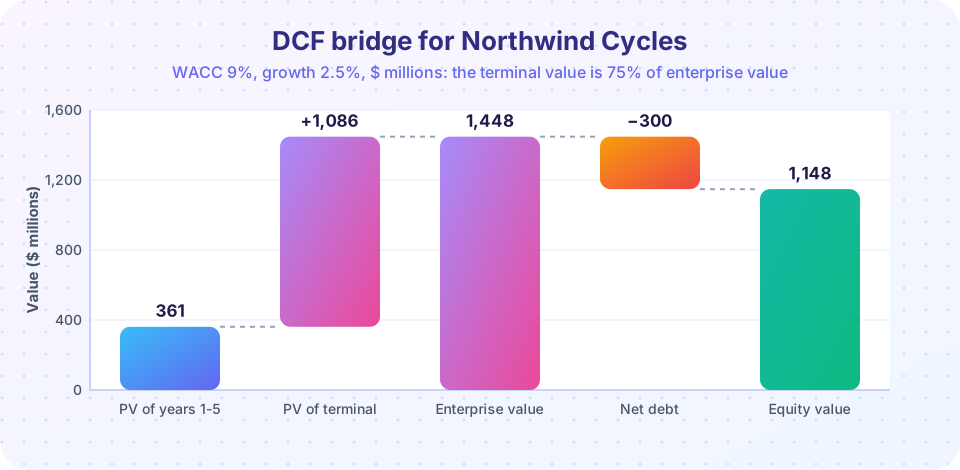
We discount at the WACC, because FCFF belongs to both lenders and shareholders. With WACC = 9%, the present value of year t is FCFF_t / 1.09^t: 73.4, 74.1, 73.4, 71.6 and 68.9, which sum to about $361 million.
But the firm does not die in year 5. A terminal value captures everything after. The growing-perpetuity (Gordon) method assumes cash flow grows at a constant rate g forever:
TV₅ = FCFF₅ × (1 + g) / (WACC − g)
With g = 2.5%: TV₅ = 106 × 1.025 / (0.09 − 0.025) = 108.65 / 0.065 ≈ $1,671.5 million. That is the value at the end of year 5, so discount it five years: 1,671.5 / 1.09⁵ ≈ $1,086 million.
Adding up: EV = 361 + 1,086 ≈ $1,448 million. Note the proportions: about 75% of the value sits in the terminal value. This is typical, and it means a DCF is mostly a statement about what happens after the forecast.
A common alternative is the exit multiple method: apply a multiple (such as EV/EBITDA) to the final-year figure. It is quicker but imports the market's current mood; the next lesson covers multiples.
Press Run (or Ctrl + Enter) to see the result here.
Program input · what you'd type while the program runs
Type the answers before you press Run, one per line. Each time the program reads a line (with input()), it gets the next line from this box.
From enterprise value to equity value
EV is the value of the operating business to all investors. Shareholders own what is left after lenders and others are paid, so subtract the claims that rank ahead:
Equity value = EV − Debt + Cash − Preferred stock − Minority interests (and similar claims)
(That is EV minus net debt when only debt and cash matter.) Northwind has net debt of $300 million, so equity value is 1,447.6 − 300 = $1,147.6 million. With 100 million shares outstanding (use diluted shares: count options and convertibles that would be exercised), the value per share is about $11.48. If the market price is $9, the DCF suggests the shares are cheap; if it is $15, expensive, always conditional on the forecast.
Use market values or fair estimates for debt, include debt-like items such as pension deficits and leases (depending on how your cash flows treat lease costs), and add non-operating assets (a stake in another company, spare land) that FCFF did not capture.
What drives the answer
Terminal value is FCFF × (1 + g) / (WACC − g), which is very sensitive when WACC and g are close. With WACC 9%, moving g from 2.5% to 3.0% raises EV by about 7% (from 1,448 to 1,544); moving WACC from 9% to 8% raises it by about 19% (to 1,716 with g = 2.5%). Hence two disciplines:
- Keep g modest. It must be below the long-run nominal growth of the economy; otherwise the firm would eventually become the economy. Values of 2% to 3% are typical for mature firms in many economies.
- Make growth earn its keep. Sustainable growth requires reinvestment:
g = reinvestment rate × return on new capital. If the terminal cash flow assumes 2.5% growth, it must still deduct the capital expenditure and working-capital build needed to deliver it. Forecasting growth without the matching investment is a classic way to overvalue a business.
A related rule of thumb: in the terminal year, depreciation should be roughly in line with capital expenditure for a steady-state firm, rather than the pattern of a business still in expansion.
Press Run (or Ctrl + Enter) to see the result here.
Program input · what you'd type while the program runs
Type the answers before you press Run, one per line. Each time the program reads a line (with input()), it gets the next line from this box.
FCFF versus FCFE
You can also discount free cash flow to equity (FCFE: cash left for shareholders after debt service and net borrowing) at the cost of equity to get equity value directly. Both methods give the same answer if applied consistently. FCFF with WACC is more common because it does not require forecasting debt, which can change as the firm grows. The rule that matters: the discount rate must match the cash flow: WACC for flows to all investors, cost of equity for flows to shareholders only.
Common misconceptions
"A DCF gives the true value." It gives the value implied by one set of assumptions. A defensible range is the honest output.
"Higher growth always means higher value." Only if the growth earns more than its cost of capital. Growth funded by poor projects destroys value.
"Subtract all debt but ignore cash." Net debt subtracts cash; and non-operating assets and debt-like items must be handled consistently.
"I can use WACC and then subtract interest from cash flow." Do not deduct interest from FCFF: the tax shield and financing cost are already in WACC. Doing both double counts.
Check your understanding
Quick check · 5 questions
of 5 answered You scored / 5 · perfect!
-
1. EBIT = $200m, tax 25%, D&A = $40m, capex = $60m, increase in NWC = $10m. What is FCFF?
NOPAT = 200 × 0.75 = 150; then 150 + 40 − 60 − 10 = $120m. -
2. FCFF in year 5 is $50m, WACC 10%, g 3%. What is the terminal value at year 5?
50 × 1.03 / (0.10 − 0.03) = 51.5 / 0.07 ≈ 735.7, about $736m. -
3. EV = $900m, debt = $350m, cash = $50m, 60m diluted shares. Value per share?
Equity = 900 − 350 + 50 = 600; 600 / 60 = $10.00. -
4. Why do analysts worry about the terminal value?
Since it commonly provides 60% to 80% of enterprise value, small changes in assumptions move the valuation a lot. -
5. Which discount rate matches free cash flow to equity (FCFE)?
Cash flows to shareholders must be discounted at the return shareholders require.
Summary
FCFF = EBIT(1 − T) + D&A − CapEx − ΔNWC, discounted at WACC.- Terminal value
= FCFF × (1 + g)/(WACC − g), discounted from the end of the forecast. - Equity value = EV − net debt (and other claims); divide by diluted shares.
- Terminal value dominates; keep g modest and make growth carry its investment.
Track your progress
Create a free account to tick off lessons and pick up where you left off on any device.
of Corporate Finance lessons completed