


















Lesson 13 of 45 · Valuing Bonds and Stocks
Bond yields and interest rate risk
Compute yield to maturity and current yield, see why bond prices fall when rates rise, and measure interest rate risk with maturity, coupon and duration.
In the last lesson you started from the yield and computed the price. In the market it usually goes the other way: you see a price on a screen and want to know what return it offers. That return is the yield to maturity, the most-quoted number in the bond market. This lesson shows how to find it, and why the price and yield always move in opposite directions.
Then comes the part that surprises beginners: bonds that look safe can lose a lot of value when interest rates rise. We will measure that interest rate risk with the effects of maturity and coupon, and with a tool called duration. If you hold bonds in a pension fund, a bank or a company treasury, this is the risk you manage every day.
What you will learn
- Compute the yield to maturity from a bond price.
- Compare YTM, current yield and coupon rate.
- Explain the inverse relationship between price and yield.
- Say how maturity and coupon size change interest rate risk.
- Compute duration and use it to estimate a price change.
Key terms
Yield to maturity (YTM): the single discount rate that makes the present value of all promised cash flows equal to the bond's price.
Current yield: annual coupon divided by the price; ignores any gain or loss at maturity.
Interest rate risk: the risk that bond prices fall because market yields rise.
Duration: a weighted average time to receive the bond's cash flows, in years; it measures price sensitivity.
Convexity: the curvature of the price-yield relationship; prices rise more for a yield fall than they drop for an equal yield rise.
Finding the yield to maturity
Suppose a 5-year bond with a 5% annual coupon (face 1,000) trades at $950. What yield does it offer? You need the rate y that solves
950 = 50 x [1 - (1 + y)^-5] / y + 1,000 / (1 + y)^5
There is no neat algebraic solution. Finance calculators and spreadsheets use trial and error: try 6%, which gives 957.88 (too high), try 7%, which gives 918.00 (too low), and home in between. The answer is about 6.19%. The bond's coupon rate is 5% but its yield is higher, because you buy at a discount and gain on the way to par.
The current yield is 50 / 950 = 5.26%. It captures the coupon income but ignores the 50 gain at maturity, so it is lower than the YTM here. For a bond at a premium the current yield is higher than the YTM. Only the YTM combines both income and the pull to par.
The YTM has a clear meaning: it is the annual return you would earn if you buy at the price, hold to maturity, receive every payment, and could reinvest every coupon at the same yield. The last condition is a limitation, because real reinvestment rates change.
Price and yield move opposite ways
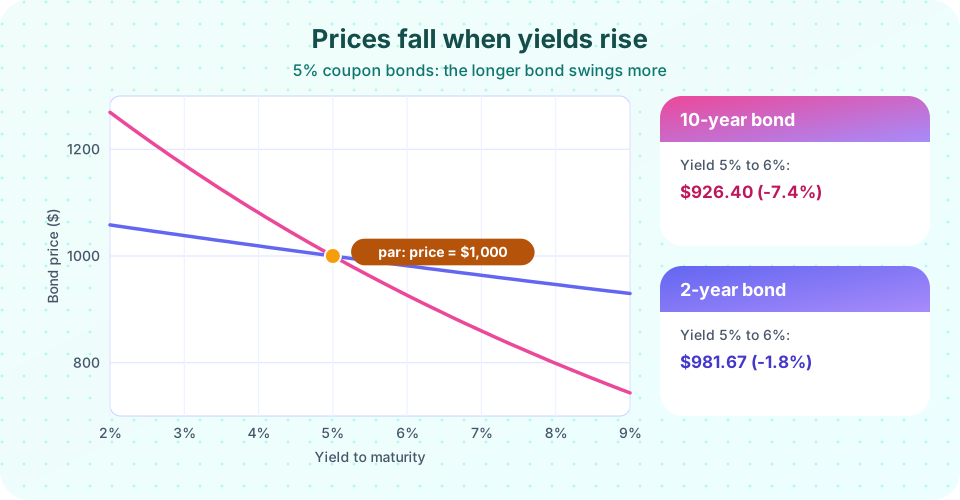
Every cash flow of a bond is fixed. If the market yield rises, the same cash flows are discounted more heavily, so their present value falls. The relationship is the curve in the picture. For the 5% bond with 10 years left:
| Yield | Price | Change from par |
|---|---|---|
| 4% | $1,081.11 | +8.1% |
| 5% | $1,000.00 | 0 |
| 6% | $926.40 | -7.4% |
Two features stand out. First, the relationship is inverse: yields up, prices down. Second, it is convex: a one-point drop in yield raises the price by 81, while a one-point rise lowers it by only 74. The curve bends, so gains from falling yields exceed the losses from rising yields of the same size.
A good intuition: suppose you bought a 5% bond and the market now pays 6% on new bonds. Nobody will pay full price for your 5% bond unless you cut the price, giving the new buyer the extra 1% in the form of a discount.
What makes interest rate risk larger?
- Longer maturity. The picture shows it clearly: when the yield moves from 5% to 6%, the 10-year bond loses 7.4% but the 2-year bond loses only 1.8%. Far-off cash flows are hit the hardest by a change in the discount rate.
- Smaller coupons. A low-coupon bond delivers more of its value late, so it behaves like a longer bond. A zero-coupon bond is the most sensitive for its maturity.
- Lower starting yields. At low yields, a given change moves prices more.
These three factors are captured in a single number: duration.
Duration
Macaulay duration is the weighted average time at which you receive the cash flows, where the weights are the present values of each cash flow as a share of the price. For the 10-year 5% bond at a 5% yield, the average is about 8.11 years: much closer to the end than the middle, because the 1,000 at the end carries most of the value. A zero-coupon bond's duration equals its maturity (10 years for a 10-year zero).
Modified duration is Macaulay / (1 + y), here 8.11 / 1.05 = 7.72. It gives a direct estimate of price sensitivity:
% change in price ≈ - modified duration x change in yield
For a yield rise of one percentage point (0.01): -7.72 x 0.01 = -7.7%, about 77 on a price of 1,000. The exact change is -73.6 (-7.4%) for a rise and +81.1 for a fall. The estimate is a straight-line approximation of the curve, so it is slightly off, and the gap is explained by convexity. For small changes in yield, duration works well; for large changes, convexity matters.
For the 2-year 5% bond, the Macaulay duration is 1.95 years and the modified duration is 1.86, so a 1% yield rise lowers the price by about 1.9%, matching the exact 1.8%.
Managing the risk
- A bank or an insurance company can match the duration of its assets to the duration of its liabilities, so rate changes affect both sides equally. This is called immunization.
- An investor who expects rates to fall holds longer bonds; one who expects them to rise shortens.
- Holding a bond to maturity removes the price risk (you get your face value), but the opportunity cost remains if rates rose.
Common misconceptions
"Government bonds are risk free." A government bond may have no default risk, but its price can fall sharply when rates rise. In 2022, long-term government bonds in many countries lost more than 20% in value.
"Yield to maturity is the return I will certainly get." It is the return only if you hold to maturity, nothing defaults, and coupons are reinvested at the YTM.
"A bond's coupon is its yield." Coupon is a fixed percentage of face value. Yield depends on the price.
Try it
The first program solves for the YTM by bisection (the same trial-and-error method calculators use), and computes current yield, duration and the duration-based estimate of price changes.
Press Run (or Ctrl + Enter) to see the result here.
Program input · what you'd type while the program runs
Type the answers before you press Run, one per line. Each time the program reads a line (with input()), it gets the next line from this box.
The second program draws the price-yield curve of the 10-year bond with the duration "straight line" at 5%. The gap between the curve and the line is convexity.
Press Run (or Ctrl + Enter) to see the result here.
Program input · what you'd type while the program runs
Type the answers before you press Run, one per line. Each time the program reads a line (with input()), it gets the next line from this box.
Check your understanding
Quick check · 5 questions
of 5 answered You scored / 5 · perfect!
-
1. When the market yield rises, the price of an existing fixed-coupon bond:
The fixed cash flows are discounted at a higher rate, so their present value falls. -
2. A bond with a $60 annual coupon trades at $800. Its current yield is:
Current yield = coupon / price = 60 / 800 = 7.5%. -
3. Which bond has the largest interest rate risk (similar yield)?
Long maturity and a low coupon both increase duration, so the 30-year 2% bond is the most sensitive. -
4. A bond's modified duration is 6. The yield rises by 0.5 percentage points. The estimated price change is:
Change = -6 x 0.005 = -0.03, a 3% fall. -
5. The Macaulay duration of a 7-year zero-coupon bond is:
A zero pays everything at maturity, so the weighted average time to cash is exactly its maturity.
Summary
- YTM is the discount rate that equates the PV of cash flows to the price; it is found by trial and error.
- Current yield ignores gains or losses at maturity: coupon / price.
- Price and yield move in opposite directions; the relationship is convex.
- Long maturity and low coupon mean higher interest rate risk.
- Modified duration estimates the percentage price change:
-D x change in yield.
Track your progress
Create a free account to tick off lessons and pick up where you left off on any device.
of Corporate Finance lessons completed