


















Lesson 14 of 45 · Valuing Bonds and Stocks
Stock valuation and the dividend discount model
Value a share as the present value of its dividends: zero growth, constant growth (Gordon), two-stage growth, and how to estimate growth and required return.
A bond's cash flows are written in a contract. A stock's are not. A share entitles its owner to a vote and to a slice of whatever profits the company decides to pay out, with no end date and no promised amount. So how can we value something so open-ended?
The answer is the same as before: by the cash it will pay its owner. The cash an owner receives from a share is a stream of dividends, plus the sale price if she sells. This gives the dividend discount model, and a few sensible assumptions about how dividends grow turn an infinite sum into formulas as simple as the perpetuities of chapter 2.
What you will learn
- Write the price of a stock as the present value of future dividends.
- Use the zero-growth and constant-growth (Gordon) models.
- Estimate the growth rate from retention and return on equity.
- Back out the required return from a market price.
- Value a stock with a high-growth phase followed by stable growth.
Key terms
Dividend: a cash payment from a company to its shareholders, usually per share per period.
Required return (r): the return investors demand for the risk of the stock; it is the discount rate.
Growth rate (g): the expected annual growth of dividends.
Retention ratio (b): the fraction of earnings the company keeps rather than pays out.
Return on equity (ROE): net income divided by shareholders' equity.
The dividend discount model
Suppose you buy a share today, hold it for one year, and sell. You receive a dividend D1 and the sale price P1. The value today is P0 = (D1 + P1) / (1 + r). But P1 is itself the value of dividends from year 2 onward, so we can expand: P1 = (D2 + P2) / (1 + r), and so on. Chaining forever gives
P0 = D1 / (1 + r) + D2 / (1 + r)^2 + D3 / (1 + r)^3 + ...
This says that the price today is the present value of all future dividends, even if you plan to sell soon, because the buyer will in turn value the share by its later dividends. The model is a general truth; to use it we need assumptions about the pattern of dividends.
Case 1: zero growth
If the dividend stays the same forever, the stock is a perpetuity:
P0 = D / r
A company pays a fixed $3.00 per share and investors require 10%: P0 = 3 / 0.10 = $30. This describes preferred stock well, and some mature, stable payers.
Case 2: constant growth (the Gordon model)
If dividends grow at a constant rate g forever, we have a growing perpetuity. With D1 the dividend expected next year,
P0 = D1 / (r - g) (requires r > g)
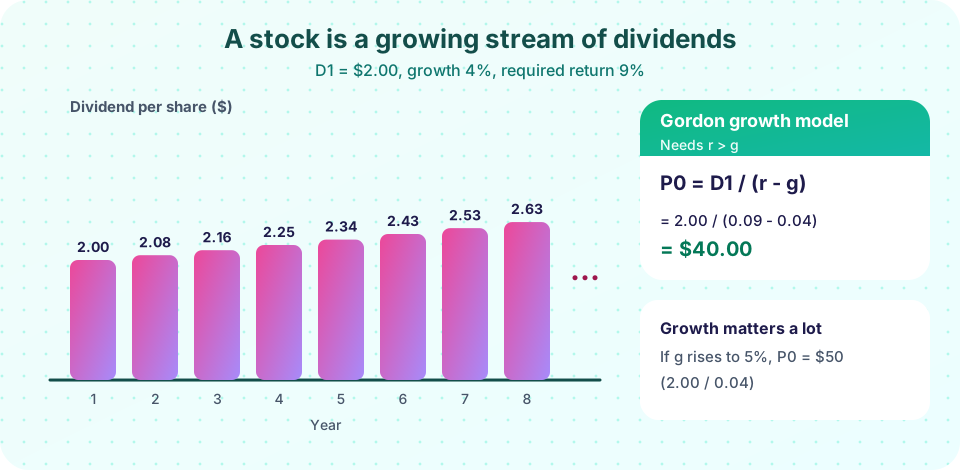
This is named after Myron Gordon, who developed it in the 1950s. In the picture, D1 = 2.00, g = 4%, r = 9%: P0 = 2 / 0.05 = $40.00.
If you know the last dividend D0, then D1 = D0 x (1 + g). A stock that just paid 1.923 would have D1 = 2.00 at 4% growth.
Sensitivity: the model is touchy
Look how the price reacts to small changes in the inputs, with D1 = 2 fixed:
| g | r = 9% | r = 11% |
|---|---|---|
| 3% | $33.33 | $25.00 |
| 4% | $40.00 | $28.57 |
| 5% | $50.00 | $33.33 |
A change of one percentage point in g or in r moves the price by 20% or more. This is because the denominator r - g is small. It explains why stock prices move so much when expectations about growth or interest rates change, and why a single Gordon calculation should never be taken as precise. Treat it as a way to think, and test a range of assumptions.
Where does g come from?
Dividends can grow only if the company's earnings grow, and growth needs reinvestment. A simple estimate is
g = retention ratio x return on equity = b x ROE
A firm that keeps 40% of earnings (and pays out 60%) and earns 15% on its equity can sustainably grow at 0.40 x 0.15 = 6%. This sustainable growth rate assumes ROE stays constant and the capital structure is unchanged. Be sceptical of any model where growth exceeds the growth rate of the economy forever.
Where does r come from?
Rearrange the Gordon model: r = D1 / P0 + g. The required return has two parts: the dividend yield D1 / P0 and the growth (capital gain) g. If a share trades at $50, D1 = 2 and expected growth is 5%, then r = 2/50 + 0.05 = 4% + 5% = 9%. That is the return the market is implicitly demanding. Chapter 5 will show how to estimate r from the stock's risk with the capital asset pricing model.
Case 3: non-constant growth
Young companies often grow fast for a while and then slow down. Use a two-stage method:
- Forecast dividends one by one for the fast-growth years.
- At the end of the fast phase, value the stock with the Gordon model from then on (a terminal value).
- Discount everything to today.
Example. D0 = 2.00. Dividends grow 15% a year for 3 years, then 4% forever. The required return is 10%.
| Year | Dividend | Present value at 10% |
|---|---|---|
| 1 | 2.300 | 2.09 |
| 2 | 2.645 | 2.19 |
| 3 | 3.042 | 2.29 |
Terminal value at the end of year 3: P3 = D4 / (r - g) = 3.042 x 1.04 / 0.06 = 52.72. Its present value is 52.72 / 1.10^3 = 39.61. Sum: 2.09 + 2.19 + 2.29 + 39.61 = $46.17. Notice that most of the value, about 86%, comes from the terminal value. This is typical, and it is why growth assumptions in the long run matter so much.
Companies that pay no dividends
Many growing companies pay no dividend. The model still applies: investors expect dividends, or cash from a sale of the company or share buybacks, eventually. In practice analysts often value such firms by discounting free cash flow (the cash available to all investors, as in lesson 4 of chapter 1) instead of dividends, which is the approach of chapter 8. Both approaches rest on the same principle: value is the present value of cash that can eventually be taken out.
Common misconceptions
"A stock is worth its earnings multiple, so dividends do not matter." Multiples are shortcuts. The underlying value is still the present value of cash paid to owners; a company that never pays out anything would be worthless.
"The Gordon model works for any growth rate." It requires g < r. If you find g >= r, your growth forecast cannot be maintained forever.
"Higher growth always means a higher price." Only if the growth is financed by projects that earn more than the required return. Growth from bad projects destroys value.
Try it
The first program values stocks with the zero-growth, constant-growth and two-stage models, estimates sustainable growth and the implied required return.
Press Run (or Ctrl + Enter) to see the result here.
Program input · what you'd type while the program runs
Type the answers before you press Run, one per line. Each time the program reads a line (with input()), it gets the next line from this box.
The second program plots the Gordon price against growth for different required returns. Watch how the curve explodes as g approaches r.
Press Run (or Ctrl + Enter) to see the result here.
Program input · what you'd type while the program runs
Type the answers before you press Run, one per line. Each time the program reads a line (with input()), it gets the next line from this box.
Check your understanding
Quick check · 5 questions
of 5 answered You scored / 5 · perfect!
-
1. A share pays a constant dividend of $4 and investors require 8%. The value is:
Zero growth: P0 = D / r = 4 / 0.08 = 50. -
2. D1 = $3, r = 11%, g = 5%. The Gordon value is:
P0 = 3 / (0.11 - 0.05) = 50. -
3. A firm keeps 50% of its earnings and has an ROE of 12%. Its sustainable growth rate is:
g = b x ROE = 0.5 x 0.12 = 6%. -
4. A share costs $40, the next dividend is $1.60 and growth is expected at 6%. The implied required return is:
r = D1 / P0 + g = 1.60 / 40 + 0.06 = 0.04 + 0.06 = 10%. -
5. Why is the Gordon formula invalid when g is larger than r?
If growth outpaces the discount rate, the terms of the sum never shrink. No company can outgrow the economy forever.
Summary
- Stock value = PV of expected dividends (or, equivalently, of the cash that will eventually be paid to owners).
- Zero growth:
P0 = D / r; constant growth:P0 = D1 / (r - g)withr > g. - Estimate growth with
g = b x ROE, and the required return withr = D1/P0 + g. - Fast growth then stable growth: forecast dividends, add a terminal value, discount.
- The price is very sensitive to
gandr, so test a range of assumptions.
Next: Chapter 3 review
Track your progress
Create a free account to tick off lessons and pick up where you left off on any device.
of Corporate Finance lessons completed