


















Lesson 15 of 45 · Valuing Bonds and Stocks
Chapter 3 review: Valuing Bonds and Stocks
Review chapter 3: bond pricing, yield to maturity, duration, the dividend discount and Gordon models, with a summary picture and a ten-question quiz.
This chapter had one idea and two applications. The idea: a security is worth the present value of its expected cash flows. The applications: bonds, whose cash flows are promised, and stocks, whose cash flows are forecast. If you can explain why a bond's price falls when its yield rises, and why a stock's price depends so much on the growth rate, you have the core of the chapter.
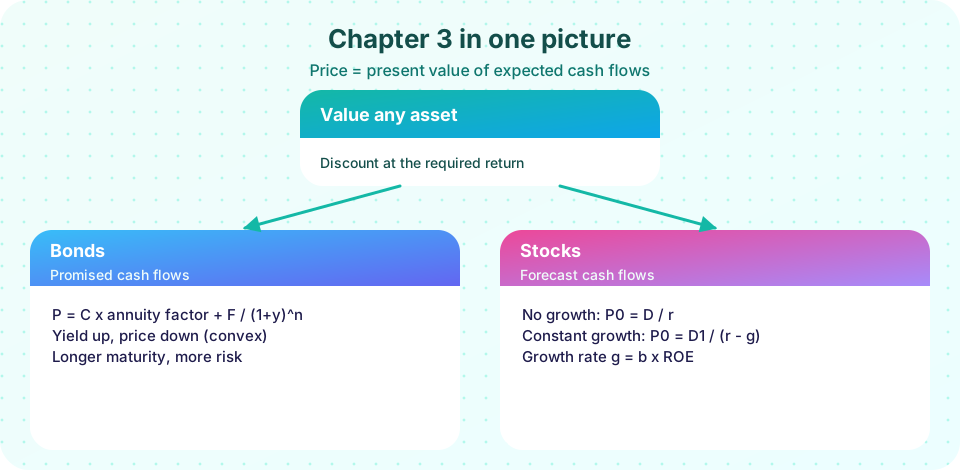
The chapter in a table
| Topic | Key formula | Remember |
|---|---|---|
| Coupon bond price | C x [1 - (1 + y)^-n] / y + F / (1 + y)^n |
Annuity plus single sum |
| Premium / discount | Yield below / above the coupon rate | Par when yield equals coupon rate |
| Zero-coupon bond | F / (1 + y)^n |
Duration equals maturity |
| Semiannual bond | Halve coupon and yield, double periods | Rate and period must match |
| YTM | Solve price equation for y |
Needs trial and error |
| Current yield | Coupon / price | Ignores gain at maturity |
| Interest rate risk | Longer maturity, lower coupon, higher risk | Modified duration estimates it |
| Zero-growth stock | D / r |
Perpetuity |
| Gordon model | D1 / (r - g), needs r > g |
Very sensitive to r and g |
| Growth and return | g = b x ROE, r = D1/P0 + g |
Two-stage: add a terminal value |
Linking bonds and stocks
Compare the two models side by side. The bond uses a known cash flow and a market yield. The stock uses a forecast cash flow and a required return, and it never ends. The two differ in risk and therefore in the discount rate: a company's stock must offer a higher expected return than its own bonds. In chapter 5 you will learn how to measure that extra risk, and in chapter 6 how a firm blends the two returns into its cost of capital.
A worked mixed problem
Harbor Foods has a 10-year bond with a 5% coupon, face value 1,000, and a market yield of 6%. Its price is 926.40. Its stock has a next-year dividend of 2.00, growing at 4%, with a required return of 9%, so the stock is worth 40.00.
Now suppose the central bank raises interest rates, and every required return rises by one percentage point. The bond's yield becomes 7%, so its price drops to 859.53, a fall of 7.2%. The stock's required return becomes 10%, so 2 / (0.10 - 0.04) = 33.33, a fall of 16.7%. The stock fell more, because its cash flows run forever and are very sensitive to the gap r - g. This is the reason growth stocks tend to be hit harder than short-dated bonds when rates jump.
What would change the answer? If the bond's maturity were 3 years, the fall would be much smaller: its price would go from 973.27 to 947.51, about 2.6%. If the stock's growth were 2% instead of 4%, the stock would be worth 2 / 0.07 = 28.57 at the start and 2 / 0.08 = 25.00 after the rate rise, a fall of 12.5%, smaller than before. Always ask which inputs the answer is most sensitive to.
Common exam traps
- Forgetting to halve the coupon and the yield for semiannual bonds.
- Using
D0where the Gordon formula needsD1. - Applying the Gordon formula when
gis not belowr. - Comparing the coupon rate with the yield and getting the premium and discount the wrong way round.
- Treating YTM as a guaranteed return.
Try it
This program is a check tool for the chapter: it solves a set of standard problems, so you can compare it with your hand calculations.
Press Run (or Ctrl + Enter) to see the result here.
Program input · what you'd type while the program runs
Type the answers before you press Run, one per line. Each time the program reads a line (with input()), it gets the next line from this box.
The second program shows a "valuation sheet" for one imaginary company: the stock price and the bond price side by side under a change in the market discount rate. Which one reacts more?
Press Run (or Ctrl + Enter) to see the result here.
Program input · what you'd type while the program runs
Type the answers before you press Run, one per line. Each time the program reads a line (with input()), it gets the next line from this box.
Check your understanding
Quick check · 10 questions
of 10 answered You scored / 10 · perfect!
-
1. A 4-year, 4% annual coupon bond (face 1,000) has a yield of 5%. Its price is closest to:
40 x 3.54595 + 1,000 / 1.05^4 = 141.84 + 822.70 = 964.54, a discount because the yield exceeds the coupon rate. -
2. A 5-year zero-coupon bond with face value 1,000 is priced at a 6% yield. Its price is:
1,000 / 1.06^5 = 747.26. -
3. A bond sells at par. Its yield to maturity equals:
At par, price equals face value, which happens exactly when the yield equals the coupon rate. -
4. Modified duration is 5. Yields fall by 0.8 percentage points. The estimated price change is:
Change = -5 x (-0.008) = +0.04, a 4% rise. -
5. A 6-year bond pays semiannual coupons. The number of periods to use is:
Two periods per year for 6 years makes 12 half-year periods. -
6. D0 = $1.50, g = 4%, r = 9%. The Gordon price is:
D1 = 1.50 x 1.04 = 1.56; P0 = 1.56 / 0.05 = 31.20. -
7. A firm pays out 70% of earnings and has an ROE of 10%. Its sustainable growth rate is:
Retention is 30%, so g = 0.30 x 10% = 3%. -
8. P0 = $25, D1 = $1, g = 3%. The implied required return is:
r = D1/P0 + g = 4% + 3% = 7%. -
9. Which bond is the most sensitive to a rise in interest rates?
Long maturity and low coupon both raise duration. -
10. Why must the required return on a stock exceed that on the same firm's bonds?
Shareholders get the residual, so they bear more risk and need a higher expected return.
Summary
- Price = PV of expected cash flows at a risk-appropriate rate; bonds use the market yield, stocks the required return.
- Bond prices and yields move in opposite directions; long, low-coupon bonds are the most sensitive.
- Dividend models: zero growth
D/r, constant growthD1/(r-g), two-stage with a terminal value. g = b x ROEandr = D1/P0 + glink valuation to company policy and market prices.- Results are sensitive to
randg: test ranges, not single numbers.
Track your progress
Create a free account to tick off lessons and pick up where you left off on any device.
of Corporate Finance lessons completed