


















Lesson 42 of 45 · Projects and Practice
Practice problem set: chapters 5 to 8
Eighteen practice problems on risk and return, cost of capital, capital structure, working capital and valuation, with a solver, an answer checker and worked results.
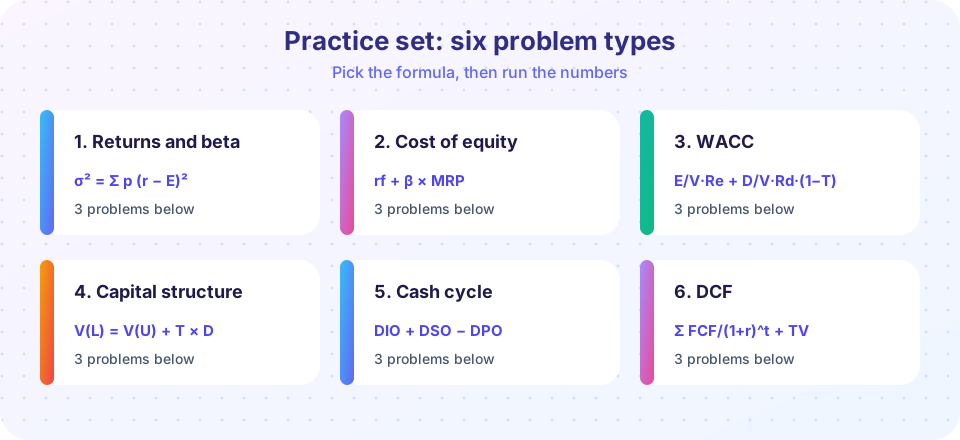
Reading about formulas is not the same as using them. This practice set has eighteen problems, three for each of the six main skills from chapters 5 to 8. Try each by hand first, with a calculator if you like. Then run the solver below to see how a program checks the same figures, and compare with the answer table. All companies and numbers are invented for practice.
What you will learn
- Choose the right formula for a worded problem.
- Practise the arithmetic of the chapter's core ideas until it is automatic.
- Use a short program to check your work.
How to work a problem
A routine that prevents most mistakes: (1) write down what is given and what is asked; (2) name the formula; (3) check units (percent versus decimals, millions versus units); (4) compute; (5) ask whether the answer is plausible. A WACC above the cost of equity, a negative variance or a beta of 15 means something went wrong.
Set A: returns and risk
- A share is bought for $80, pays a $3 dividend and is sold for $84. What is the holding-period return?
- A stock returns +25% in a boom (probability 30%), +8% in a normal year (50%) and −18% in a bust (20%). Find the expected return, the variance and the standard deviation.
- A portfolio holds 60% in asset A (standard deviation 25%) and 40% in asset B (15%). The correlation is 0.2. What is the portfolio standard deviation, and how does it compare with the weighted average of the two?
Set B: costs of equity and debt
- The risk-free rate is 3.5%, the market risk premium is 6% and a stock's beta is 0.9. What is the CAPM cost of equity?
- A company's last dividend (D0) was $1.20, growth is expected at 4% a year and the share price is $26. What is the dividend-growth cost of equity?
- A bond has a $1,000 face value, a 5% annual coupon, eight years to maturity and a price of $920. What is its yield to maturity, and what is the after-tax cost at a 25% tax rate?
Set C: WACC
- Equity is worth $450 million at a cost of 12%; debt is worth $150 million at 7% before tax; the tax rate is 30%. What is the WACC?
- A comparable has an equity beta of 1.3, a debt-to-equity ratio of 0.6 and a 25% tax rate. Unlever the beta, then relever it for a project financed at D/E = 0.2.
- A project needs $8 million of new equity and the issuer's flotation cost is 4% of the amount raised. How much must be raised, and what is the fee?
Set D: capital structure
- A firm has perpetual EBIT of $60 million, a 30% tax rate and an unlevered cost of capital of 12%. Find the unlevered value, and the levered value with $150 million of permanent debt.
- With no taxes, R0 = 10%, Rd = 6% and D/E = 0.5, what is the cost of equity?
- Plan A issues new shares, leaving 9 million shares and no interest. Plan B borrows instead, leaving 6 million shares and costing $5 million a year in interest. Find the break-even EBIT (ignore tax, which does not change the break-even).
Set E: working capital
- Sales are $1,825 million, COGS $1,095 million, inventory $150 million, receivables $200 million and payables $90 million. Find DIO, DSO, DPO and the cash conversion cycle.
- Supplier terms are 3/15 net 45. What is the effective annual rate of skipping the discount?
- Annual demand is 18,000 units, ordering cost is $30 an order and holding cost is $1.50 per unit a year. Find the EOQ.
Set F: valuation
- EBIT is $160 million, tax 25%, D&A $30 million, capital expenditure $45 million and the increase in net working capital $8 million. What is FCFF?
- Year-5 FCFF is $70 million, WACC is 10% and long-run growth 3%. Find the terminal value at year 5 and its present value.
- Enterprise value is $700 million, debt $260 million, cash $40 million and shares 50 million. What is the value per share?
Press Run (or Ctrl + Enter) to see the result here.
Program input · what you'd type while the program runs
Type the answers before you press Run, one per line. Each time the program reads a line (with input()), it gets the next line from this box.
Answers
| # | Answer | Key step |
|---|---|---|
| 1 | 8.75% | (84 − 80 + 3) / 80 |
| 2 | E = 7.9%, variance ≈ 221.9, σ ≈ 14.9% | probability-weighted squared deviations |
| 3 | 17.2% versus 21.0% weighted average | cross term uses ρ = 0.2 |
| 4 | 8.9% | 3.5% + 0.9 × 6% |
| 5 | 8.8% | 1.248 / 26 = 4.8%, plus 4% |
| 6 | YTM ≈ 6.30%, after tax ≈ 4.73% | solve the bond price equation |
| 7 | 10.225% | 0.75 × 12% + 0.25 × 7% × 0.7 |
| 8 | βu ≈ 0.897, relevered ≈ 1.031 | 1.3 / 1.45, then × 1.15 |
| 9 | raise $8.333m, fee $0.333m | 8 / 0.96 |
| 10 | VU = $350m, VL = $395m | 60 × 0.7 / 0.12, plus 0.3 × 150 |
| 11 | 12% | 10% + 4% × 0.5 |
| 12 | $15m | EBIT/9 = (EBIT − 5)/6 |
| 13 | DIO 50, DSO 40, DPO 30, CCC 60 days | days formulas |
| 14 | about 44.9% | (1 + 3/97)^(365/30) − 1 |
| 15 | about 849 units | √(2 × 18,000 × 30 / 1.5) |
| 16 | $97m | 120 + 30 − 45 − 8 |
| 17 | TV = $1,030m, PV ≈ $639.5m | 70 × 1.03 / 0.07, then ÷ 1.1⁵ |
| 18 | $9.60 | (700 − 260 + 40) / 50 |
Strategy for exams and interviews
Problems like these appear in university exams and finance interviews, and a few habits help in both. Say your formula out loud or write it down before touching numbers. It forces you to confirm that you are solving the right problem, and in an interview it shows your reasoning even if the arithmetic slips. Round late. Keep several decimals through the calculation and round only the final answer; early rounding is the most common source of answers that are "almost right". Sanity check by magnitude. A cost of equity near 9%, a WACC just below it, a beta near 1: these are the ranges you expect. A result far from them should prompt a recheck. Know the limits of the model. If asked to comment on an answer, mention one weakness: the CAPM's single factor, the sensitivity of a terminal value, the invented nature of a peer group.
When you get a problem wrong, do not just correct the number. Identify which of the four common errors it was: wrong formula, wrong units, wrong base or arithmetic slip. Keeping a short error log for a week or two reveals your personal pattern, and fixing a pattern is far more effective than redoing the same problem.
Common mistakes to watch for
Mixing percent and decimals. 0.12 and 12 are not interchangeable inside a formula.
Forgetting the tax adjustment on debt in WACC, or applying it to equity or preferred.
Using the coupon rate instead of the yield for the cost of debt.
Dividing by the wrong base in the working capital days: receivables use sales, inventory and payables use COGS.
Discounting the terminal value one year too few. It is discounted by the same number of years as the final forecast year.
Check your understanding
Quick check · 5 questions
of 5 answered You scored / 5 · perfect!
-
1. A stock costs $50, pays a $2 dividend and ends the year at $49. What is the return?
(49 − 50 + 2) / 50 = 1 / 50 = 2%. -
2. E = $60m at 10%, D = $40m at 5%, T = 20%. What is the WACC?
0.6 × 10% + 0.4 × 5% × 0.8 = 6.0% + 1.6% = 7.6%. -
3. FCFF is $30m in year 1, WACC is 8% and growth is 2%. If the cash flows continue forever from year 2 at that growth, the value at year 1 of the later flows is about:
30 × 1.02 / (0.08 − 0.02) = 30.6 / 0.06 = $510m. -
4. COGS $730m and payables $60m. DPO is:
60 / 730 × 365 = 30 days. -
5. D = 800, S = $20, H = $2. The EOQ is:
√(2 × 800 × 20 / 2) = √16,000 ≈ 126.
Summary
- Name the formula, check units, compute, and test plausibility.
- The six skills: return and risk, cost of equity and debt, WACC, capital structure, working capital, valuation.
- Use a program to confirm your arithmetic, not to replace the reasoning.
Next: Glossary
Track your progress
Create a free account to tick off lessons and pick up where you left off on any device.
of Corporate Finance lessons completed