


















Lesson 43 of 45 · Projects and Practice
Glossary: terms from chapters 5 to 8
A plain-language glossary of corporate finance terms from risk and return, cost of capital, capital structure, working capital and valuation, with flashcards for practice.
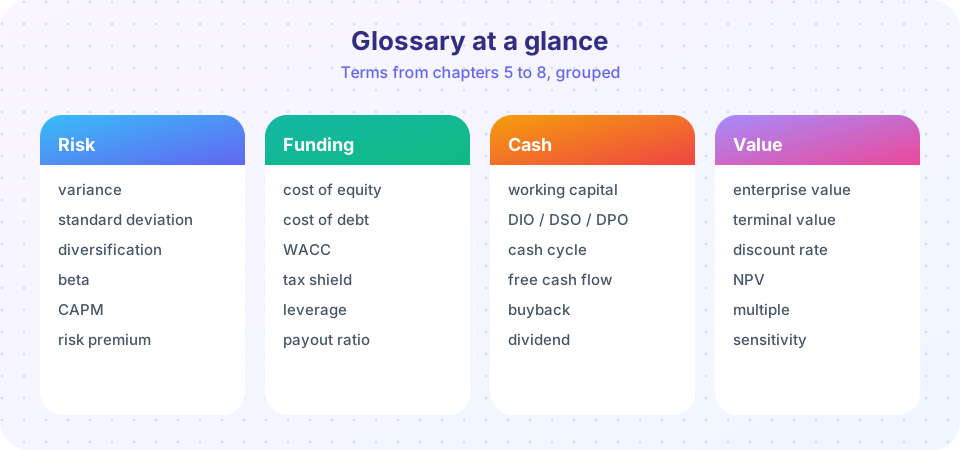
Finance has its own vocabulary, and much of the difficulty of a first course is simply learning to read the words. This glossary collects the key terms from the second half of the course, grouped the same way as the picture below: risk, funding, cash and value. Definitions are short and use the formulas from the lessons. Use it as a reference, and then test yourself with the flashcards.
Risk and return
| Term | Meaning |
|---|---|
| Holding-period return | (ending price − starting price + income) / starting price. |
| Expected return | Probability-weighted average of possible returns. |
| Variance | Probability-weighted average of squared deviations from the expected return. |
| Standard deviation | Square root of variance; the usual risk measure, in the same units as return. |
| Arithmetic average | Simple average of returns; best estimate of a single future year. |
| Geometric average | Compound annual growth rate; always at or below the arithmetic average. |
| Risk-free rate | Return on an asset with no default risk, such as a short government bill. |
| Risk premium | Expected return minus the risk-free rate. |
| Correlation | Scaled covariance between two returns, from −1 to +1. |
| Diversification | Spreading money across assets that do not move together to reduce risk. |
| Unique (idiosyncratic) risk | Risk specific to one firm; removed by diversification. |
| Market (systematic) risk | Risk shared by nearly all assets; cannot be diversified away. |
| Beta | Sensitivity of an asset's return to market returns: Cov(asset, market) / Var(market). |
| CAPM | Required return = risk-free rate + beta × market risk premium. |
| Security market line | The CAPM line of required return against beta. |
| Alpha | Return in excess of what the CAPM requires for the asset's beta. |
Funding and cost of capital
| Term | Meaning |
|---|---|
| Cost of equity | Return shareholders require; estimated by CAPM, dividend growth or bond yield plus premium. |
| Cost of debt | Return lenders require; use the market yield to maturity. |
| Yield to maturity | Discount rate that makes a bond's promised cash flows equal its price. |
| Interest tax shield | Tax saved because interest is deductible: T × interest. |
| WACC | Weighted average of after-tax funding costs using market-value weights. |
| Hurdle rate | The minimum return a project must earn to be accepted. |
| Unlevered (asset) beta | The beta a firm would have with no debt. |
| Pure play | A listed company operating almost entirely in the line of business being valued. |
| Flotation cost | Fees paid to issue new securities; added to the initial outlay. |
| Capital structure | The mix of debt and equity used to fund the firm. |
| Leverage | The use of debt in funding. |
| Modigliani-Miller | The theorems showing capital structure is irrelevant in a perfect market and worth T × D with taxes. |
| Financial distress | Difficulty meeting obligations to lenders; carries direct and indirect costs. |
| Agency cost | Value lost to conflicts of interest among managers, owners and lenders. |
| Pecking order | Preference for retained earnings, then debt, then new equity. |
| Degree of financial leverage | EBIT / (EBIT − interest); the amplification of EBIT changes in EPS. |
Payout and cash
| Term | Meaning |
|---|---|
| Payout ratio | Dividends divided by net income. |
| Dividend yield | Annual dividend divided by share price. |
| Ex-dividend date | First day shares trade without the right to the declared dividend. |
| Share repurchase (buyback) | The firm buys its own shares, reducing the share count. |
| Residual dividend policy | Pay out what is left after funding all positive-NPV projects. |
| Stock split | Exchange of each share for several; changes price and share count, not value. |
| Net working capital | Operating current assets minus operating current liabilities. |
| DIO, DSO, DPO | Days of inventory, sales (receivables) and payables outstanding. |
| Cash conversion cycle | DIO + DSO − DPO. |
| Trade credit | Credit extended by suppliers; terms like 2/10 net 30. |
| Economic order quantity | Order size that minimizes ordering plus holding costs: √(2DS/H). |
| Float | Delay between writing a payment and the funds clearing. |
Valuation
| Term | Meaning |
|---|---|
| NOPAT | EBIT × (1 − T), operating profit after tax. |
| Free cash flow to the firm (FCFF) | NOPAT + D&A − capex − increase in net working capital. |
| Terminal value | Value at the end of the forecast of all later cash flows. |
| Enterprise value | Value of the operating business to all investors. |
| Net debt | Debt minus cash. |
| Equity value | Enterprise value minus net debt and other senior claims. |
| Diluted shares | Shares outstanding plus those from options and convertibles likely to be exercised. |
| EBITDA | Earnings before interest, taxes, depreciation and amortization. |
| Multiple | Value divided by a financial measure, such as EV/EBITDA or P/E. |
| Comparable | A similar listed firm used as a benchmark. |
| Sensitivity analysis | Re-computing value as inputs change. |
| Scenario analysis | Valuing coherent bear, base and bull cases and weighting them. |
| Monte Carlo simulation | Repeated draws from input distributions to see the spread of values. |
| Football field | Chart stacking value ranges from different methods. |
Check your understanding
Quick check · 4 questions
of 4 answered You scored / 4 · perfect!
-
1. Which term describes the risk that cannot be removed by diversification?
Market (systematic) risk is shared across assets, so diversification cannot remove it. -
2. Which term means DIO + DSO − DPO?
The operating cycle is DIO + DSO; subtracting DPO gives the cash conversion cycle. -
3. What is net debt?
Net debt = total debt minus cash and equivalents. -
4. What does EBITDA exclude?
EBITDA is earnings before those four items.
Summary
- Terms fall into four families: risk, funding, cash and value.
- Many terms are formulas in disguise; learn the formula with the word.
- Use the flashcards to practise recall.
Next: Cheat sheet
Track your progress
Create a free account to tick off lessons and pick up where you left off on any device.
of Corporate Finance lessons completed