


















Lesson 30 of 45 · Capital Structure and Payout
Chapter overview: Capital Structure and Payout
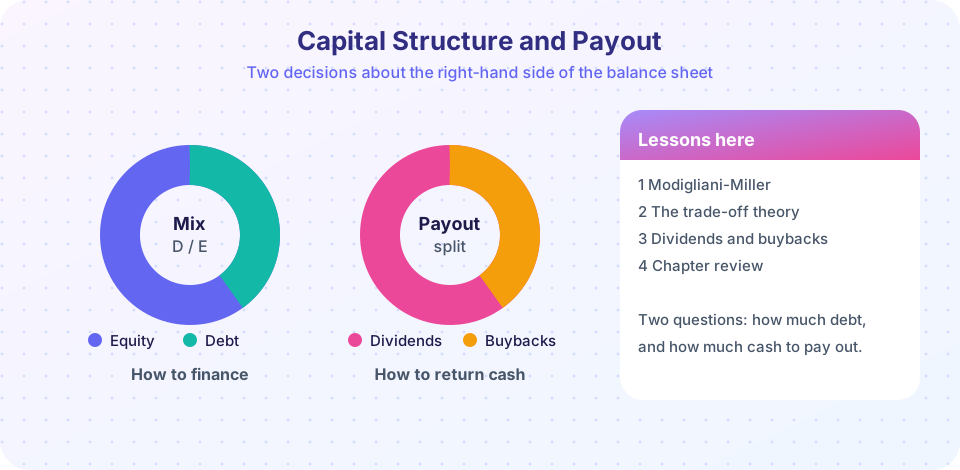
A map of the capital structure and payout chapter: Modigliani-Miller, the trade-off between tax shield and distress costs, and dividends versus buybacks.
Every company must answer two questions that sit on the right-hand side of its balance sheet. First: how should we fund the business? Some mix of borrowed money (debt) and owners' money (equity). Second: what should we do with the cash the business earns? Pay it out to owners, as dividends or share buybacks, or keep it. The first is capital structure; the second is payout policy. Both look like matters of taste, and both turn out to have precise economic logic, which this chapter unpacks.
The big picture
In 1958 Franco Modigliani and Merton Miller asked a deceptively simple question: in a perfect market, does the way you slice a company's claims between lenders and owners change its total value? Their answer, "no", became the foundation for everything that followed, not because it is realistic, but because it tells you exactly where to look if capital structure does matter. Look at taxes (interest is deductible, which makes debt valuable), at distress (too much debt can bankrupt a firm, and bankruptcy is costly) and at incentives and information (managers and outsiders do not know the same things).
Payout policy has an exactly parallel story. In a perfect market, paying a dividend versus keeping the cash and letting shareholders sell a few shares is a matter of indifference. Real-world frictions (taxes, signalling, flexibility, agency problems) break the equivalence and give the policy its texture.
Perfect markets: structure is irrelevant
Frictions make it matter
Payout choices
What each lesson covers
- Modigliani-Miller: the irrelevance propositions, why the cost of equity rises with leverage, and how the interest tax shield changes the answer.
- The trade-off theory: how the tax shield, distress costs and agency costs combine into a target debt ratio, plus a look at leverage's effect on earnings per share.
- Payout policy: dividends and buybacks, payout irrelevance, signalling and a worked example of a repurchase.
- Chapter review: one-picture summary and ten questions.
Reading the chapter like an economist
A useful habit: whenever you meet a claim about financing ("debt is cheap", "buybacks boost EPS"), ask who gains and who loses in the value of the firm? If the answer is "nobody, it only reshuffles claims", the claim is probably an illusion of accounting. If it is "the tax authority loses and shareholders gain", you have found real value. This test, a direct descendant of the Modigliani-Miller argument, will keep you from mistaking a change in earnings per share for a change in wealth.
Key terms for the chapter. Capital structure: the mix of debt and equity funding. Leverage: the use of debt. Interest tax shield: tax saved because interest is deductible. Financial distress: difficulty meeting debt obligations. Payout policy: how a firm returns cash to shareholders.
Study tip: for each theory in this chapter, write down the assumption that fails in real life and name the friction that replaces it. Modigliani-Miller needs no taxes and no distress costs; the trade-off theory adds both; the pecking order adds information gaps. If you can match each theory to its assumption and its friction, you can answer almost any exam question on the topic without memorizing formulas in isolation.
Check your understanding
Quick check · 3 questions
of 3 answered You scored / 3 · perfect!
-
1. What did Modigliani and Miller show for a perfect market with no taxes?
Slicing the same cash flows between debt and equity cannot change their total value. -
2. Which is a friction that can make capital structure matter?
Tax-deductible interest creates a tax shield that adds value. -
3. Payout policy is about:
Dividends and buybacks are the two main payout channels.
Summary
- Capital structure and payout are the two right-hand-side decisions.
- In perfect markets neither matters; frictions give each its real-world logic.
- The chapter's tools: M&M, the trade-off theory, and the economics of dividends and buybacks.
Next: Modigliani-Miller
Track your progress
Create a free account to tick off lessons and pick up where you left off on any device.
of Corporate Finance lessons completed