


















Lesson 45 of 45 · Projects and Practice
Further study: where to go after corporate finance
Plan your next steps after corporate finance: connected tracks on accounting, statistics, spreadsheets, investing and economics, plus advanced topics and practice habits.
You have now covered the core of corporate finance: how risk is measured and priced, what capital costs, how firms choose their funding and payout, how working capital keeps them alive and how to value the whole business. This final lesson shows how these ideas connect to other subjects, what advanced topics lie beyond, and how to keep practising so the skills do not fade.
What you will learn
- See how corporate finance connects to neighbouring subjects.
- Choose a next topic that fits your goal.
- Build habits that keep the skills sharp.
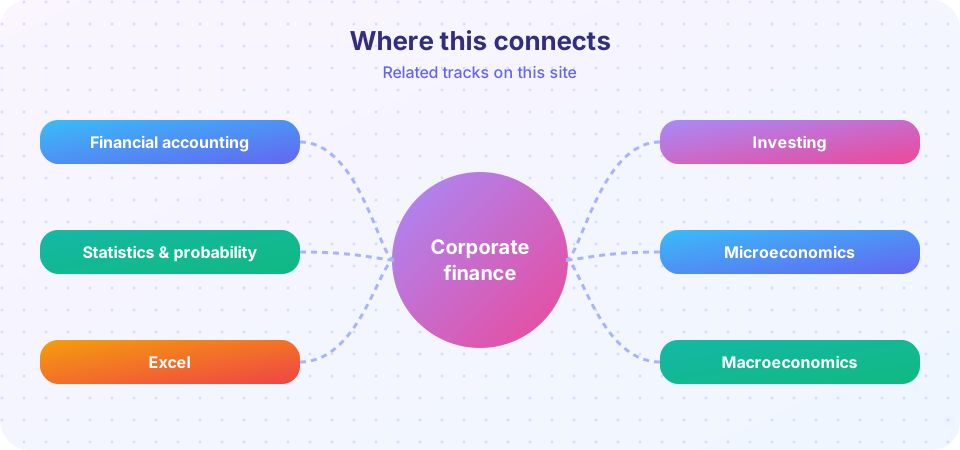
Connected tracks on this site
- Financial accounting is where the inputs come from. Income statements, balance sheets and cash flow statements supply EBIT, depreciation, working capital and debt. Reading statements fluently makes every forecast in this course easier.
- Statistics and probability deepens the risk chapters: distributions, correlation, regression (the machinery behind beta) and hypothesis tests.
- Excel is the everyday tool for building DCF models, scenario tables and amortization schedules. Everything in this course can be rebuilt in a spreadsheet, and that is how most practitioners do it.
- Investing applies the same ideas from the investor's side: portfolios, asset allocation, valuation of shares and bonds.
- Microeconomics explains the competitive markets, incentives and information problems behind agency costs, signalling and pricing.
- Macroeconomics explains interest rates, inflation and growth, the forces behind the risk-free rate, the market risk premium and terminal growth assumptions.
- Econometrics goes further into estimation, which matters when you want to measure betas, risk factors or the effect of a policy change.
- Personal finance uses the time value of money and risk on a household scale.
- Business studies gives the strategic and organizational setting in which financial decisions are made.
Topics beyond this course
If you want to continue within corporate finance, here are the usual next steps:
- Advanced capital budgeting: real options (the value of flexibility to expand, delay or abandon), adjusted present value (APV, which values the tax shield separately), and capital rationing.
- Multi-factor asset pricing: the Fama-French models, momentum and the arbitrage pricing theory, which extend the CAPM beyond one factor.
- Derivatives and risk management: options, forwards and swaps; hedging currency, interest-rate and commodity exposure; the Black-Scholes model and its use in valuing equity as an option on the firm.
- Mergers and acquisitions: valuing synergies, deal structures, takeover defences and post-merger integration.
- Leveraged buyouts and private equity: how highly leveraged structures are built, valued and exited.
- Behavioural finance: how psychological biases explain departures from the models you have learned. The behavioral economics track is a good companion.
- International finance: exchange rates, political risk and the cost of capital in different countries.
- Financial statement analysis and credit analysis: ratio analysis, quality of earnings and how lenders assess default risk.
- Sustainable finance: how environmental and governance factors enter cash flows and discount rates.
Professional pathways also include formal credentials, such as chartered analyst or accountancy qualifications in many countries. Their syllabi cover this material and more, and a solid course like this one is a sound foundation. Check the current requirements with the awarding body.
How to keep the skills sharp
- Rebuild, do not just read. Recreate one model from this course in a spreadsheet or in code each month: a WACC, a DCF, a cash conversion cycle.
- Read real reports, then test the numbers. Take a public company's annual report, compute its working capital days, estimate its WACC with your own inputs and compare with commentary.
- State your assumptions. Whenever you see a valuation, find the discount rate and growth rate and ask how the answer changes if they move.
- Teach it. Explain the difference between a dividend and a buyback to a friend. Gaps in your explanation are gaps in your understanding.
- Be skeptical of precision. Estimates of beta, the market risk premium and growth come with large margins of error; honest practitioners report ranges.
Check your understanding
Quick check · 3 questions
of 3 answered You scored / 3 · perfect!
-
1. Which subject supplies the statements (EBIT, working capital, debt) that feed a DCF?
Income statements, balance sheets and cash flow statements are the raw material for forecasts. -
2. Which topic extends the CAPM beyond a single beta?
Fama-French and related models add factors such as size, value and momentum. -
3. Why should you report valuation ranges rather than a single number?
Sensitivity to uncertain inputs makes a range the honest summary.
Summary
- Corporate finance connects accounting, statistics, spreadsheets, investing and economics.
- Natural next topics: real options, multi-factor models, derivatives, M&A and behavioural finance.
- Keep skills sharp by rebuilding models, reading real reports and reporting ranges.
You have reached the end of this part of the course. Return to the Corporate Finance track page to review earlier chapters or revisit any lesson.
Track your progress
Create a free account to tick off lessons and pick up where you left off on any device.
of Corporate Finance lessons completed