


















Lesson 19 of 45 · Capital Budgeting
Project cash flows and free cash flow
Build project cash flows correctly: incremental cash flows, sunk and opportunity costs, depreciation tax shields, working capital, salvage value and a full NPV example.
The NPV rule is only as good as the cash flows you put into it. Most real-world capital budgeting errors are not arithmetic mistakes but forecasting ones: counting money that would have been spent anyway, forgetting that a project ties up working capital, or taxing the wrong amount. This lesson is a practical guide to building a project's cash flows correctly.
The principle is simple to state: include only incremental, after-tax cash flows, meaning the difference between the firm's cash flows with the project and without it. The details are where the skill lies, so we walk through each in turn and then build a complete five-year example, from the first dollar spent to the last dollar recovered.
What you will learn
- Identify incremental cash flows and exclude sunk costs.
- Include opportunity costs, side effects (cannibalization) and working capital.
- Compute operating cash flow and the depreciation tax shield.
- Treat salvage value and recovery of working capital at the end.
- Build a project's cash flows and its NPV from scratch.
Key terms
Incremental cash flow: the change in the firm's total cash flow caused by accepting the project.
Sunk cost: money already spent that cannot be recovered whatever you decide.
Opportunity cost: the value of the best alternative use of a resource the project uses.
Net working capital (NWC): current assets (cash, receivables, inventory) minus current liabilities; money tied up in operations.
Depreciation tax shield: the tax saved because depreciation is deductible: depreciation times the tax rate.
The rules of incremental cash flow
1. Count cash, not accounting profit. Depreciation is not a cash outflow, and a sale on credit is not yet cash. Start from the effect on cash.
2. Ignore sunk costs. Suppose the firm already paid $50 for a market study. Whether it goes ahead or not, the money is gone. Including it would bias the decision against the project. A common management error is "we have already spent so much that we must continue"; the right question is always what happens from now on.
3. Include opportunity costs. If the project uses a warehouse that the firm could otherwise rent out for $30 a year, that rent forgone is a cost of the project, even though no cash leaves the firm.
4. Include side effects. A new product can steal sales from an existing one (cannibalization or erosion), or help sell other products (a complementary effect). Count only the net new sales: if the new e-bike line brings 1,040 of revenue but takes 40 away from the old line, the incremental revenue is 1,000.
5. Include working capital. New sales need new stock and customers who pay later. The cash invested in inventory and receivables (less what suppliers finance) is an outflow when it is created and an inflow when the project winds down and it is recovered.
6. Exclude financing costs. Interest and dividends are not included in the project cash flows, because the discount rate already reflects the cost of the money. Counting them in both places would charge the project twice.
7. Be consistent about inflation. Discount nominal cash flows at a nominal rate (see chapter 2), real at real.
8. Account for tax carefully. Tax is paid on taxable income, which is revenue minus cash costs minus depreciation. The depreciation deduction reduces tax even though it is not a cash cost.
Operating cash flow
Starting from the incremental income statement, there are three equivalent ways to compute the operating cash flow (OCF). They give the same answer if done right:
| Method | Formula |
|---|---|
| Bottom-up | OCF = net income + depreciation |
| Top-down | OCF = revenue - cash costs - taxes |
| Tax-shield | OCF = (revenue - cash costs) x (1 - T) + depreciation x T |
(When there is no interest in the project cash flows, as we assume, net income here means net income before financing.) The tax-shield approach is the most insightful: depreciation adds depreciation x tax rate to cash flow, which is the saved tax.
A full free cash flow also subtracts capital spending and increases in working capital:
FCF = OCF - capital spending - increase in NWC
A complete example: a new e-bike line
Brightway Bikes considers a new line. The information (in thousands of dollars, all invented):
- Equipment costs 600, depreciated straight-line over 5 years to zero (120 a year). After 5 years it can be sold for 100.
- Net working capital of 100 is needed at the start and recovered at the end.
- Incremental revenue is 1,000 a year for 5 years (already net of 40 lost sales on the existing line).
- Cash operating costs are 700 a year.
- The tax rate is 25%. The discount rate is 12%.
- A 50 market study was paid last year (sunk: ignore it).
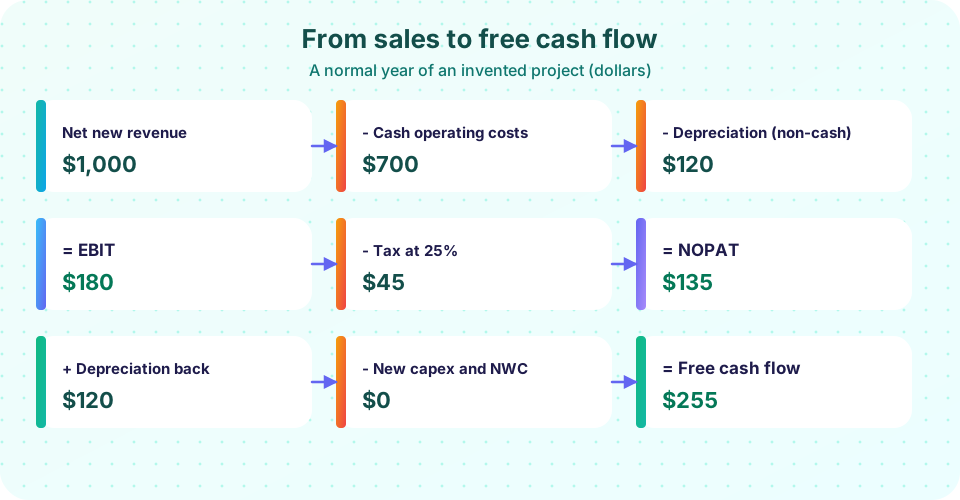
Step 1. Yearly operating cash flow.
| Line | Amount |
|---|---|
| Revenue | 1,000 |
| Cash operating costs | -700 |
| Depreciation | -120 |
| EBIT | 180 |
| Tax at 25% | -45 |
| NOPAT (EBIT after tax) | 135 |
| Add back depreciation | +120 |
| Operating cash flow | 255 |
Check with the tax-shield method: (1,000 - 700) x 0.75 + 120 x 0.25 = 225 + 30 = 255. Same.
Step 2. Initial outlay (year 0). Equipment 600 plus working capital 100: -700.
Step 3. End of life (year 5). The equipment is sold for 100, but its book value is zero, so the whole 100 is a taxable gain: after-tax salvage is 100 x (1 - 0.25) = 75. Working capital of 100 is recovered (no tax on that). Year 5 cash flow: 255 + 75 + 100 = 430.
Step 4. The cash flows and the NPV.
| Year | 0 | 1 | 2 | 3 | 4 | 5 |
|---|---|---|---|---|---|---|
| Cash flow | -700 | 255 | 255 | 255 | 255 | 430 |
At 12%, split the flows into an annuity of 255 for 5 years, worth 255 x 3.60478 = 919.22, and the extra 175 of terminal cash flow (after-tax salvage plus working capital) in year 5, worth 175 / 1.12^5 = 99.30. So NPV = -700 + 919.22 + 99.30 = $318.52. The IRR is about 27.8%. The project adds about $318,500 of value, so accept.
What happens if you make the usual mistakes?
| Mistake | NPV | Error |
|---|---|---|
| Correct analysis | 318.52 | |
| Forget the recovery of NWC and the salvage | 219.22 | -99.30 |
| Include the sunk 50 study | 268.52 | -50 |
| Use NOPAT (135) as the yearly cash flow, forgetting to add back depreciation | -114.06 | The sign of the decision flips |
Each error either throws away value that exists or counts cost that does not matter. With a thin NPV, such errors flip the decision.
Taxes and depreciation: a few notes
Real tax law has its own depreciation schedules (for example the MACRS system in the US, or capital allowances in the UK and elsewhere), often faster than straight-line. Faster depreciation brings the tax savings earlier, which raises NPV, so the schedule matters. We use straight-line here for clarity. Tax rates vary across countries and by firm; always use the marginal rate that applies to the extra income.
Common misconceptions
"Depreciation is a cost, so it reduces the project's cash flow." Depreciation reduces taxable income, and so reduces tax, but the cash for the equipment was spent at the start.
"Interest should be included in the project cash flows." No: the discount rate already includes the financing cost.
"Money already spent on research is part of the project's cost." Sunk costs are ignored; only future cash flows matter.
"Working capital is not a real cost." It is cash tied up; you must fund it up front and recover it later.
Try it
The first program builds the project's cash flows from the inputs and computes the NPV and IRR. Change the tax rate or the salvage value and see the effect.
Press Run (or Ctrl + Enter) to see the result here.
Program input · what you'd type while the program runs
Type the answers before you press Run, one per line. Each time the program reads a line (with input()), it gets the next line from this box.
The second program draws the project's yearly cash flows and the cumulative discounted cash flow, so you can see the point where the project pays back its cost in present-value terms.
Press Run (or Ctrl + Enter) to see the result here.
Program input · what you'd type while the program runs
Type the answers before you press Run, one per line. Each time the program reads a line (with input()), it gets the next line from this box.
Check your understanding
Quick check · 5 questions
of 5 answered You scored / 5 · perfect!
-
1. Which of these should NOT be included in a project's incremental cash flows?
The study is a sunk cost. The other three are incremental effects of the project. -
2. Revenue 500, cash costs 300, depreciation 80, tax rate 20%. The operating cash flow is:
EBIT = 120, tax = 24, NOPAT = 96, plus depreciation 80 gives 176. Check: (500 - 300) x 0.8 + 80 x 0.2 = 160 + 16 = 176. -
3. Equipment with zero book value is sold for 200 at a tax rate of 30%. The after-tax salvage cash flow is:
The whole 200 is a taxable gain: 200 x (1 - 0.30) = 140. -
4. Why are interest payments excluded from project cash flows?
Financing costs live in the discount rate, not in the cash flows. -
5. A project needs 80 of net working capital at the start, which is fully recovered at the end. The treatment is:
Working capital is a real outflow when funded, and a real inflow when recovered; the timing difference costs value.
Summary
- Use incremental, after-tax cash flows: with the project minus without it.
- Ignore sunk costs and financing costs; include opportunity costs, side effects and working capital.
OCF = (revenue - cash costs)(1 - T) + depreciation x T;FCF = OCF - capex - increase in NWC.- At the end, add after-tax salvage value and the recovery of working capital.
- Errors in cash flows change decisions more often than the choice of rule.
Next: Chapter 4 review
Track your progress
Create a free account to tick off lessons and pick up where you left off on any device.
of Corporate Finance lessons completed