


















Lesson 12 of 45 · Valuing Bonds and Stocks
Bond valuation
Learn to price coupon and zero-coupon bonds as the present value of coupons plus face value, and see why bonds sell at a premium, a discount or at par.
A bond is the simplest valuable thing in finance. You lend money; the borrower promises to pay you a fixed interest amount every period and to return your principal at the end. Because those promises are written down, you can list every cash flow in advance and value the bond with the annuity formula you learned in chapter 2. No forecast is needed, only the right discount rate.
Governments and companies around the world issue trillions of dollars of bonds, and many of the world's pension funds hold them. In this lesson you will learn the vocabulary, price a bond from first principles, understand why the same bond can sell for more or less than its face value, and handle two common variations: zero-coupon bonds and bonds that pay coupons twice a year.
What you will learn
- Define face value, coupon rate, maturity and yield.
- Price a bond as the present value of coupons plus the face value.
- Explain when a bond sells at a premium, at par or at a discount.
- Price a zero-coupon bond and a bond with semiannual coupons.
- Describe how credit risk affects the yield investors demand.
Key terms
Face value (par value): the amount repaid at maturity, often 1,000.
Coupon: the periodic interest payment, equal to the coupon rate times the face value.
Maturity: the date the face value is repaid.
Yield to maturity (YTM): the discount rate that makes the present value of the cash flows equal the price; it is the bond's market rate of return.
Zero-coupon bond: a bond that pays no coupons, only the face value at maturity.
Pricing a coupon bond
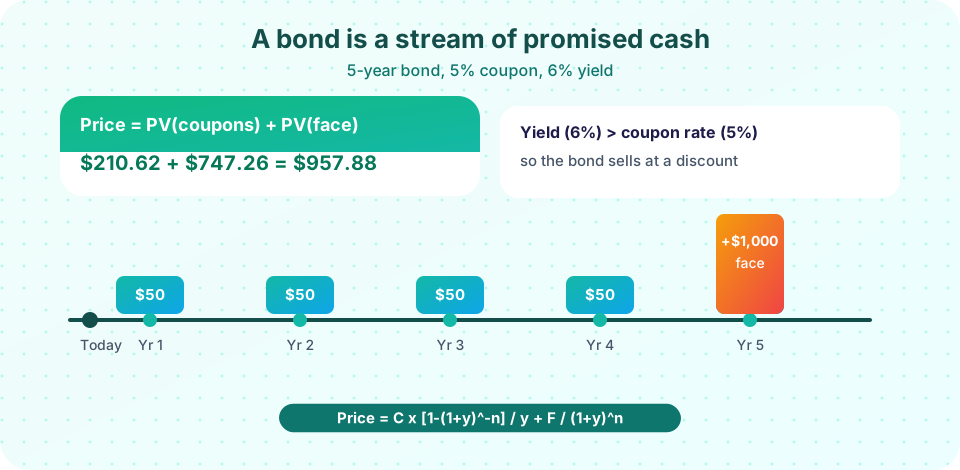
Consider a bond with a face value of $1,000, a 5% annual coupon and 5 years to maturity. The cash flows are:
- $50 at the end of years 1, 2, 3, 4 and 5 (the coupons);
- $1,000 at the end of year 5 (the face value).
The coupons form an annuity and the face value is a single sum. So the price is the sum of two present values:
Price = C x [1 - (1 + y)^-n] / y + F / (1 + y)^n
where C is the coupon, F the face value, y the yield and n the number of periods. If similar bonds currently yield 6%:
- PV of coupons:
50 x (1 - 1.06^-5) / 0.06 = 50 x 4.21236 = 210.62 - PV of face value:
1,000 / 1.06^5 = 747.26 - Price: 957.88
The bond sells for $957.88, less than 1,000. Look at it from the buyer's side: the bond pays only 5% but the market offers 6% elsewhere. To compete, the bond's price must fall until the buyer's return, including the gain of climbing back to 1,000, is 6%.
Premium, par and discount
The relationship between the coupon rate and the market yield decides the price:
| If | The bond sells at |
|---|---|
| Yield > coupon rate | A discount (below face value) |
| Yield = coupon rate | Par (equal to face value) |
| Yield < coupon rate | A premium (above face value) |
At a 4% yield, the same bond is worth 50 x 4.45182 + 1,000 / 1.04^5 = 222.59 + 821.93 = $1,044.52, a premium. At a 5% yield, the price is exactly 1,000, because the coupons match what the market demands.
Pull to par
As a bond approaches maturity its price converges to the face value, because the remaining cash flows are closer and the final 1,000 dominates. A 10-year 5% bond priced at a 7% yield is worth about $859.53 today. If the yield stays at 7%, its price climbs to $918.00 after 5 years and reaches $1,000 at maturity. This steady rise is called pull to par, and it is part of the bondholder's return.
Zero-coupon bonds
A zero-coupon bond pays nothing until maturity, so it is sold at a deep discount. Its price is just one discounted sum:
Price = F / (1 + y)^n
A 10-year zero with a face value of $1,000 at a 5% yield costs 1,000 / 1.05^10 = $613.91. The entire return comes from the price rising to par. Long zeros are very sensitive to yield changes, a point we will examine in the next lesson. Governments sell zero-coupon securities such as Treasury bills and strips, and some bond investors use them to match a future known liability.
Semiannual coupons
Many bonds, especially in the United States, pay coupons twice a year. Convention: the quoted coupon rate and yield are APRs, so you halve the rate, halve the coupon and double the periods. Take a 10-year bond with a 6% coupon (3% every six months, so $30), priced at an 8% yield (4% per half-year):
Price = 30 x [1 - 1.04^-20] / 0.04 + 1,000 / 1.04^20 = 407.71 + 456.39 = $864.10
Note the rule from the last lesson: rate and number of periods must be in the same unit. Here, n = 20 half-years and y = 4% per half-year. Bond markets quote the yield on this "bond equivalent" basis, which is an APR and not an EAR; the EAR of an 8% semiannual yield is 8.16%.
Risk: why different bonds have different yields
The yield investors demand depends on the risks of the cash flows.
- Default risk: the issuer may not pay. Rating agencies such as Moody's, S&P and Fitch grade issuers; "investment grade" ratings (BBB- or Baa3 and above) indicate lower default risk. The extra yield over a safe government bond of the same maturity is the credit spread.
- Interest rate risk: if market yields rise, prices fall. This is the main subject of the next lesson.
- Inflation risk: fixed payments lose purchasing power when inflation is higher than expected.
- Liquidity risk: a bond that is hard to sell must offer a higher yield.
A company with a shaky balance sheet might pay a 9% yield while a stable one pays 5% on the same maturity; the difference prices the extra chance of loss.
Common misconceptions
"A bond always pays back what you invested." Only if held to maturity and if the issuer does not default. If you sell earlier, the price may be above or below what you paid.
"The coupon rate is the return." The coupon rate is fixed on the face value. Your return depends on the price you pay, which is why we use the yield.
"Higher yield means a better bond." A high yield often signals higher default risk.
Try it
The first program is a bond calculator for annual or semiannual coupons, zero-coupon bonds and the premium/discount relationship.
Press Run (or Ctrl + Enter) to see the result here.
Program input · what you'd type while the program runs
Type the answers before you press Run, one per line. Each time the program reads a line (with input()), it gets the next line from this box.
The second program draws the pull-to-par path of the 10-year bond: if its yield stays at 7%, how does its price move toward 1,000 as time passes?
Press Run (or Ctrl + Enter) to see the result here.
Program input · what you'd type while the program runs
Type the answers before you press Run, one per line. Each time the program reads a line (with input()), it gets the next line from this box.
Check your understanding
Quick check · 5 questions
of 5 answered You scored / 5 · perfect!
-
1. A bond has a 6% coupon and the market yield is 8%. The bond sells at:
When the yield exceeds the coupon rate, the price is below face value. -
2. What is the price of a 3-year zero-coupon bond with a $1,000 face value at a 5% yield?
1,000 / 1.05^3 = 1,000 / 1.157625 = 863.84. -
3. For a bond with a face value of 1,000 and a 7% annual coupon, the yearly coupon payment is:
Coupon = coupon rate x face value = 0.07 x 1,000 = 70. -
4. A bond pays 8% semiannual coupons and has 5 years to maturity. In the pricing formula you use:
Semiannual bonds have 2 periods per year: 10 periods, with the yield and the coupon halved. -
5. If the yield stays constant, a discount bond's price over time will:
This is pull to par: the price converges to the face value at maturity.
Summary
- Price = PV of coupons (an annuity) + PV of the face value (a single sum), discounted at the market yield.
- Yield above coupon rate gives a discount; equal gives par; below gives a premium.
- A zero-coupon bond is priced as
F / (1 + y)^n. - Semiannual bonds: halve the coupon and the yield, double the periods.
- Yield reflects default, interest rate, inflation and liquidity risk.
Track your progress
Create a free account to tick off lessons and pick up where you left off on any device.
of Corporate Finance lessons completed