


















Lesson 41 of 45 · Projects and Practice
Case study: valuing a company end to end
Value an invented software company from revenue forecast to per-share value: build free cash flow, derive WACC, run a DCF, cross-check with multiples and report a range.
Valuing a company is the capstone of corporate finance: it needs the cost of capital, free cash flow, a terminal value, an equity bridge, multiples and sensitivity analysis. In this case you value Lumen Labs, an invented software company, from a revenue forecast to a value per share, and you finish with the kind of range-based statement a professional would give a board. All numbers are made up for teaching, and the setting is deliberately simple so every line can be checked by hand.
What you will learn
- Turn operating assumptions into a free cash flow forecast.
- Derive a WACC from market inputs and use it in a DCF.
- Cross-check a DCF with multiples and sanity-test the terminal value.
- Present the valuation as a range with a football-field chart.
The company and the assumptions
Lumen Labs sells subscription software. Last year's revenue was $500 million. The analyst makes these assumptions:
| Assumption | Value |
|---|---|
| Revenue growth, years 1 to 5 | 10%, 9%, 8%, 7%, 6% |
| EBIT margin | 18% of revenue |
| Tax rate | 25% |
| Depreciation and amortization | 4% of revenue |
| Capital expenditure | 5% of revenue |
| Increase in net working capital | 10% of the increase in revenue |
| Long-run growth after year 5 (g) | 2.5% |
| Net debt | $150 million |
| Diluted shares | 80 million |
Step 1: the WACC
Lumen targets 80% equity and 20% debt. With rf = 4%, an equity beta of 1.25 and a market risk premium of 5.5%:
Re = 4% + 1.25 × 5.5% = 10.875%- Debt costs 5.5% before tax, so
5.5% × 0.75 = 4.125%after tax. WACC = 0.80 × 10.875% + 0.20 × 4.125% = 8.70% + 0.825% = 9.525%.
We round to 9.5% for the valuation, which is a fair level of precision given the inputs.
Step 2: free cash flow
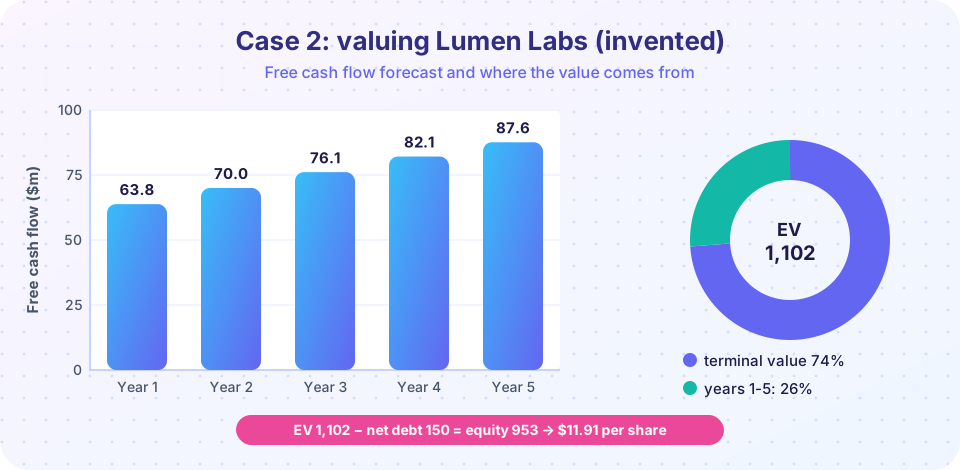
Each year: revenue × margin gives EBIT; EBIT after tax gives NOPAT; add D&A, subtract capex and the working-capital build. Year 1 as a check: revenue = 500 × 1.10 = 550; EBIT = 99; NOPAT = 74.25; D&A = 22; capex = 27.5; increase in NWC = 10% × 50 = 5; FCFF = 74.25 + 22 − 27.5 − 5 = $63.8 million. The full forecast is 63.8, 70.0, 76.1, 82.1 and 87.6.
Press Run (or Ctrl + Enter) to see the result here.
Program input · what you'd type while the program runs
Type the answers before you press Run, one per line. Each time the program reads a line (with input()), it gets the next line from this box.
Step 3: the DCF result
Discounting at 9.5% and using a terminal growth rate of 2.5%:
- Present value of the five forecast years: about $287 million.
- Terminal value at year 5:
87.6 × 1.025 / (0.095 − 0.025) ≈ $1,283 million, worth about $815 million today. - Enterprise value ≈ $1,102 million, of which the terminal value is 74%.
- Equity value ≈ $952.5 million after net debt of $150 million, or $11.91 per share.
Step 4: sanity-check the terminal value
A terminal value that supplies three-quarters of the value deserves scrutiny. Three checks:
- Implied exit multiple. The terminal value of $1,283 million divided by year-5 EBITDA (22% of $734 million = $161.6 million) is 7.9 times. Today's implied multiple is 10 times (EV 1,102 / EBITDA 110), so the terminal value assumes the multiple compresses as growth slows. That is reasonable and arguably conservative.
- Reinvestment consistency. In year 5 the firm reinvests about 11.6% of its NOPAT to support 6% growth. Our terminal formula carries that reinvestment forward to support only 2.5% growth. A steady-state firm would need less reinvestment, so the base case may understate value. A "normalized" terminal year with 2.5% growth gives an enterprise value of about $1,124 million, or $12.18 a share, about 2% higher. The two answers are close, which is reassuring.
- Growth versus the economy. 2.5% is below typical long-run nominal growth, so the firm does not outgrow the economy.
Press Run (or Ctrl + Enter) to see the result here.
Program input · what you'd type while the program runs
Type the answers before you press Run, one per line. Each time the program reads a line (with input()), it gets the next line from this box.
Step 5: multiples and sensitivity
Today's EBITDA is 500 × 22% = $110 million, so the DCF implies 10.0 times EBITDA. If comparable software firms (invented here) trade between 9 and 11 times, Lumen's DCF value sits in the middle of the peer range: good agreement. Net income last year was (90 − 9) × 0.75 = $60.75 million, with interest of $9 million on $150 million of debt, so the DCF equity value implies a P/E of about 15.7 times, within a peer range of 14 to 18.
Sensitivity matters more. Varying WACC from 8.5% to 10.5% and g from 2% to 3% gives enterprise values from about $918 million to $1,386 million (roughly $9.60 to $15.50 per share), a wide range from inputs that all look reasonable. WACC moves the answer more than g in this grid.
Step 6: the conclusion
A sound closing statement: "Lumen Labs is worth about $12 per share on our base case (enterprise value $1.1 billion, 74% from the terminal value). Reasonable changes in WACC and growth give $9.6 to $15.5; multiples imply roughly $10.5 to $13.5. If the shares trade below about $10, they look cheap relative to most of this range; above $15, expensive." The key discipline is saying which assumptions deliver which conclusion.
What could go wrong with this forecast
A valuation is only as strong as its weakest assumption, so a good analyst lists the threats. For Lumen Labs the main ones are these. Growth fade: revenue growth is assumed to fall smoothly from 10% to 6%; if competitors arrive sooner, growth could drop faster, and since the terminal value rests on year-5 cash flow, early disappointments flow through to value. Margin: an 18% EBIT margin held flat for five years ignores both the chance of improvement as the business scales and the chance of pressure from discounting and rising staff costs. Reinvestment: the case spends 5% of revenue on capex and 10% of new revenue on working capital; software firms may also capitalize development costs or pay staff in shares, which changes the true cash cost. Discount rate: a beta of 1.25 comes from past returns and may not suit a company whose business mix is changing. Capital structure: the 20% target debt weight sits above the current 14% implied by net debt over enterprise value, so the WACC assumes a mix the firm has not yet reached.
For each threat you can attach a rough size using the tools from the chapter: re-run the forecast with lower growth, vary the margin by two points, change the WACC by one. The ranking of those effects tells the board where to focus its diligence.
Common misconceptions
"The DCF gives one right answer." It gives a base case from stated assumptions. The sensitivity range is part of the answer.
"If the multiples agree with the DCF, both are right." Agreement is reassuring, but both may inherit the same optimism, for example from peers trading at lofty prices.
"A bigger terminal growth rate is harmless." Because TV is 74% of value, an extra half-point of g adds around 6% to the enterprise value.
Check your understanding
Quick check · 5 questions
of 5 answered You scored / 5 · perfect!
-
1. Lumen's year-1 revenue is $550m with an 18% EBIT margin and 25% tax. What is NOPAT?
EBIT = 550 × 0.18 = 99; NOPAT = 99 × 0.75 = 74.25. -
2. EV = $1,102m, net debt = $150m, 80m shares. What is the value per share?
(1,102 − 150) / 80 = 952 / 80 ≈ $11.91. -
3. Why does the terminal value need extra scrutiny?
At 74% of EV, small changes in its assumptions swing the valuation. -
4. If the DCF implies 10x EBITDA and peers trade at 9-11x, what does that suggest?
The DCF-implied multiple sits within the peer range, a useful consistency check. -
5. Which input moved the enterprise value more in the sensitivity grid?
Varying WACC by ±1 point shifts EV more than varying g by ±0.5 point.
Summary
- Valuation chain: assumptions, free cash flow, WACC, terminal value, enterprise value, equity value, per share.
- Check the terminal value with implied multiples and reinvestment logic.
- Cross-check with multiples and stress-test with a sensitivity grid.
- Report a range and say which assumptions drive it.
Next: Practice problem set
Track your progress
Create a free account to tick off lessons and pick up where you left off on any device.
of Corporate Finance lessons completed