


















Lesson 25 of 45 · Risk and Return
Chapter review: Risk and Return
Review the risk and return chapter in one picture: return and variance, diversification and the CAPM, with a recap table, a worked calculator and a ten-question quiz.
You have now seen the three moves that turn uncertainty into a number: measure the spread of returns, notice how diversification shrinks it, and price what remains with beta. This review puts the chapter on one page, links the formulas into a single chain of reasoning, and gives you a longer quiz to test whether the ideas stick.
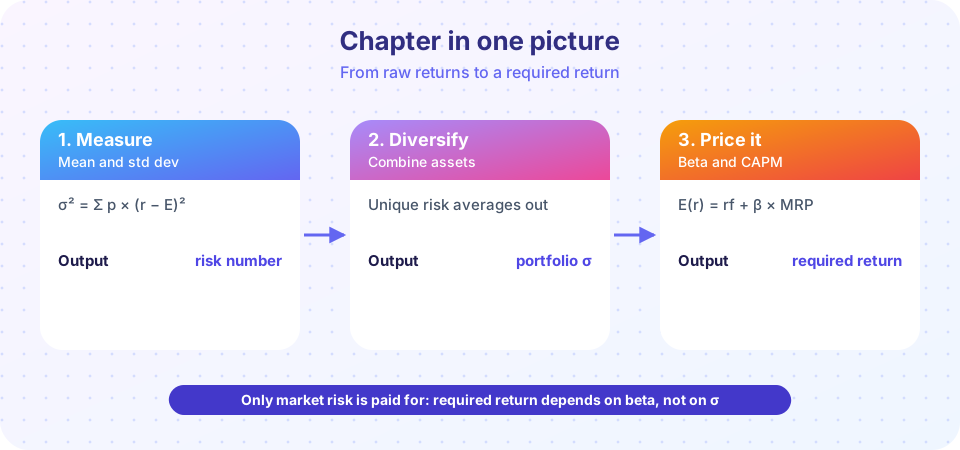
The chain of reasoning
Start with a stock. Its returns vary, and the variance and standard deviation tell you how much (return and variance). Now imagine it as one holding among many. Because it does not move in lockstep with the others, most of its own variation disappears inside the portfolio (diversification). What survives is its sensitivity to the market as a whole, beta, and the CAPM turns beta into the return investors require (CAPM and beta). That required return is the cost of equity you will use in the next chapter.
Recap table
| Idea | Formula or rule | Remember |
|---|---|---|
| Holding-period return | (P1 − P0 + D) / P0 | include dividends |
| Expected return | Σ p × R | a balance point, not a promise |
| Variance, standard deviation | Σ p × (R − E)², its square root | spread in both directions |
| Geometric vs arithmetic | geometric ≈ arithmetic − σ²/2 | geometric is the compound rate |
| Risk premium | E(R) − rf | the price of bearing risk |
| Two-asset portfolio variance | wA²σA² + wB²σB² + 2wAwBρσAσB | correlation is the dial |
| Many assets | σ²/n + (1 − 1/n)C | the floor is average covariance |
| Beta | Cov(i,m) / Var(m) | market risk only |
| CAPM | rf + β × MRP | below the SML means overpriced |
Traps that catch people
- Confusing risk with loss. Standard deviation measures spread in both directions. A stock can have a high standard deviation and still have a good chance of gaining.
- Averaging percentages. The arithmetic mean of +50% and −50% is zero, but the investor ends with 75% of the starting money. When the question is about growth over several periods, use the geometric average.
- Forgetting the cross term. Portfolio variance is not the sum of the weighted variances. The covariance term can add or subtract a lot, and it is the entire reason diversification works.
- Using total risk in the CAPM. The CAPM prices beta, not standard deviation. Two assets with the same volatility can have very different betas and therefore very different required returns.
- Treating beta as a fact. It is a noisy estimate. If an exam or an interviewer gives you two betas from different data providers, the right response is to explain why they differ, not to pick one at random.
Explain it in one minute
Try saying this aloud without notes: "Returns are uncertain, so we describe them by a mean and a spread. Holding several assets whose returns do not move together shrinks the spread, because bad luck in one is offset by good luck in another. But some risk, the kind that hits the whole economy, cannot be shared away, and investors insist on being paid for carrying it. Beta says how much of that economy-wide risk an asset has, and the CAPM turns it into a required return." If you can say that and then run one example with numbers, you own the chapter.
Try it
A single calculator that chains the steps: build a two-asset portfolio, find its beta as the weighted average, and apply the CAPM.
Press Run (or Ctrl + Enter) to see the result here.
Program input · what you'd type while the program runs
Type the answers before you press Run, one per line. Each time the program reads a line (with input()), it gets the next line from this box.
Check your understanding
Quick check · 10 questions
of 10 answered You scored / 10 · perfect!
-
1. A share bought at $20 pays $1 in dividends and ends the year at $19. What was the return?
(19 − 20 + 1) / 20 = 0%. The dividend exactly offsets the price fall, so the return is 0%. -
2. Outcomes are +12% (probability 0.4) and −3% (probability 0.6). What is the expected return?
0.4 × 12 + 0.6 × (−3) = 4.8 − 1.8 = 3.0%. -
3. Which statement about standard deviation is correct?
Standard deviation is the square root of variance, expressed in percent. -
4. Returns of +30% then −30% give what result for $100?
100 × 1.3 × 0.7 = $91. Volatility drags compound growth below the arithmetic average of 0%. -
5. For which correlation does diversification give no risk reduction?
With perfect positive correlation, portfolio risk is just the weighted average of the standard deviations. -
6. What is the floor of risk for a very large, equally weighted portfolio?
Unique risk vanishes; the average covariance term remains. -
7. A stock's beta is 1.6 and the market falls 5%. What is the best estimate of the stock's move?
Beta scales market moves: 1.6 × (−5%) = −8%, on average. -
8. With rf = 2% and MRP = 6%, what does the CAPM require for β = 0.75?
2% + 0.75 × 6% = 2% + 4.5% = 6.5%. -
9. A stock expected to return 9% has a required return of 10%. What is true?
Alpha is −1%: the stock offers less than its risk requires, so its price should fall. -
10. Why does the market not reward a stock's unique risk?
Any premium for avoidable risk would be competed away by diversified investors.
Summary
- Risk = spread of returns; standard deviation is the usual measure.
- Diversification removes unique risk, with correlation controlling the benefit.
- Beta isolates market risk, and the CAPM converts it into a required return.
- The required return becomes the cost of equity in the next chapter.
Track your progress
Create a free account to tick off lessons and pick up where you left off on any device.
of Corporate Finance lessons completed