


















Lesson 35 of 45 · Working Capital and Valuation
Chapter overview: Working Capital and Valuation
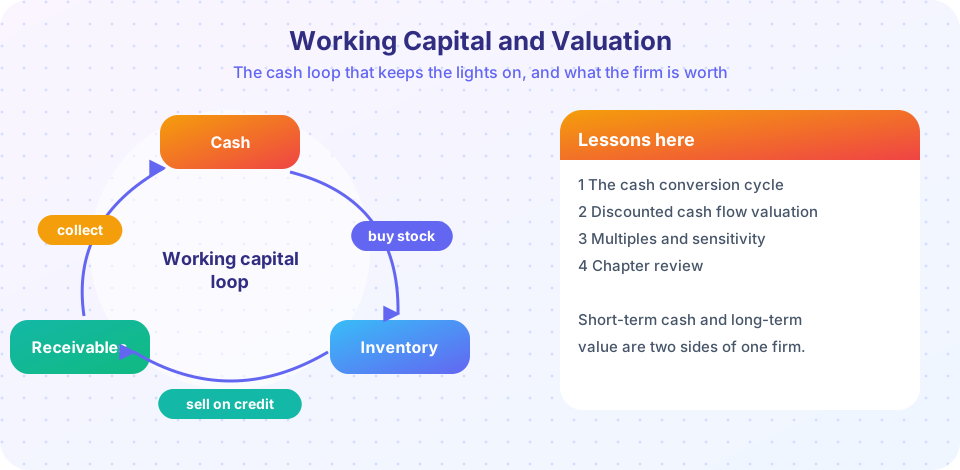
A map of the working capital and valuation chapter: the cash conversion cycle, discounted cash flow valuation and valuation by multiples with sensitivity analysis.
A company lives on two clocks. The short clock ticks in days: buy materials, make a product, sell it, collect the cash, pay the supplier. If that loop stalls, a perfectly profitable firm can run out of money and fail. The long clock ticks in years: what the business as a whole is worth, given the cash it is expected to produce. This chapter covers both, because they share a thread: cash, not accounting profit, is what keeps a firm alive and what gives it value.
The big picture
Working capital is the money tied up in day-to-day operations: inventory, customers who owe the firm, minus what the firm owes its own suppliers. Managing it means shortening the time between paying out cash and getting it back. The key measure is the cash conversion cycle: how many days of funding the loop needs. Trimming ten days can release millions of dollars without selling anything extra.
Valuation answers the question every investor and acquirer asks: what is this business worth? The main tool is discounted cash flow (DCF): forecast the free cash flow a business will generate, discount it at the cost of capital you computed in earlier chapters and add a terminal value for the years beyond the forecast. A second tool is multiples: compare the price of the business to a measure like earnings or EBITDA, using similar companies as a guide. Neither gives certainty. Experts therefore run sensitivity analysis, asking how the answer moves when the assumptions change.
Cash cycle: the short clock
DCF: the long clock
Cross-check and stress test
What each lesson covers
- The cash conversion cycle: inventory, receivable and payable days, financing policy, trade credit and the cost of missing a discount, and the economic order quantity.
- Discounted cash flow valuation: free cash flow, the terminal value, the bridge from enterprise value to equity value.
- Multiples and sensitivity: EV/EBITDA, P/E and how to choose comparables, plus sensitivity grids and scenarios.
- Chapter review: the chapter in one picture and a ten-question quiz.
Why these topics sit together
Profit is an accounting opinion; cash is a fact. A fast-growing firm can report rising profit while sinking toward insolvency because it pays suppliers before customers pay it. Valuation, in turn, depends on how much cash the firm produces after funding growth in working capital and equipment. The change in net working capital is a direct line in the free cash flow formula you will meet in lesson 2. So the loop on the first page feeds straight into the value on the last.
Key terms for the chapter. Net working capital: operating current assets minus operating current liabilities. Cash conversion cycle: inventory days + receivable days − payable days. Free cash flow: cash available to all investors after operating costs, taxes and reinvestment. Enterprise value: the value of the operating business to all funders. Multiple: a ratio of value to a financial metric.
Study tip: bring a real company into your study. Download the balance sheet and income statement of any listed business, compute its inventory, receivable and payable days, and see how they compare with a competitor. Then try the valuation tools on the same company. Real statements are messier than textbook ones, and working through the mess is where most of the learning happens.
Check your understanding
Quick check · 3 questions
of 3 answered You scored / 3 · perfect!
-
1. Why can a profitable firm run out of cash?
Profit counts sales when made; cash arrives only when customers pay, and suppliers may need paying first. -
2. What does DCF valuation discount?
DCF values the business by the present value of the free cash flow it will generate. -
3. What is the purpose of sensitivity analysis?
Forecasts are uncertain, so a range of outcomes is more honest than a single figure.
Summary
- Working capital is the short clock: manage the days between paying out and collecting cash.
- DCF is the long clock: discount forecast free cash flow at WACC.
- Multiples and sensitivity tables cross-check and stress-test the result.
Track your progress
Create a free account to tick off lessons and pick up where you left off on any device.
of Corporate Finance lessons completed