


















Lesson 40 of 45 · Projects and Practice
Case study: financing and valuing an expansion
Work through a complete corporate finance decision: estimate a cost of capital, adjust it for project risk, compute NPV, IRR and payback, stress-test the result and check funding.
Theory becomes skill when you run a whole decision from start to finish. In this case study you play the finance manager of an invented cafe chain, Crumb & Co. The board asks one question: should we open five new cafes in a region where we have never operated? To answer it you will use ideas from several chapters: the CAPM and WACC, project-specific rates, net present value, IRR, sensitivity analysis and financing costs. All figures are invented for teaching.
What you will learn
- Chain WACC, project-risk adjustment, NPV, IRR and payback into one analysis.
- Quantify how robust a positive NPV is, using break-even cash flows and scenarios.
- Account for flotation costs and the funding mix.
- Write a short, defensible recommendation.
The situation
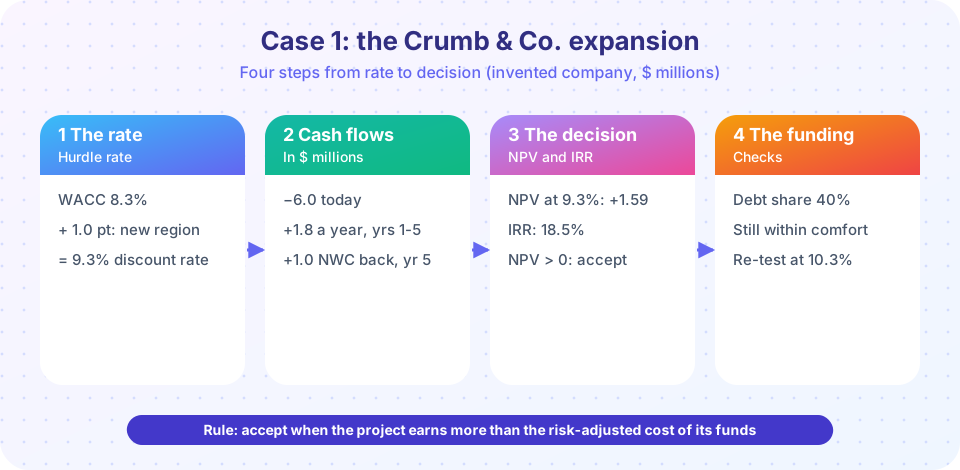
Crumb & Co. runs cafes in its home region. The proposed expansion needs $6.0 million today: $5.0 million for equipment and fit-out, and $1.0 million of working capital (stock and cash floats). Management expects each year for five years an after-tax operating cash flow of $1.8 million for the whole project (this already includes the depreciation tax shield). At the end of year 5 the working capital is released ($1.0 million) and the equipment has no resale value.
| Year | 0 | 1 | 2 | 3 | 4 | 5 |
|---|---|---|---|---|---|---|
| Cash flow ($ m) | −6.0 | 1.8 | 1.8 | 1.8 | 1.8 | 1.8 + 1.0 = 2.8 |
Crumb's market data: the risk-free rate is 4%; the market risk premium is 5.5%; Crumb's equity beta is 1.2; its debt yields 6.5%; the tax rate is 25%; and it targets 60% equity and 40% debt.
Step 1: the firm's WACC
- Cost of equity (CAPM):
4% + 1.2 × 5.5% = 10.6%. - After-tax cost of debt:
6.5% × (1 − 0.25) = 4.875%. - WACC:
0.60 × 10.6% + 0.40 × 4.875% = 6.36% + 1.95% = 8.31%.
8.31% is the right hurdle for a project that looks like Crumb's existing business.
Step 2: adjust for project risk
A new region means unfamiliar customers, rents and competitors. The cash flows are riskier than the home cafes'. A pure-play comparison would be ideal; here, management judges the extra risk equivalent to one percentage point, giving a project discount rate of 8.31% + 1.0% = 9.31%. This is a judgment call, so we will test it later. The principle is the one from the WACC lesson: price the project's risk, not the firm's average.
Step 3: NPV, IRR and payback
Discounting at 9.31%:
NPV = −6.0 + 1.8 × (annuity factor for 5 years at 9.31%) + 1.0 / 1.0931⁵ ≈ +$1.59 million
At the plain WACC of 8.31% the NPV would be $1.80 million, and at 10.31% it would be $1.38 million, so the conclusion survives a two-point swing in the rate.
The IRR, the rate at which NPV is zero, is about 18.5%, far above the hurdle. The simple payback is 3.3 years (cumulative undiscounted cash turns positive in year 4). The discounted payback, which discounts each flow, is about 4.1 years. Payback is a liquidity check, not a value measure: it ignores everything after the cutoff.
Press Run (or Ctrl + Enter) to see the result here.
Program input · what you'd type while the program runs
Type the answers before you press Run, one per line. Each time the program reads a line (with input()), it gets the next line from this box.
Step 4: stress-test
A positive NPV is only as good as its inputs. Three checks:
- Break-even cash flow. The annual cash flow at which NPV is exactly zero is about $1.39 million, which is 23% below the forecast of $1.8 million. The project survives a sizeable miss.
- Scenario. If cash flows are 15% lower than forecast (annual $1.53 million), NPV falls to about $0.54 million: still positive, but thin.
- Discount rate. From step 3, even at 10.3% the NPV is still positive. Because the NPV is mostly driven by cash flows rather than by the rate, the exact risk premium matters less than the forecast itself.
The finding to report: the project is robust to the rate but sensitive to sales, so the key risk is the demand forecast. A sensible board response is to test the demand estimate (pilot one cafe first) rather than argue about half a point of WACC.
Press Run (or Ctrl + Enter) to see the result here.
Program input · what you'd type while the program runs
Type the answers before you press Run, one per line. Each time the program reads a line (with input()), it gets the next line from this box.
Step 5: funding and flotation costs
The project needs $6.0 million. Following the target mix, Crumb plans to raise 40% by borrowing ($2.4 million) and 60% from equity ($3.6 million). Suppose the equity portion is a share issue with a flotation cost of 5% of the amount raised. To net $3.6 million Crumb must raise 3.6 / 0.95 ≈ 3.79 million, so the fee is about $0.19 million. Charged to the initial outlay, NPV falls from $1.59 million to about $1.40 million: still clearly positive. If instead Crumb funds the equity part from retained earnings, there is no flotation cost.
Also check the funding mix: adding $2.4 million of debt and $3.6 million of equity keeps debt near 40% of total funds, so the WACC assumption stays valid. Had the project been financed entirely with debt, the firm's capital structure would drift from its target, and you would need to revisit the WACC (the cost of equity would rise as leverage rises).
The recommendation
A short memo might read: "Open the five cafes. At a project rate of 9.3%, which adds a full point to our 8.3% WACC for regional risk, the investment has an NPV of about $1.6 million and an IRR near 18%. NPV stays positive if annual cash flows fall by up to 23%, or if the discount rate rises by two points. Flotation costs on the equity portion trim NPV to about $1.4 million. The main uncertainty is demand in the new region, so we recommend opening one cafe first and confirming sales before committing all five."
Notice what a good memo does: it states the decision, gives the headline numbers, shows how robust they are and names the main risk.
Common misconceptions
"IRR above WACC means accept." Only when the hurdle reflects the project's risk. Compare IRR with the project rate, 9.31% here, not the firm's average.
"Positive NPV means no risk." NPV is an expected value under the forecast. The stress-tests show how much room there is for error.
"Financing details belong in the discount rate." Flotation costs go into the cash flows; the tax shield on debt is already in WACC.
Try it
Check your understanding
Quick check · 5 questions
of 5 answered You scored / 5 · perfect!
-
1. Crumb's WACC is 8.31% but the new region is riskier. What rate should the project use?
Discount rates should match the risk of the cash flows being valued. -
2. Which is the cost of equity in the case?
4% + 1.2 × 5.5% = 10.6%. -
3. The break-even annual cash flow is about $1.39m versus a forecast of $1.8m. What does this tell you?
1 − 1.39/1.8 ≈ 23%: that is the margin of safety on the cash-flow forecast. -
4. Where do flotation costs on new equity belong?
They are cash paid at funding, so they raise the initial investment and lower NPV. -
5. Payback is 3.3 years but NPV is positive. Which tells you more about value?
NPV counts all cash flows and the time value of money; payback ignores flows after the cutoff.
Summary
- Combine WACC, a project-risk adjustment, NPV, IRR and payback into one analysis.
- Stress-test with break-even cash flow, scenarios and discount-rate changes.
- Put flotation costs in the cash flows, and keep the funding mix consistent with the WACC.
- A good recommendation states the decision, the numbers, the robustness and the main risk.
Track your progress
Create a free account to tick off lessons and pick up where you left off on any device.
of Corporate Finance lessons completed